
The galaxy cluster Abell 2029 is sometimes described as “the most relaxed cluster in the Universe.” This moniker does not arise from some sort of mellow vibe, but rather because of how calm and undisturbed the superheated gas that pervades the cluster appears to be.
New observations from NASA’s Chandra X-ray Observatory clearly show that Abell 2029 had a much more colorful history than its current disposition suggests. The latest study finds that Abell 2029 is still settling down after a raucous collision with another smaller cluster about four billion years ago.
Galaxy clusters are the largest structures in the Universe held together by gravity. They are made up of hundreds or even thousands of galaxies, unseen dark matter, and a huge amount of gas that fills in the space between the galaxies. This gas is typically heated to millions of degrees, which makes it glow in X-ray light.
A team led by astronomers from Boston University (BU) and the Center for Astrophysics | Harvard & Smithsonian (CfA) obtained the deepest X-ray observation ever made of this cluster using Chandra. The results are described in an Astrophysical Journal paper led by Courtney Watson from BU and CfA.
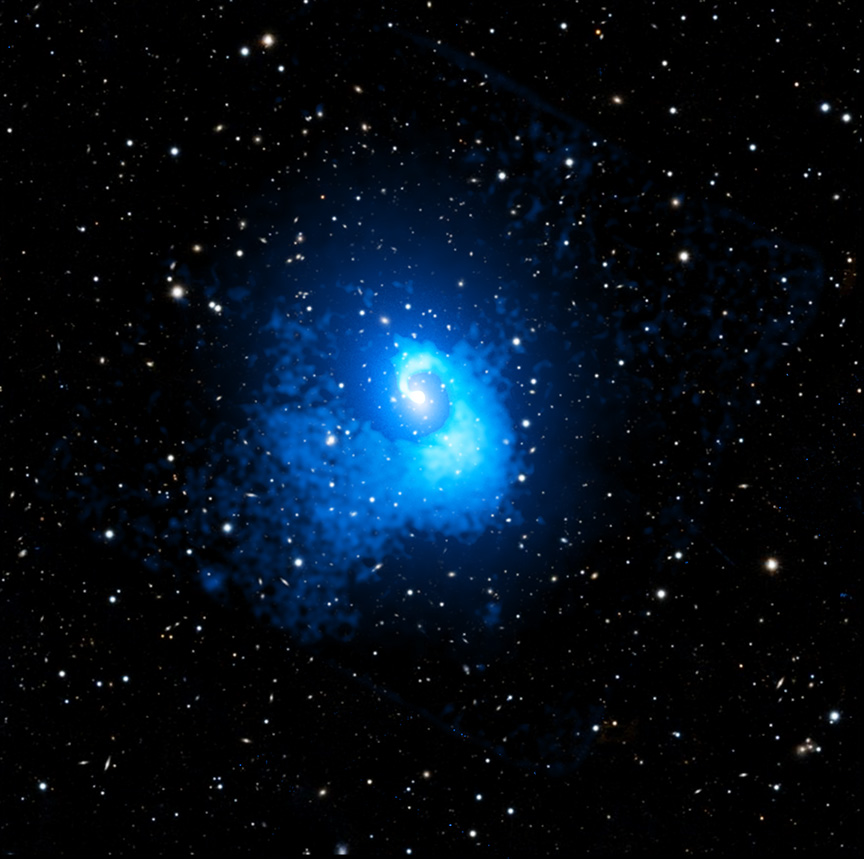
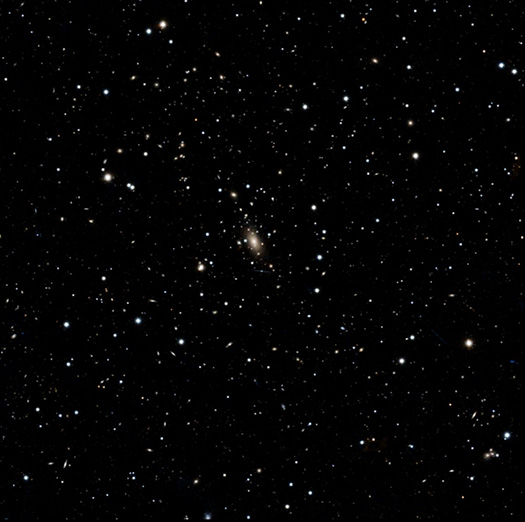
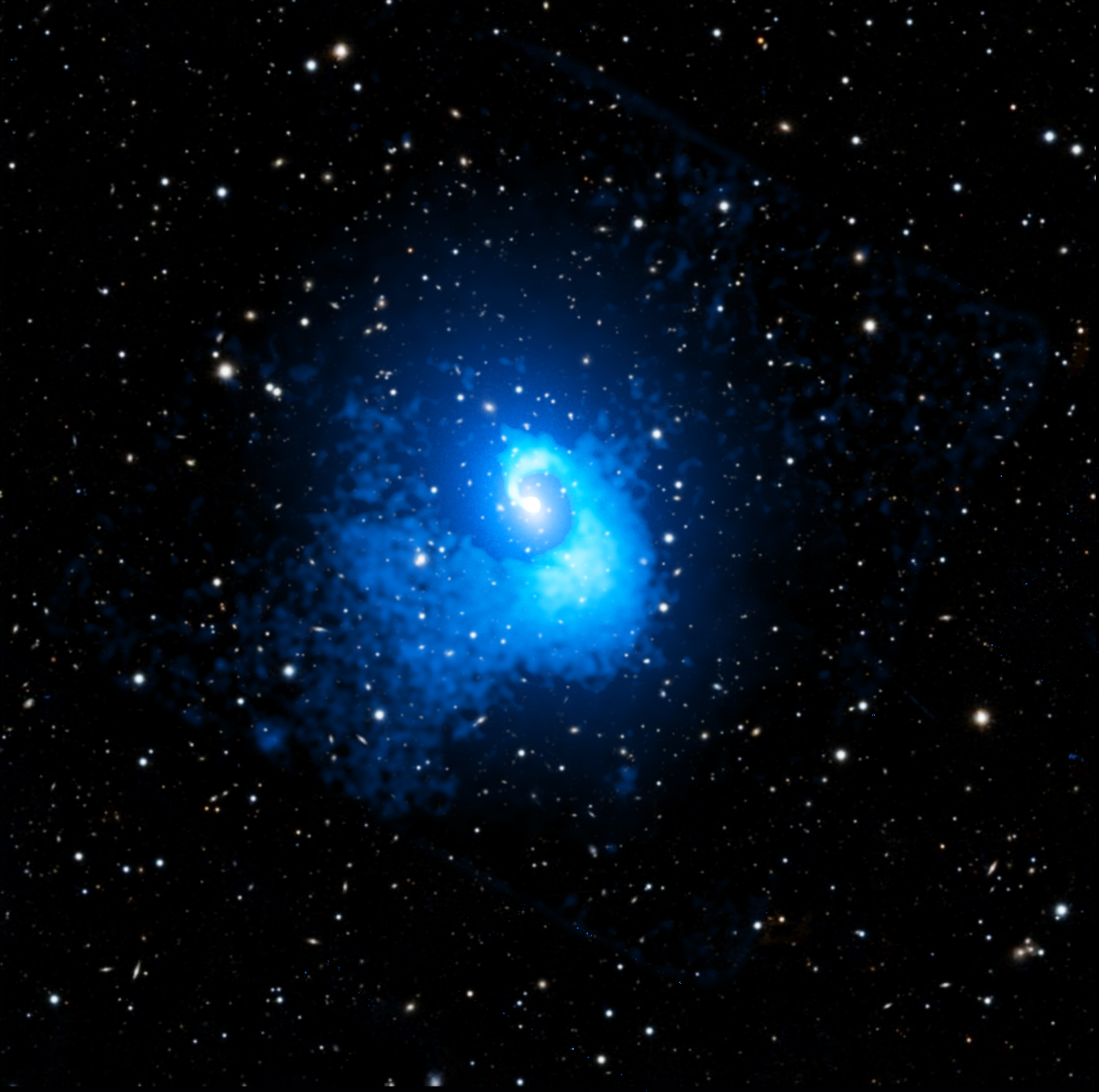
The Chandra data reveal clear signs that this cluster did not have a mundane history. This new composite image shows evidence for the cluster’s previous shenanigans in the nautilus-like shape in the Chandra data (blue). Optical light from stars and galaxies in the same field of view appears mainly white in an image from Pan-STARRS, a telescope in Hawaii.
The team think the spiral shape in the hot gas formed when gas in the cluster sloshed to the side because of the gravitational effects of the cluster collision — similar to how wine moves in a wine glass. The sloshing spiral in Abell 2029 is one of the longest ever seen, extending about two million light-years from the center of the cluster.
There are several other key pieces of evidence for the past bash, never before seen together in a cluster, allowing the team to trace the collision history of the cluster in unprecedented detail. For example, the team sees hints of a wide “splash” of cooler gas created by the collision. There may also be a shock wave — akin to a sonic boom from a supersonic plane — in the superheated gas left over from the collision. Finally, there is a “bay” feature in the hot gas, which the researchers think might be caused by an overlap between the outer parts of the spiral and gas stripped away from the smaller cluster as it passed through the larger one. Though the authors think it is a relic from the collision, other explanations for this structure are also possible.
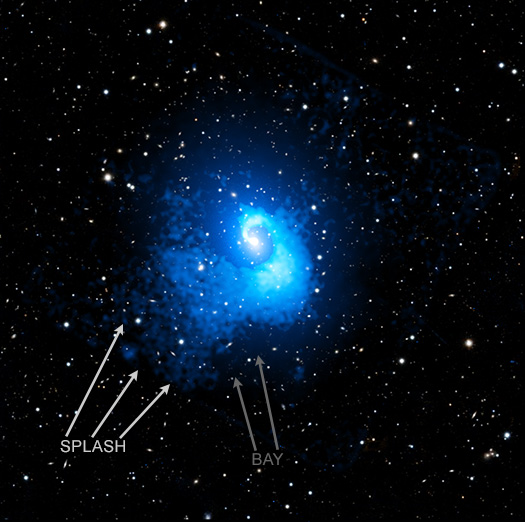
Computer simulations of the collision suggest that the smaller cluster was about ten times less massive than the larger cluster. The sloshing spiral formed when the smaller cluster made its first pass through the larger cluster, pulling its gas sideways. The gravity of the larger cluster then caused the other cluster to slow down and get pulled back in for a second collision. This drove a shock front and left behind a wake of material, forming the splash region.
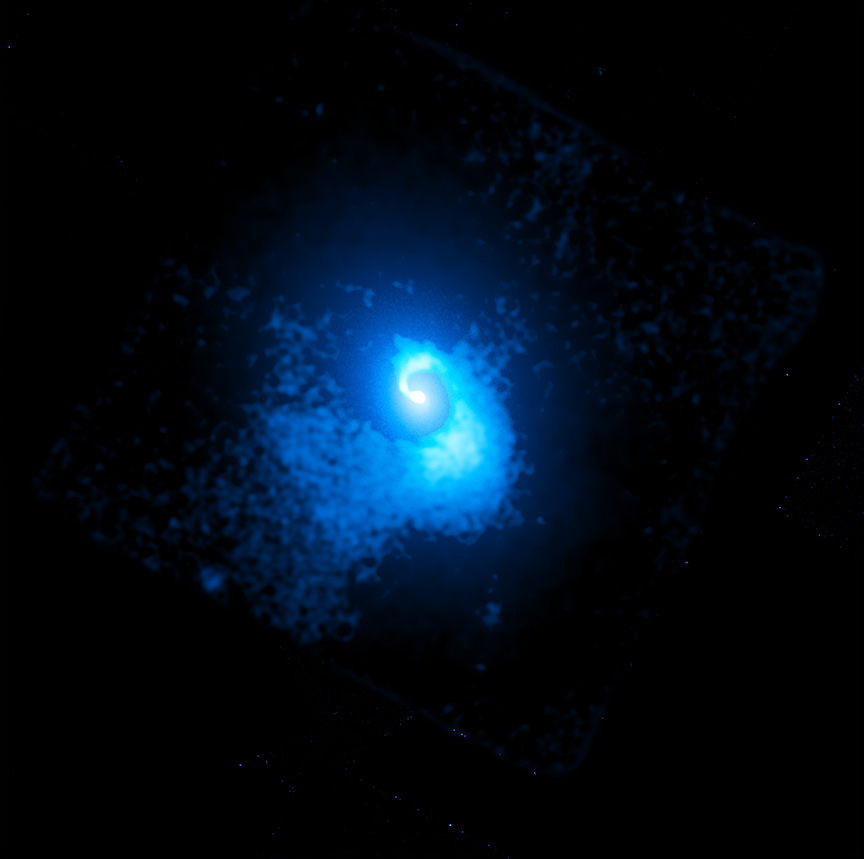
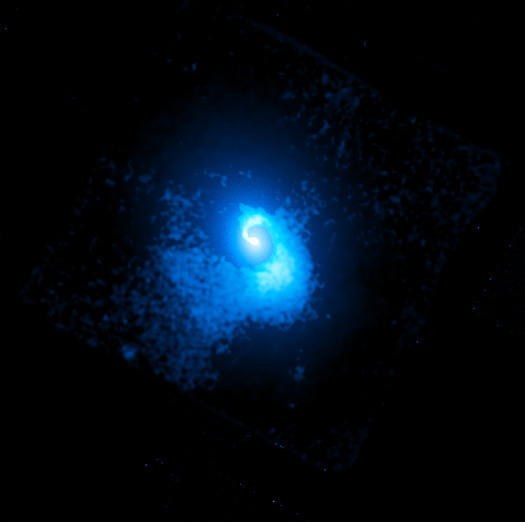
To uncover these various features the authors used a special technique that examined how much the cluster’s hot gas deviates from a symmetrical shape. Most of the hot gas is symmetrical and is approximately shaped like an oval. The authors removed (“subtracted”) this symmetrical oval shape from the original X-ray image. The remaining X-ray emission in the “subtracted image” clearly shows the unusual features of the sloshing spiral, the bay and the splash area. The shock front is too faint to be seen in this image.
The new composite image combines both the original X-ray and the subtracted X-ray images of the deep Chandra observations of Abell 2029. The subtracted X-ray image (light blue) strikingly shows the sloshing spiral. Most of the original X-ray image is a darker blue color, apart from the center of the image, which is light blue. Two other features — the bay and the splash area — are labeled in an annotated version. The brightness of the original image has been reduced in this image to better show the subtracted image.
Courtney Watson conducted this work as a graduate student at BU and a predoctoral fellow at CfA. In addition to Watson, the authors of the paper are Elizabeth Blanton (Boston University), who was the Principal Investigator for the Chandra observations, Scott Randall (CfA), Tracy Clarke (Naval Research Laboratory), and John ZuHone (CfA).
NASA's Marshall Space Flight Center in Huntsville, Alabama, manages the Chandra program. The Smithsonian Astrophysical Observatory's Chandra X-ray Center controls science operations from Cambridge, Massachusetts, and flight operations from Burlington, Massachusetts.
This release features a composite image of a galaxy cluster with a unique spiral shape, giving it the appearance of a giant galactic seashell floating in the star-speckled blackness of space.
In this composite image, the surrounding stars and individual galaxies appear white, captured in optical light from Pan-STARRS, a telescope in Hawaii. But much of the spiraling cluster is rendered in neon blues, representing X-ray gas observed by Chandra. This super-heated gas fills the space between galaxies, giving the cluster its spiral shape when observed by scientists using an X-ray telescope.
Here, the blue spiral begins as a pale blue dot at the center of the cluster. The spiral stream of light and dark neon blue gas then widens as it moves away from the center of the cluster, gently corkscrewing one full rotation as it extends two-million lightyears into the distance.
|
||||||||||||||||||||||||||||||

| Share This |


|