


CXC Home | Search | Help | Image Use Policy | Latest Images | Privacy | Accessibility | Glossary | Q&A
1
X-ray, Optical, & Infrared ImagesSonification Credit: NASA/CXC/SAO/K.Arcand, SYSTEM Sounds (M. Russo, A. Santaguida)
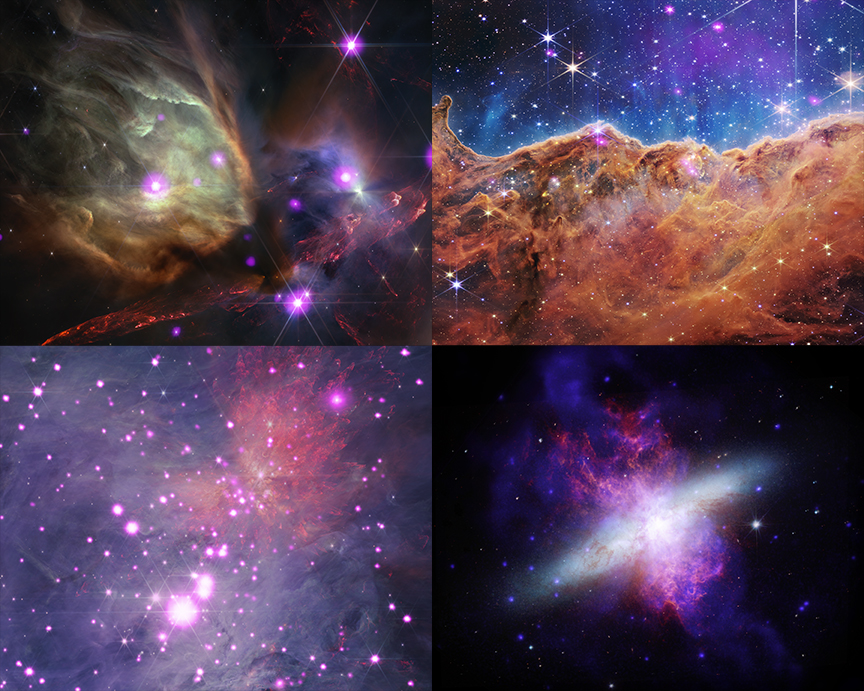
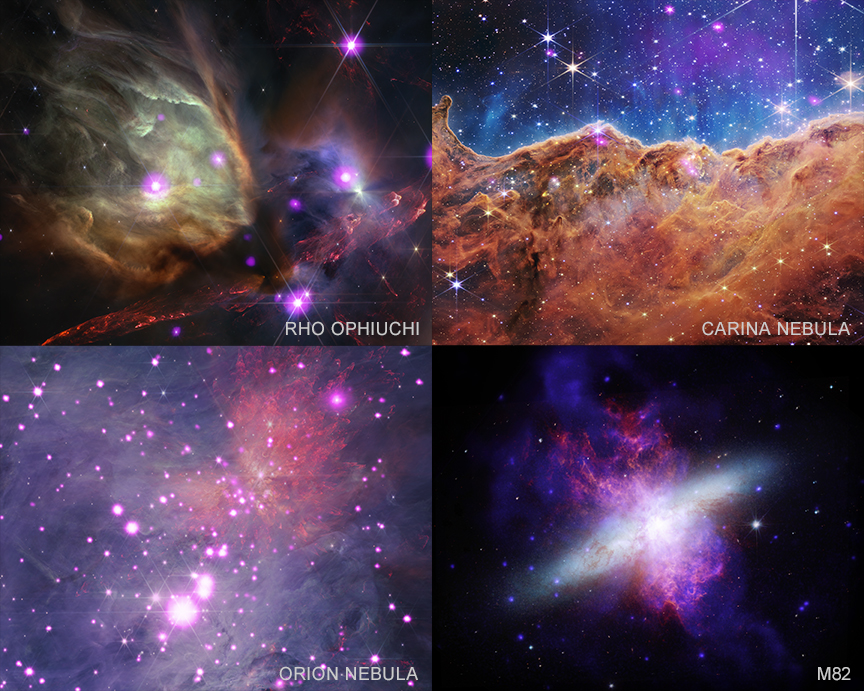
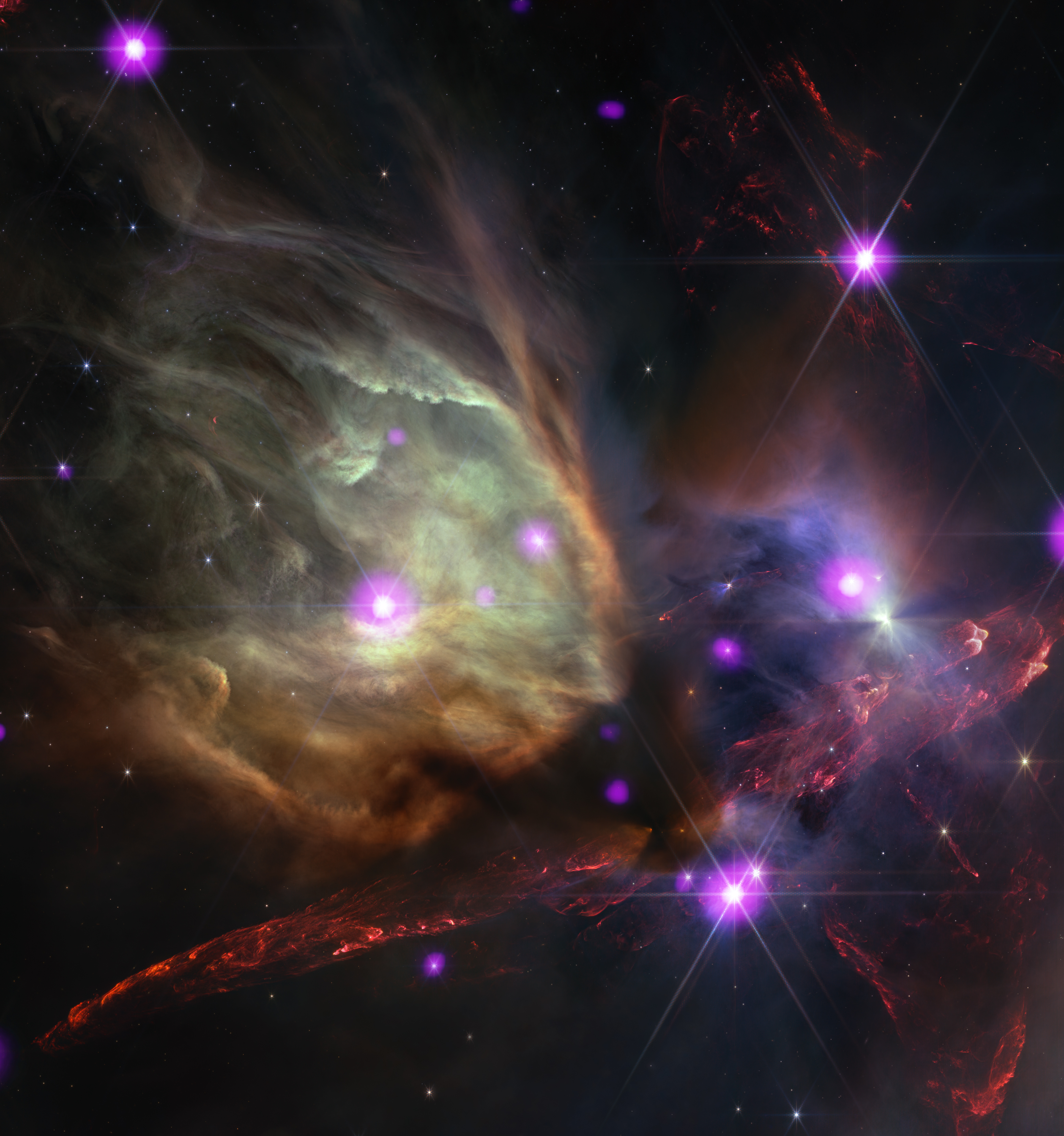
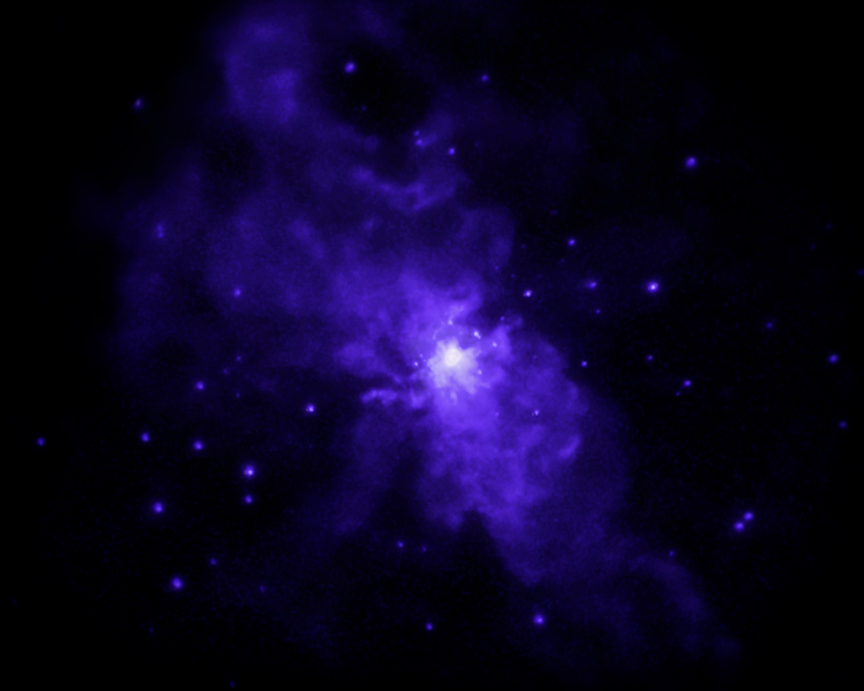
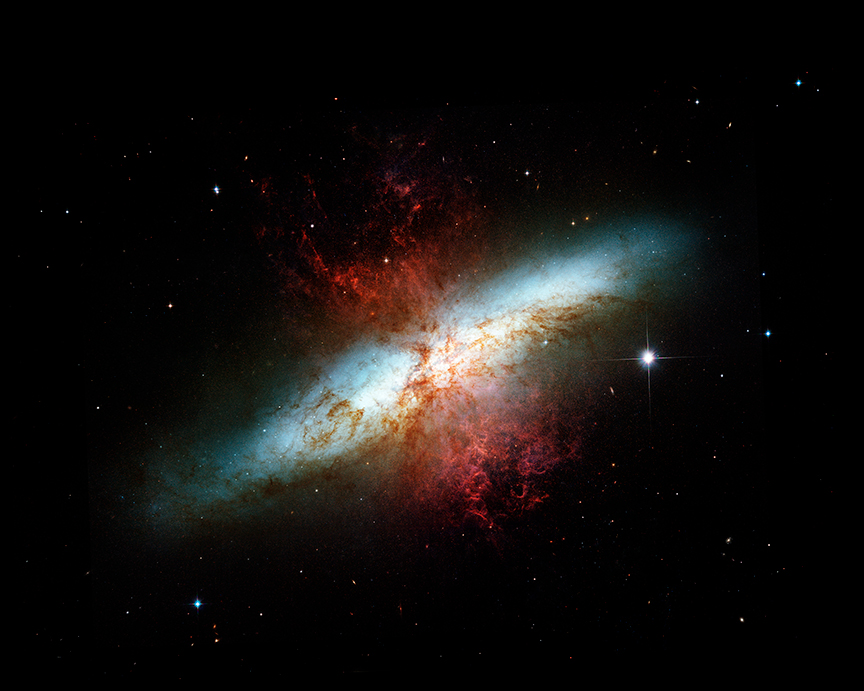
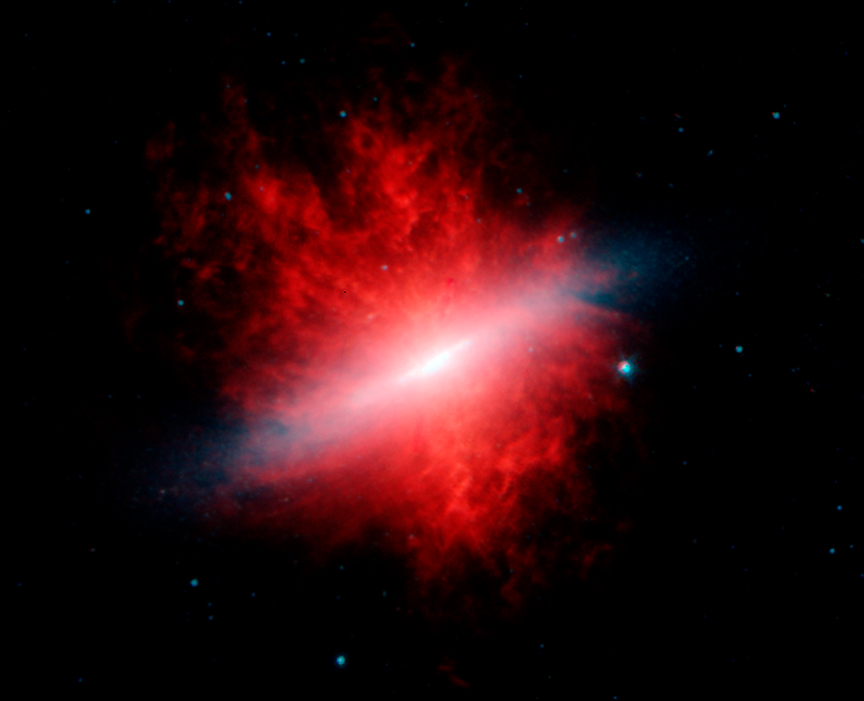
Four images show data captured by Chandra and other NASA telescopes of stars that are actively forming. Like people, stars are born, live for a finite period of time, and ultimately die. By studying places in the universe where stars are currently being born and young stars are present, astronomers can better understand the lifecycle of all stars, including our own Sun.
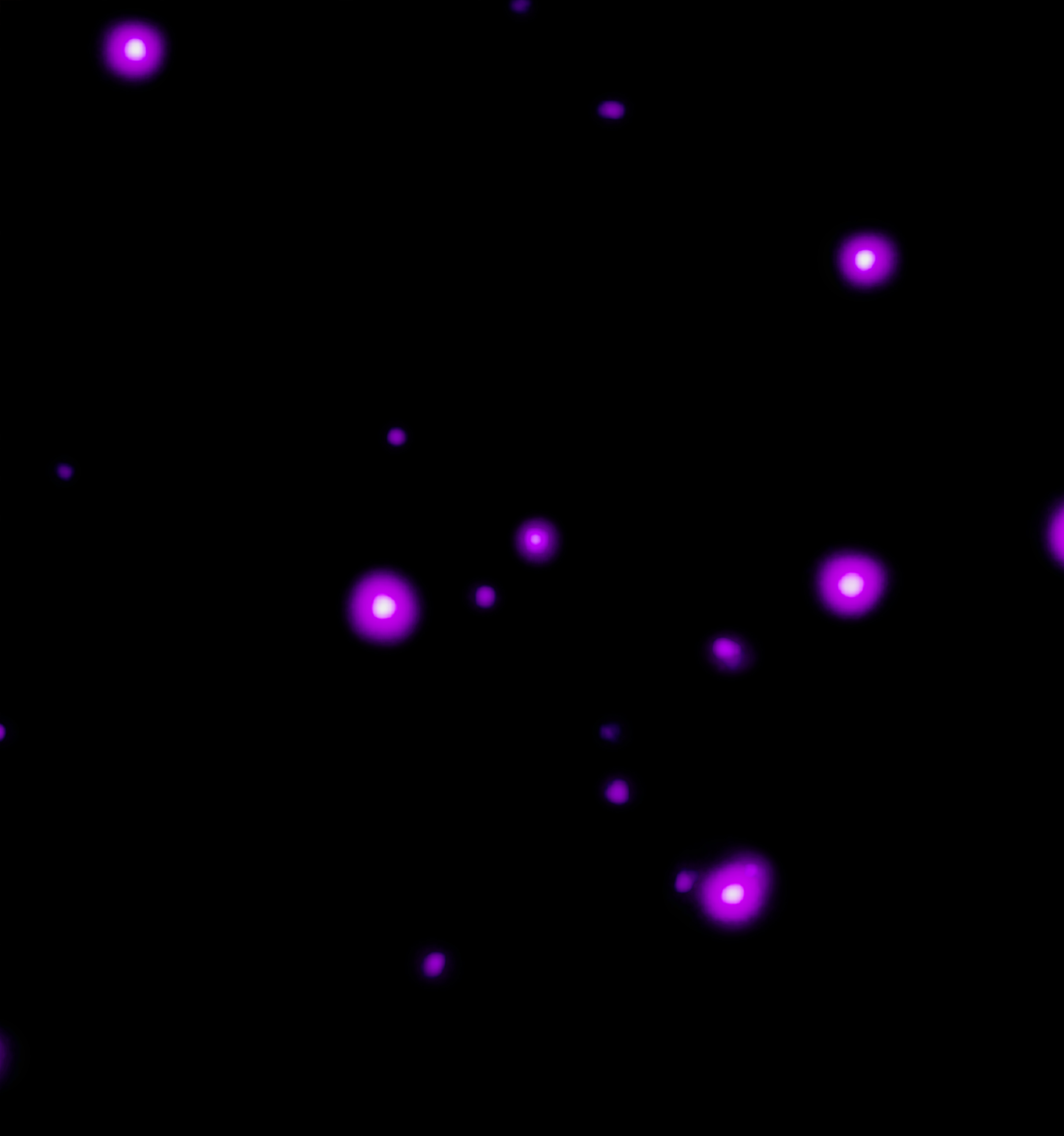
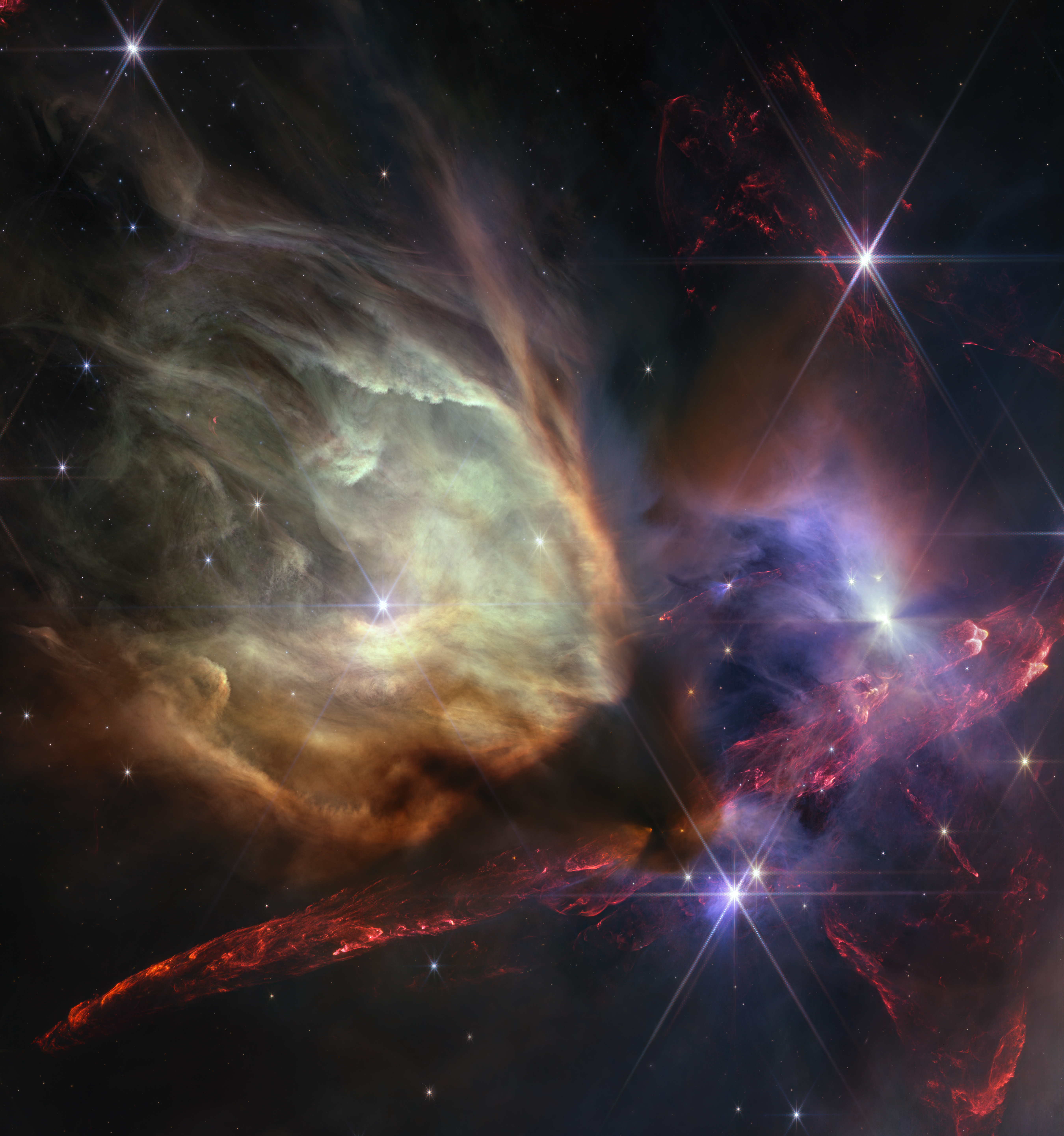
Rho Ophiuchi: Rho Ophiuchi is a striking star-forming cloud, filled with gas and stars of different sizes and ages including very young ones. Chandra reveals infant stars that violently flare and produce X-rays. Infrared data from Webb provide views of the spectacular regions of gas and dust.
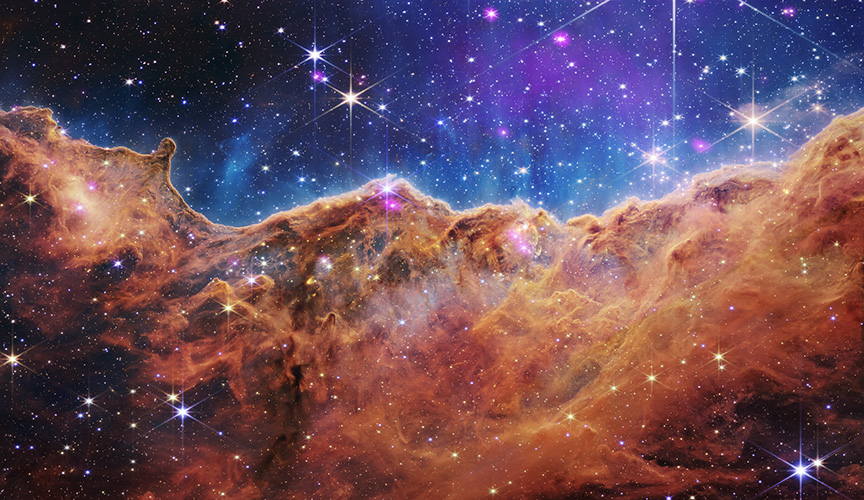
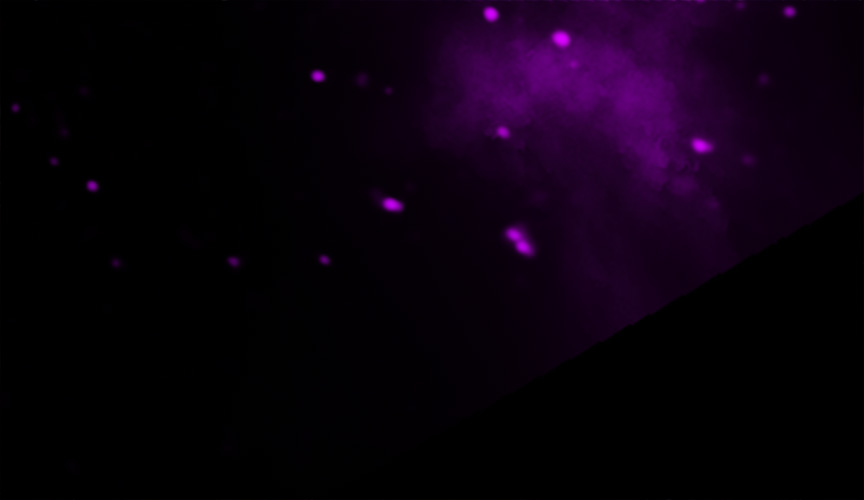
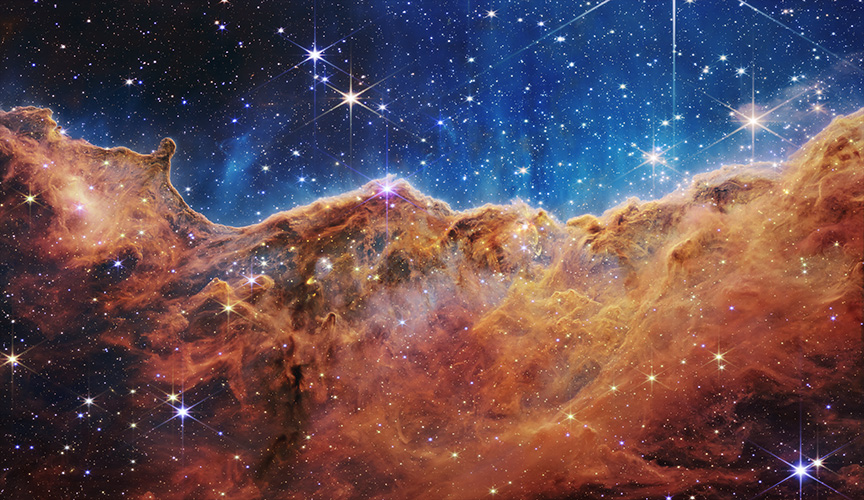
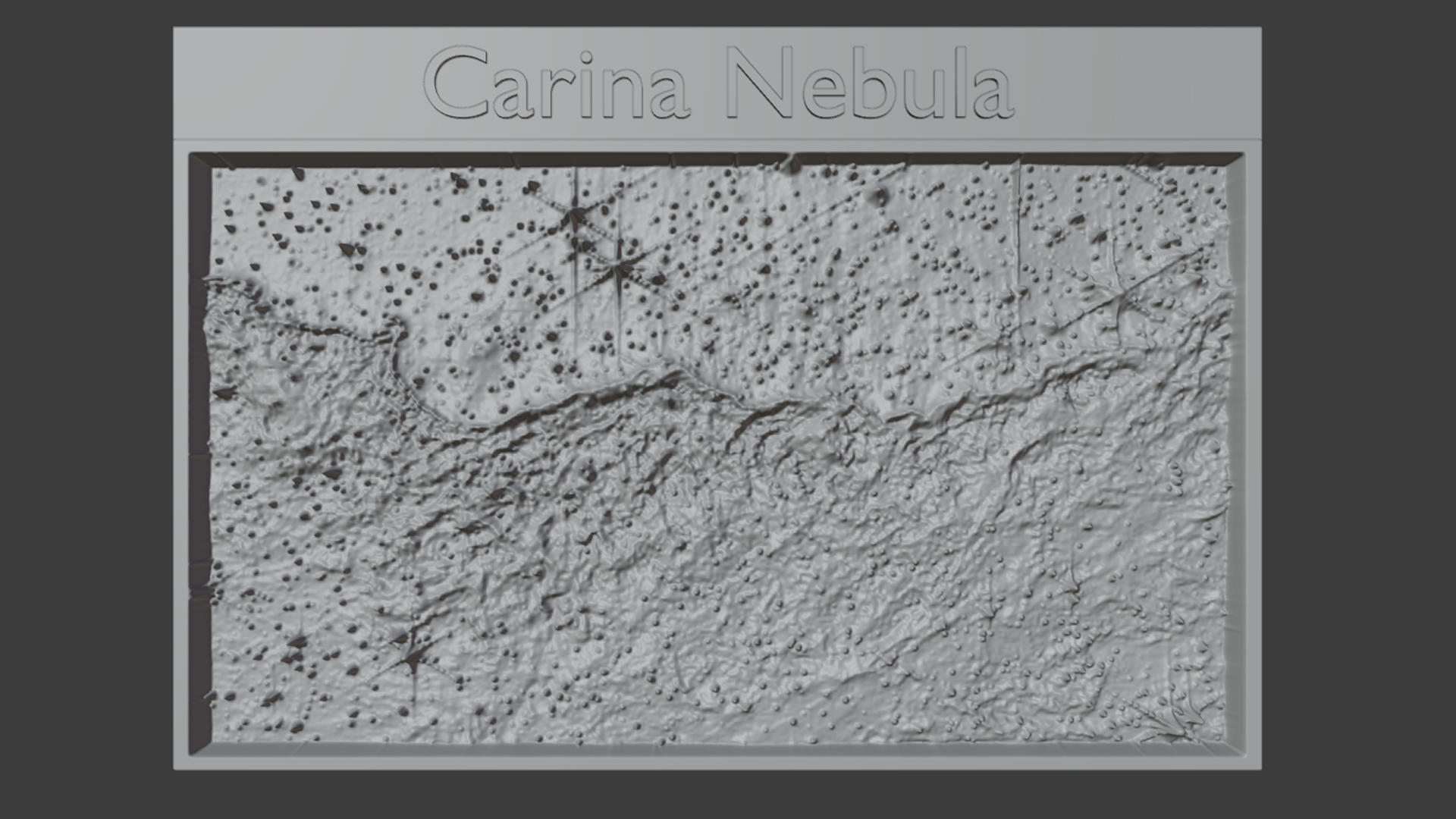
Carina Nebula, “Cosmic Cliffs”: When Webb released its image of this star formation region, it became known as the “Cosmic Cliffs” because of its spectacular structure in infrared. Chandra also looks at this region, seeing through the dust and gas, and detects individual baby stars and a diffuse X-ray glow in the region.
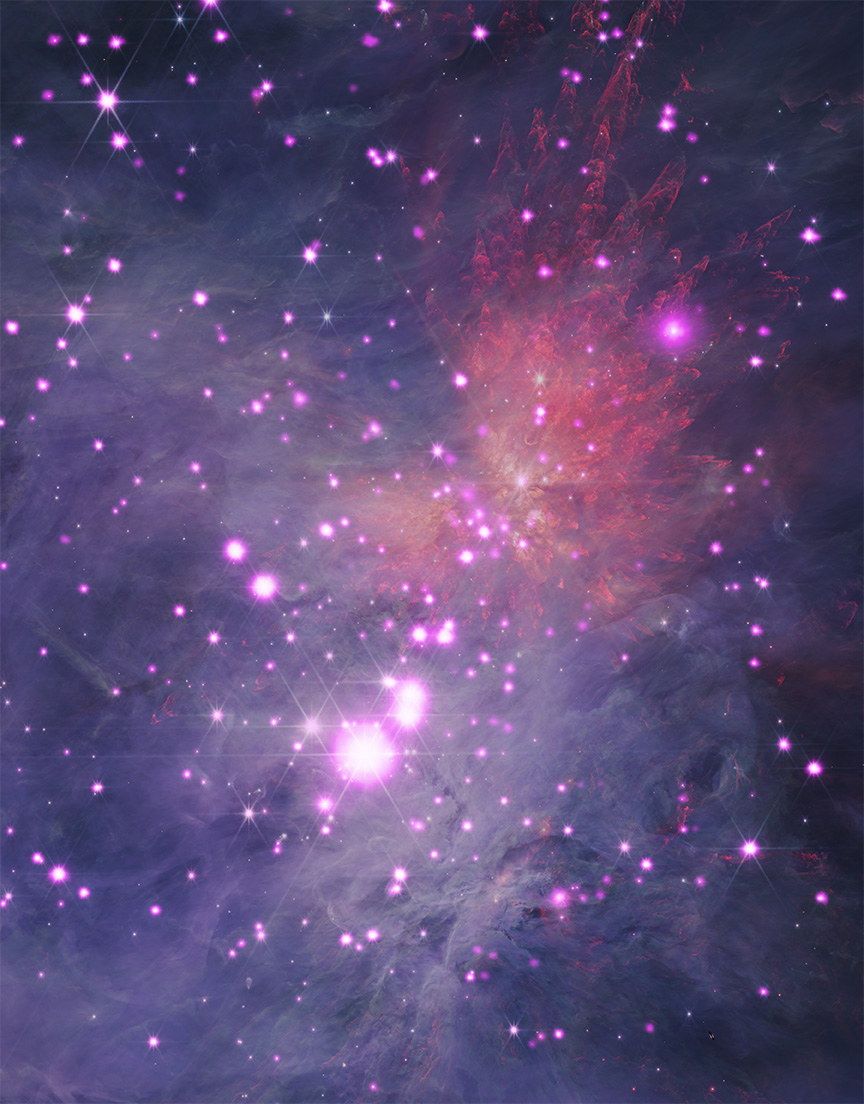
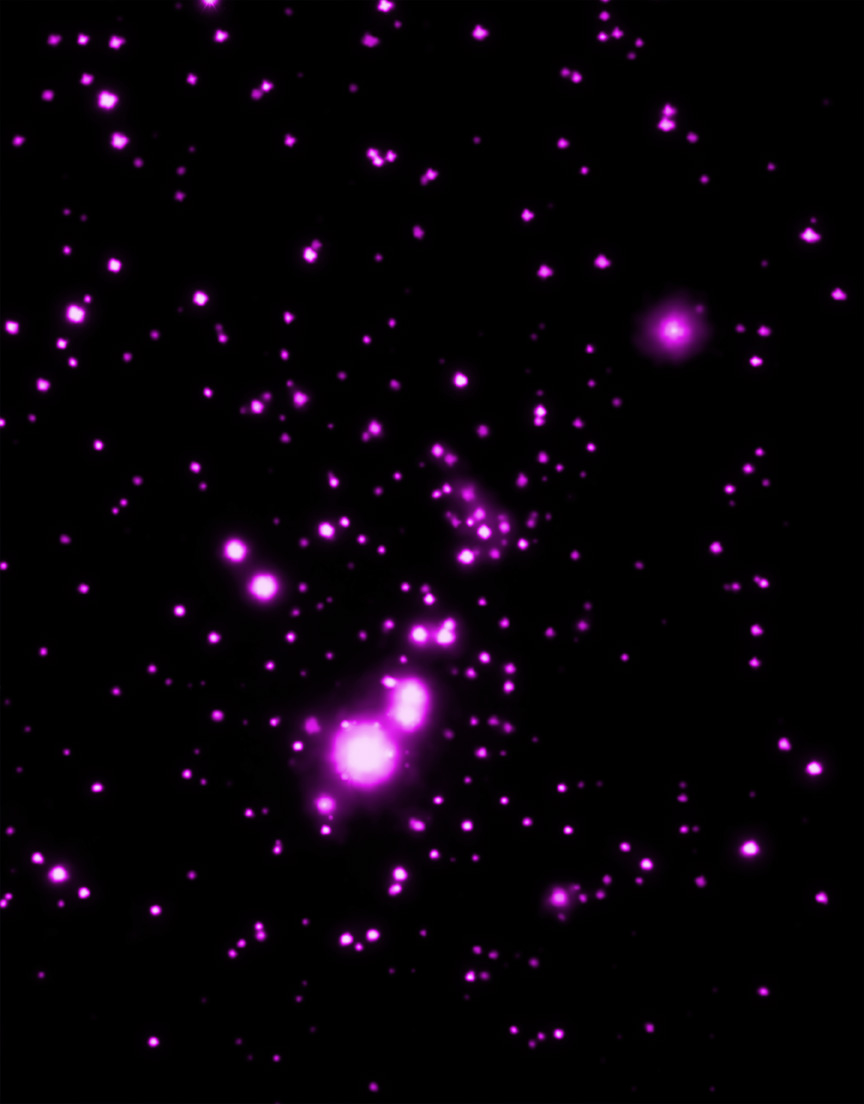
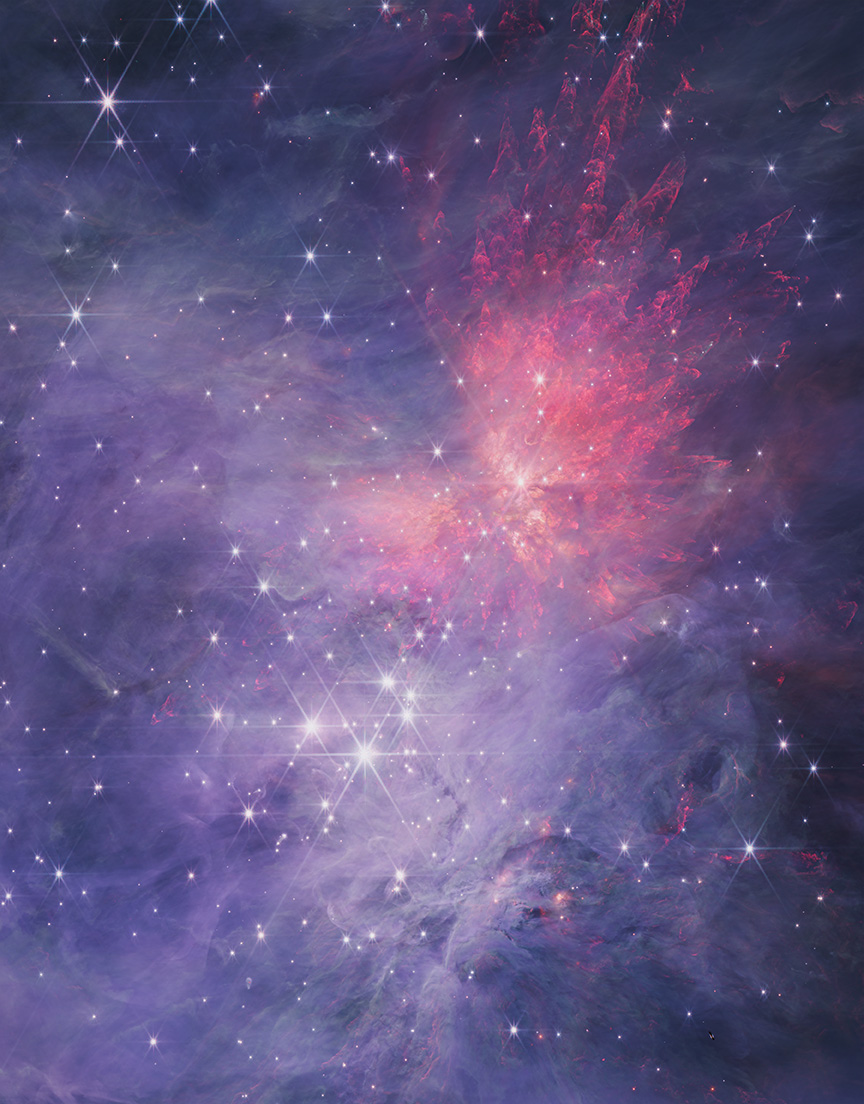
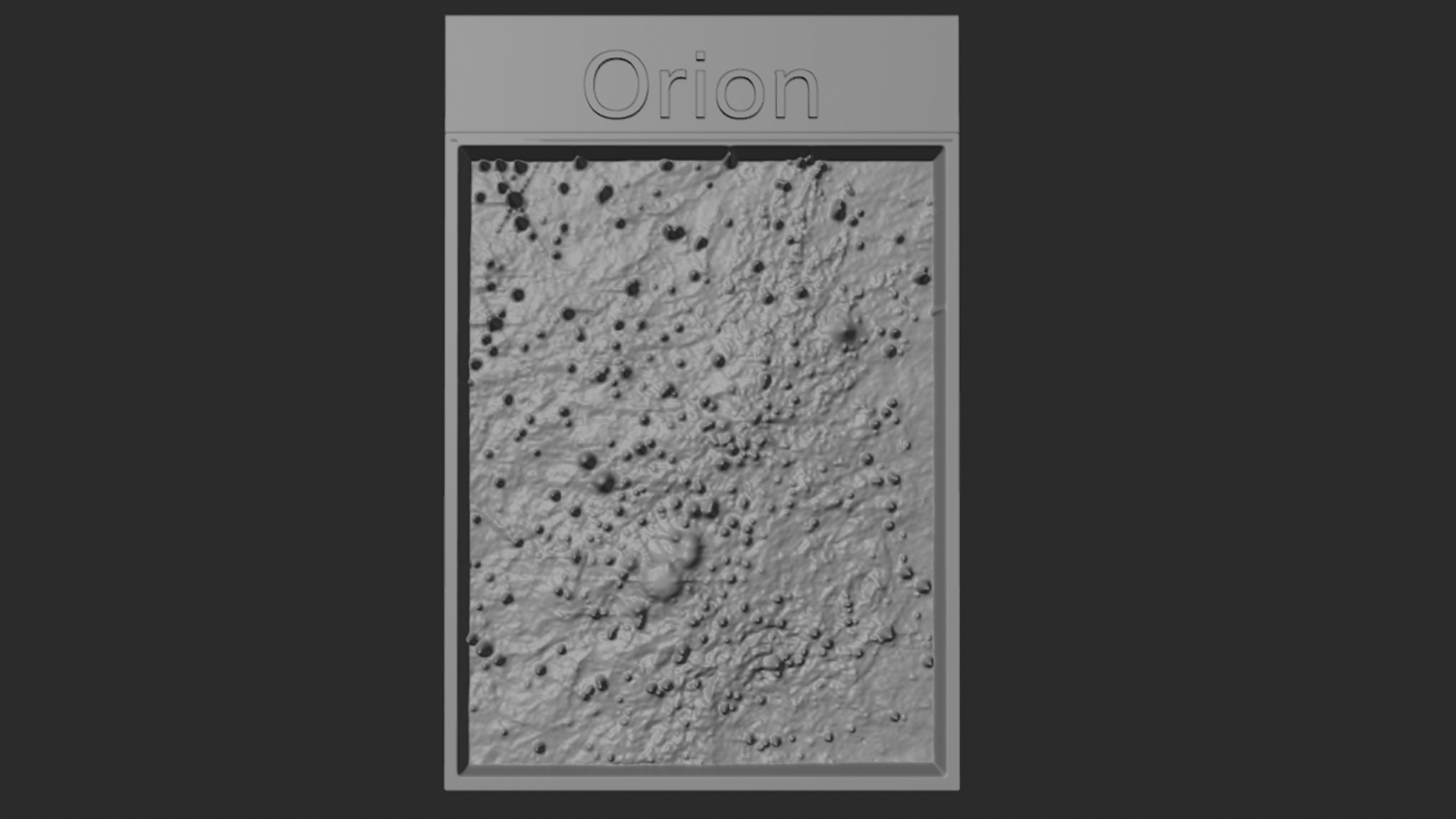
Orion Nebula: One of the closest and busiest star formation regions to Earth is the Orion Nebula (visible just below the belt in the Orion constellation with a small telescope and dark skies). Chandra sees more than a thousand stars in this area that are very energetic and active in their infancy. An infrared image from NASA’s James Webb Space Telescope reveals the raw material of dust and gas used to build these new stars.
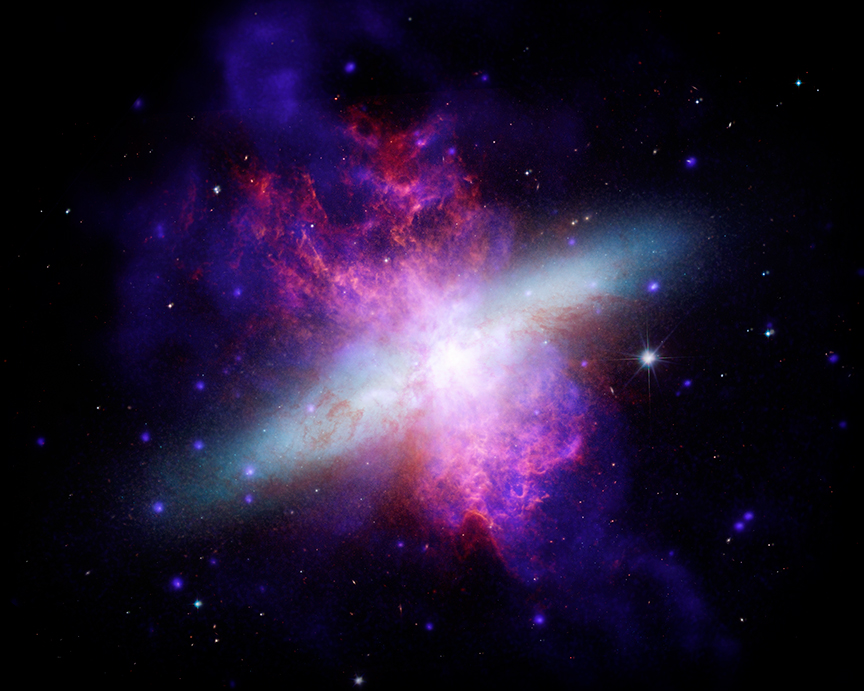
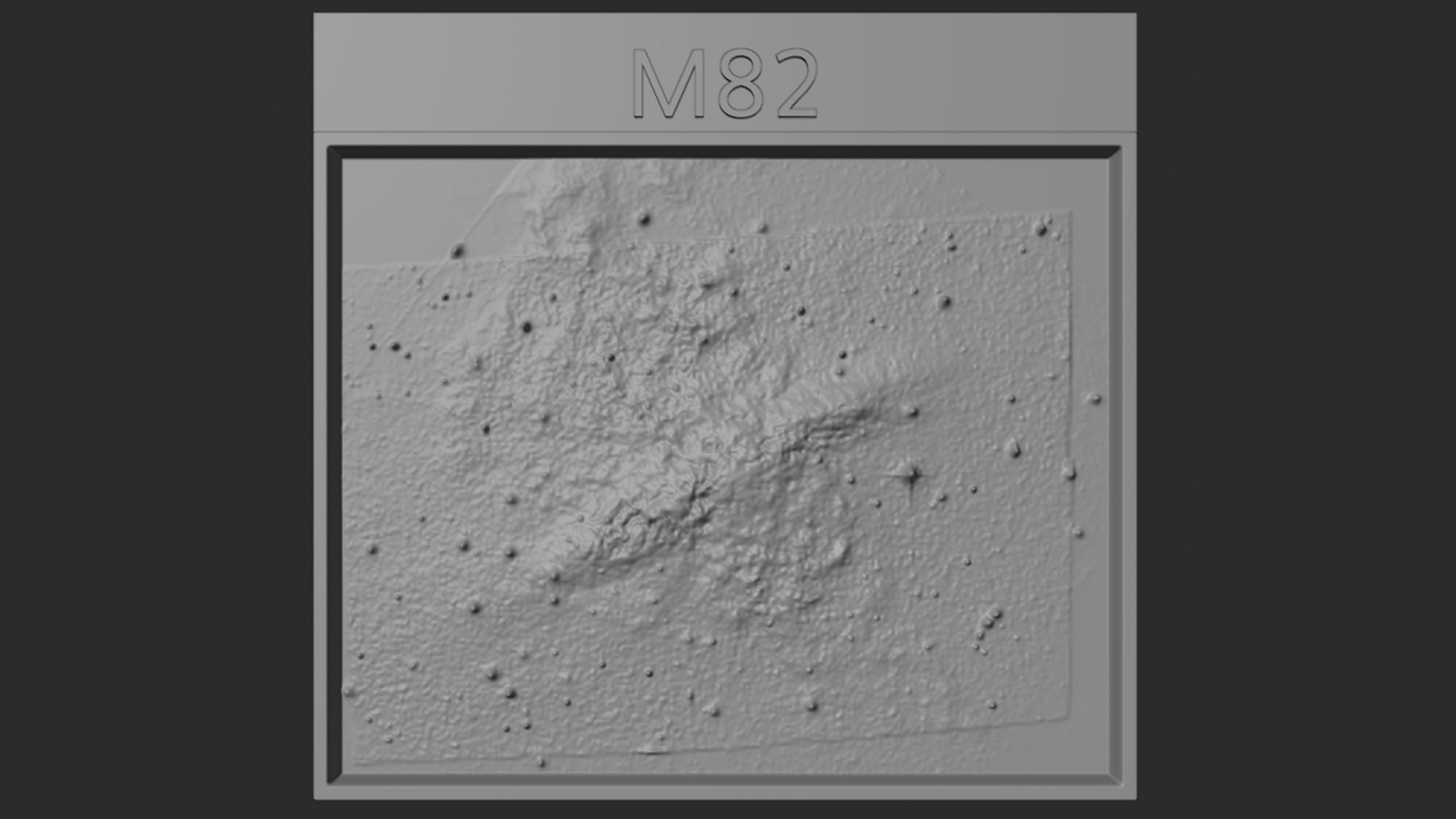
M82: The galaxy Messier 82 (M82) is called a starburst galaxy because stars are forming there at a rate that is tens or even hundreds of times higher than in our Milky Way galaxy. This stellar birth boom may be due to a collision with another galaxy in the past. Today, we see giant plumes of hot gas with Chandra that are the byproduct of young giant stars that quickly explode and other star formation activity.
[Listen to the sonifications here]
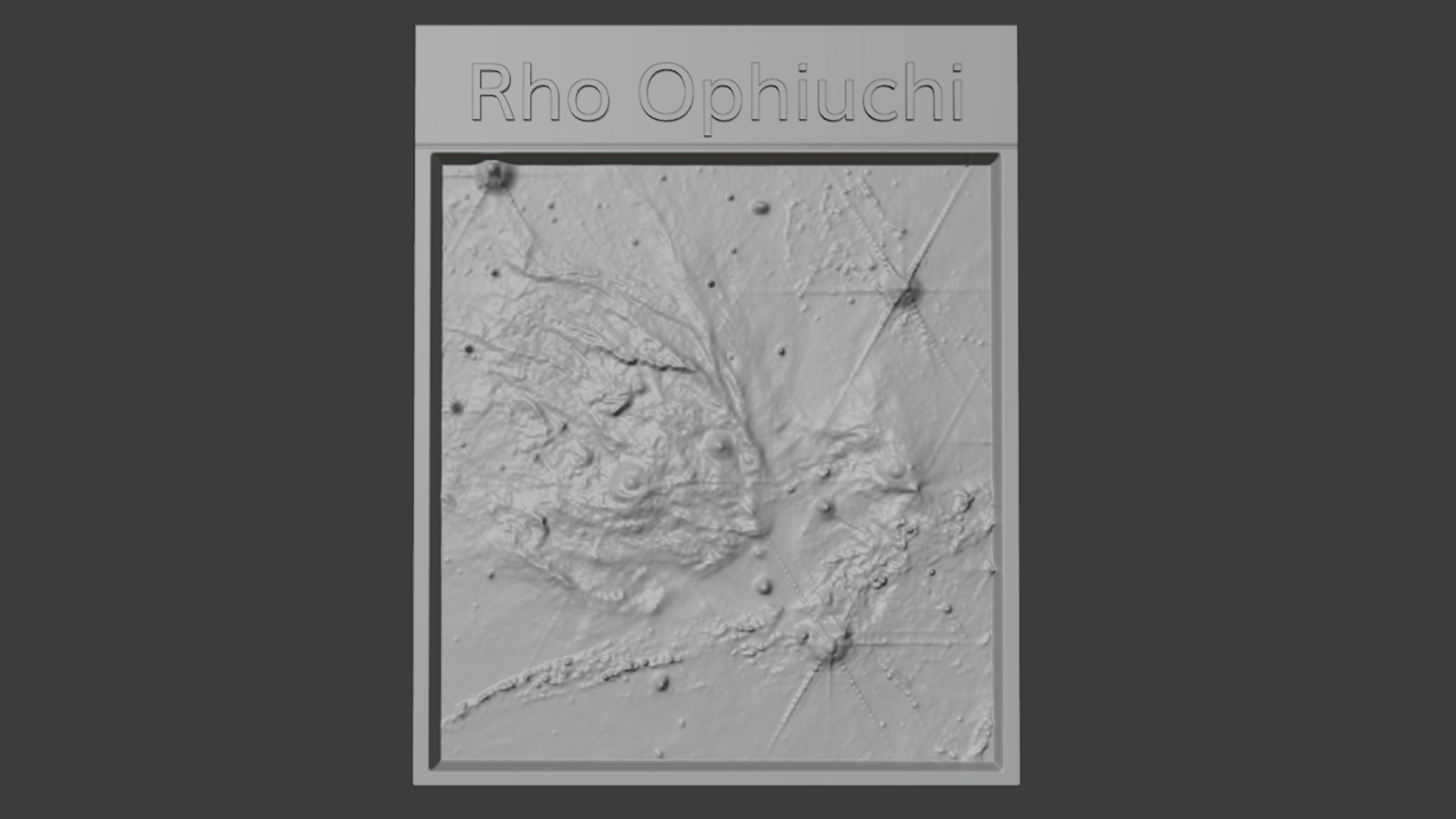
3D Printable Files: Rho Ophiuchi
(3D Print Credit: NASA/CXC/A. Jubett, using software by Tactile Universe/N. Bonne & C. Krawczyk & Blender)
(3D Print Credit: NASA/CXC/A. Jubett, using software by Tactile Universe/N. Bonne & C. Krawczyk & Blender)
This tactile plate is a physical relief map based on the intensity of X-ray and Infrared data, depicting a cloud complex filled with gas, and dotted with stars. The murky cloud resembles a ghostly head in profile, swooping down from the upper left, trailing tendrils of hair. Cutting across the bottom edge and lower righthand corner of the plate is a long, narrow, string-like cloud which resembles the ember of a stick pulled from a fire. Several large stars dot the image. Many are surrounded by rings and diffraction spikes.
3D Printable Files: Carina Nebula
(3D Print Credit: NASA/CXC/A. Jubett, using software by Tactile Universe/N. Bonne & C. Krawczyk & Blender)
(3D Print Credit: NASA/CXC/A. Jubett, using software by Tactile Universe/N. Bonne & C. Krawczyk & Blender)
This tactile plate depicts the Carina Nebula as a physical relief map based on the intensity of X-ray data captured by Chandra and infrared data captured by the Webb Space Telescope. The file for this plate can be downloaded and 3D-printed for learners to touch.
The Carina Nebula resembles a mountain range backed by a hazy night sky. A curtain of dust and gas in the nebula occupies the bottom half of the plate. The sky-like area above is streaked with vertical bands of haze which rise from the nebula below. Faint cloudy areas show hot gas that was blown away from massive stars. A starfield of specks blankets the entire plate. Three thin long diffraction spikes entering the image at our upper right hint at the presence of a bright star just out of view.
The Carina Nebula resembles a mountain range backed by a hazy night sky. A curtain of dust and gas in the nebula occupies the bottom half of the plate. The sky-like area above is streaked with vertical bands of haze which rise from the nebula below. Faint cloudy areas show hot gas that was blown away from massive stars. A starfield of specks blankets the entire plate. Three thin long diffraction spikes entering the image at our upper right hint at the presence of a bright star just out of view.
3D Printable Files: Orion Nebula
(3D Print Credit: NASA/CXC/A. Jubett, using software by Tactile Universe/N. Bonne & C. Krawczyk & Blender)
(3D Print Credit: NASA/CXC/A. Jubett, using software by Tactile Universe/N. Bonne & C. Krawczyk & Blender)
This tactile plate is a physical relief map based on the intensity of X-ray and infrared data. In this composite plate, a collection of points representing stars poke through a haze of wispy clouds. The young stars range in size from tiny specks to plump circles. Many have raised cores, and are surrounded by less-distinct rings, identifying stars detected by Chandra. Some display long, ruler-straight diffraction spikes. Near the upper right of the plate is a burst of cloud that resembles a thick shock of hair. Both the cloud burst and the collection of stars are smoothed by hazy clouds, as if felt through a thick piece of fabric.
2
3D Printable Files: M82 (3D Print Credit: NASA/CXC/A. Jubett, using software by Tactile Universe/N. Bonne & C. Krawczyk & Blender)
This tactile plate is a physical relief map based on the intensity of X-ray, infrared and optical data, featuring a tilted, disk-shaped starburst galaxy viewed edge-on. Bursting out of the core in opposite directions, perpendicular to the disk, are giant, hazy gas clouds that extend for thousands of light-years.
Return to: New Album of Baby Star Sounds Shared by NASA's Chandra (February 25, 2026)


Revised: November 16, 2026