|
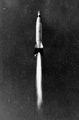
V2 Rocket
Credit: NRL
|
Date: September, 1949
Vehicle/Mission: V-2 rocket
Agency/Country: Naval Research Laboratory
Instruments/Detectors: Geiger counters
Mirror Description: No mirrors
Highlights: Detection of X-ray emission from the solar corona.
|
|
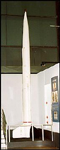
Aerobee Rocket
Credit: USAF Museum |
Date: June 18, 1962 (350 seconds)
Vehicle/Mission: Aerobee Rocket
Agency/Country: USAF
Instruments/Detectors: Proportional counter (2 -10 keV)
Mirror Description: No mirrors
Highlights: Discovery of Scorpius X-1, the first cosmic X-ray source and X-ray background, a signal appearing to come from all directions, possibly a truly diffuse emission
and possibly due to many sources, too faint to be resolved individually.
(Reference: R. Giacconi, H. Gursky, F. R. Paolini, and B. B. Rossi, "Evidence for x Rays From Sources Outside the Solar System," Physical Review Letters, 1 December 1962, Volume 9, pp.
439-443) |
|
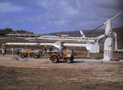
Terrier-Sandhawk rocket
Credit: Lawrence Livermore Laboratory & Sandia Laboratories |
Date: 1963 to 1970
Vehicle/Mission: Numerous rocket and balloon flights
Agency/Country: Various agencies
Instruments/Detectors: Proportional counters (0.2 -10 keV) / scintillation counters (10 -40 keV)
Mirror Description: No mirrors, except for a small solar X-ray telescope with the resolution of a few arc min
Highlights: First X-ray pictures of the sun. Discovery of 40 extra-solar X-ray sources, including X-ray stars, the Crab Nebula pulsar, supernova remnants, and the galaxy
M87. |
|

Uhuru |
Date: December 1970 to March 1973
Vehicle/Mission: Uhuru X-ray satellite
Agency/Country: NASA
Instruments/Detectors: Proportional counters (2 -20 keV)
Mirror Description: No mirrors
Highlights: Uhuru, the first satellite dedicated to the observation of cosmic X-ray sources, was equipped with a sensitive proportional counter attached to a viewing pipe to
locate the sources. It expanded the number of known sources to more than 400, showed that X-ray stars are neutron stars or black holes accreting matter from companions in binary star systems, and
discovered X-rays from hot gas in galaxy clusters. |
|
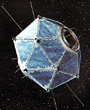
The Vela-5B Satellite
Credit: Los Alamos National Laboratory |
Date: May 1969 to June 1979
Vehicle/Mission: Vela Satellites
Agency/Country: Department of Defense (DOD)
Instruments/Detectors: Scintillation counters (3 -40 keV)
Mirror Description: No mirrors
Highlights: Discovery of gamma ray bursts, X-ray bursters |
|
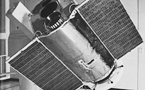
ANS |
Date: August 1974 to July 1976
Vehicle/Mission: Astronomy Netherlands Satellite (ANS)
Agency/Country: The Netherlands
Instruments/Detectors: Proportional counters (2 -40 keV), crystal spectrometer
Mirror Description: No mirrors
Highlights: Discovery of X-ray bursters, more X-ray binaries |
|
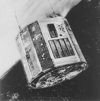
Ariel V |
Date: October 1974 to March 1980
Vehicle/Mission: Ariel V
Agency/Country: United Kingdom
Instruments/Detectors: Proportional counters (2 -10 keV)
Mirror Description: No mirrors
Highlights: Discovery of black hole X-ray nova A0620-00; brightest X-ray source ever seen |
|
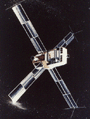
SAS-3 |
Date: May 1975 to April 1980
Vehicle/Mission: Small Astronomy Satellite-3 (SAS-3)
Agency/Country: NASA
Instruments/Detectors: Proportional counters (1.5 -10 keV)
Mirror Description: No mirrors
Highlights: Discovery of X-ray emission from white dwarf SS Cygni; research on X-ray bursters |
|
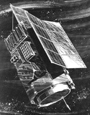
HEAO-1 |
Date: August 1977 to January 1979
Vehicle/Mission: High Energy Astronomy Observatory-1 (HEAO -1)
Agency/Country: NASA
Instruments/Detectors: Proportional counters (0.2 -20 keV) & phoswich scintillators (15 keV -10 MeV)
Mirror Description: No mirrors
Highlights: Survey used large proportional counters that covered a wide range of X-ray energies. Discovered the Cygnus superbubble, and gathered detailed information on
spectra of active galactic nuclei and the X-ray background. |
|
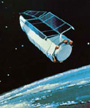
Einstein |
Date: November 1978 to April 1981
Vehicle/Mission: Einstein X-ray Observatory
Agency/Country: NASA
Instruments/Detectors: Proportional counters/microchannel plate imager/solid state spectrometer/crystal spectrometer (0.2 -4 keV)
Mirror Description: 4 nested mirror pairs with an area of 350 sq cm and a resolution of 3-5 arc sec.
Highlights: The first large X-ray telescope with mirrors. Einstein made the first X-ray images of shock waves in supernova remnants, hot gas in galaxies and clusters of
galaxies. Einstein also located accurately over 7000 X-ray sources, including stellar coronas, X-ray binaries, galaxies and quasars. It made possible a new way to study the mysterious dark matter
that is present in galaxies and clusters of galaxies and showed that most of the X-ray background is probably due to discrete sources. |
|

EXOSAT |
Date: May 1983 to April 1986
Vehicle/Mission: EXOSAT
Agency/Country: European Space Agency
Instruments/Detectors: Proportional counters (0.1 -10 keV)
Mirror Description: 2 nested mirror pairs with 80 sq cm area and 18 arc sec resolution
Highlights: Discovery of quasi-periodic oscillations from neutron stars and black holes, surveys of variability of wide variety of galactic and extragalactic sources. |
|
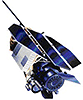
ROSAT |
Date: June 1990 to February 1999
Vehicle/Mission: Roentgensatellite (ROSAT)
Agency/Country: Germany
Instruments/Detectors: Proportional counters/microchannel plate imager (0.1 -2.5 keV)
Mirror Description: 4 nested mirror pairs with 1140 sq cm area and 3 arc sec resolution Highlights: ROSAT expanded the number of known X-ray
sources to 125,000 and proved to be especially valuable for investigating the multi-million degree gas present in the upper atmospheres of many stars, made the first detection of radiation from the
hot surface of a neutron star, and comets. It resolved 70% of soft X-ray background, and made an extensive catalogue of galaxy clusters. |
|
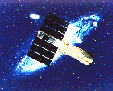
ASCA |
Date: 1993 to July 2000
Vehicle/Mission: Advanced Satellite for Cosmology and Astrophysics (ASCA)
Agency/Country: Japan
Instruments/Detectors: Proportional counters/CCDs (0.4 -12 keV)
Mirror Description: 120 nested foil mirrors with 1300 sq cm area and resolution of 180 arc sec
Highlights: The ASCA X-ray observatory with low resolution mirrors, and the first large CCD detectors, was especially designed to study the detailed spectra of X-ray sources
in supernova remnants, active galactic nuclei and galaxy clusters. Found first evidence of the gravitational redshift due to the strong gravitational field around a black hole. |
|
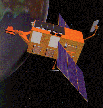
RXTE |
Date: December 1995 to present
Vehicle/Mission: Rossi X-ray Timing Explorer (RXTE)
Agency/Country: NASA
Instruments/Detectors: Proportional counters (2 -50 keV) and scintillation counters (15 -200 keV)
Mirror Description: No mirrors
Highlights: Although RXTE does not have focusing X-ray mirrors, it has the unique capability to study rapid time variability in the emission of cosmic X-ray sources over a
wide band of X-ray energies, and has made valuable contributions to our understanding of the behavior of matter in the vicinity of neutron stars and black holes. Extremely rapid variability observed
by RXTE may be evidence for the dragging of space by strong gravity in the vicinity of black holes. |
|
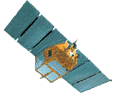
BeppoSAX |
Date: April 1996 to April 2002
Vehicle/Mission: BeppoSAX
Agency/Country: Italy & The Netherlands
Instruments/Detectors: Proportional counters (0.1 -10 keV), scintillation counters (3 -120 keV) and phoswich detectors (15 -300 keV)
Mirror Description: No mirrors
Highlights: BeppoSAX is the first X-ray mission with a scientific payload covering more than three decades of energy - from 0.1 to 300 keV, with moderate imaging capability.
BeppoSAX has proved to be especially useful for wide band spectra of active galactic nuclei, and for studying gamma-ray bursts by determining their positions with an unprecedented precision and
monitoring their X-ray afterglow. |
|
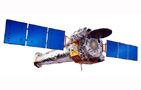
Chandra X-ray Observatory |
Date: July 1999 to present
Vehicle/Mission: Chandra X-ray Observatory
Agency/Country: NASA
Instruments/Detectors: High Resolution Imager/CCDs, grating spectrometers (0.1 -10 keV)
Mirror Description: 4 nested pairs with 1145 sq cm area and 0.5 arc sec resolution.
Highlights: Chandra's unique sensitivity and precision have made possible significant advances in many areas of astronomy. Of
particular importance are discoveries relating to the life cycles of stars, the number and nature of black holes in the universe, the generation by neutron stars of high energy matter and anti-matter
particles, and the formation and evolution of galaxies. Chandra has traced the distribution of elements such as oxygen, neon, silicon and iron in
supernova remnants, and made spectacular images of the pulsar wind nebulas in the Crab Nebula and Vela supernova
remnant.
Chandra observations have revealed the presence of many previously undetected stellar black holes in nearby galaxies, including a possible new class of intermediate mass black holes. Chandra's detailed spectral studies of the activity of supermassive black holes in the centers of galaxies have detected winds
coming from the centers of galaxies, and X-ray jets hundreds of thousands of light years in length that can be traced back to the central supermassive black
holes. Very long Chandra exposures have shown that there may be twice as many active supermassive black holes in the universe as previously thought. Chandra is enabling astronomers to study how
clusters of galaxies are formed and how they change with time, and to investigate the nature of the dark matter that comprises most of the mass of the universe. |
|

XMM-Newton |
Date: December 1999 to present
Vehicle/Mission: XMM-Newton
Agency/Country: European Space Agency
Instruments/Detectors: CCD cameras and spectrometers (0.1 - 12 keV)
Mirror Description: 3 modules each with 58 wafer-thin mirrors for a total area of 4300 sq cm and a resolution of 5 arc sec
Highlights: With its large collecting area, spectrometers and moderate resolution, XMM-Newton is especially designed to make detailed studies of the spectra of supernova
remnants, accretion disks around black holes, stars and other types of sources. Notable achievements have been to accurately measure the energy budget of radiation from a black-hole accretion disk,
the detection of heavy elements in the spectrum of the afterglow of a gamma-ray burst, the mapping of elements in supernova remnants, and detailed spectra of active galactic nuclei. |
|
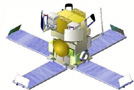
HETE-2 |
Date: October 2000 to present
Vehicle/Mission: High Energy Transient Explorer (HETE-2)
Agency/Country: USA, Japan, France, and Italy
Instruments/Detectors: X-ray cameras & gamma-ray detectors (0.5 -400 keV)
Mirror Description: No mirrors
Highlights: Detection and localization of gamma-ray bursts, and a possible new type of X-ray burst that may be related to gamma-ray bursts. |