
Chandra X-ray Observatory - HomeAbout The ChandraEducational MaterialsField GuidePhoto AlbumPress RoomResources
Chandra X-ray Observatory - HomeChandra Photo Album - You are here
ObservatoryImages by DateImages by CategorySky MapConstellationsSpecial FeaturesChandra Zoom-insImage HandoutsScale Bar ImagesTutorial Chandra Images & False Color Note on Cosmic DistanceCosmic Look Back TimeScale & DistanceScale & Angular MeasurementImage Use
Web Site ToolsVisit the Chandra ChroniclesEmail NewsletterSite MapNew & NoteworthyImage Use PolicyQuestions & AnswersGlossaryDownload Guide

Cassiopeia A:
Elemental Image Of Exploded Star
Cassiopeia A
Credit: NASA/GSFC/U.Hwang et al.
JPEG (252.3 kb) Tiff (3.9 MB) PS (4.7 MB)

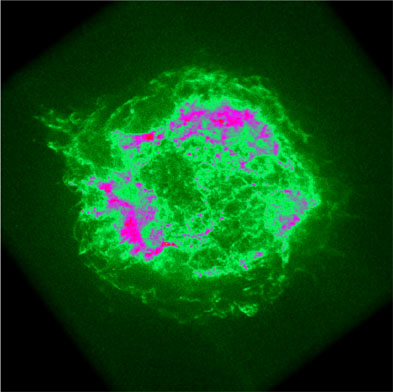
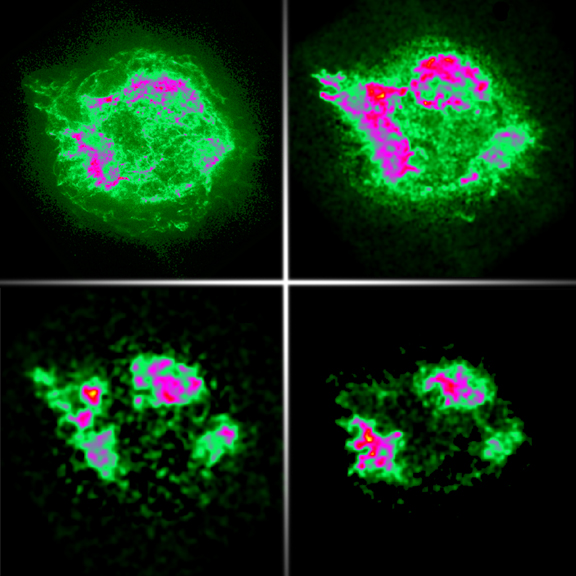
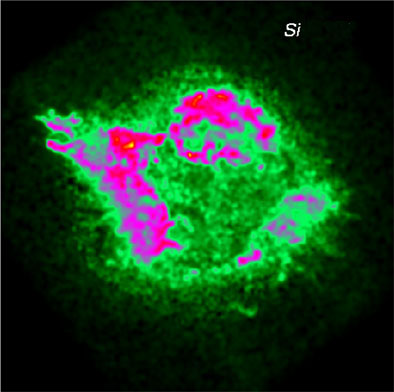
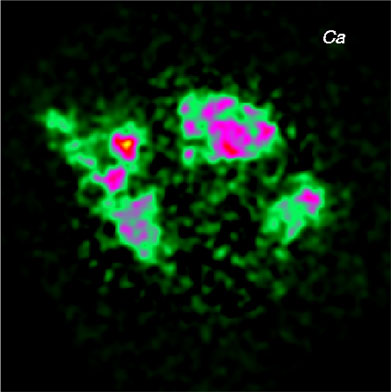
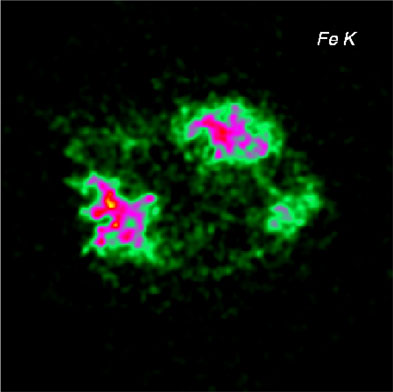
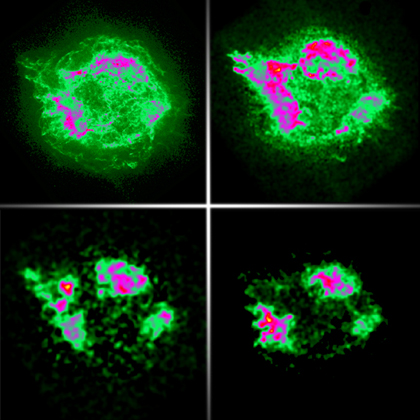
A new 14 hour Chandra observation of the supernova remnant Cassiopeia A has given the best map yet of heavy elements ejected in a supernova explosion. Upper left: Broadband X-ray image of Cassiopeia A (Cas A) Upper right: Image made by X rays from silicon ions. Lower left: Image made by X rays from calcium ions. Lower right: Image made by X rays from iron ions. All images are 8.5 arc minutes on a side (corresponding to 28.2 light years at a distance of 11,000 light years).

These images are designed to show the distribution of some of the elements ejected in the explosion that produced Cas A. The elements are part of a gas that has a temperature of about 50 million degrees Celsius. The colors represent intensity of X rays, with yellow the most intense, then red, purple, and green.

The broadband image, which shows all the X rays detected from Cas A, is more symmetric than the others. This could be due to the presence of X rays from synchrotron radiation by extremely high-energy particles spiraling in the magnetic field of the remnant, or to shock waves traveling through material puffed off thousands of years before the supernova.

The silicon image shows a bright, broad jet breaking out of the upper left side of the remnant, and faint streamers in an opposite direction. This jet could be due to an asymmetry in the explosion.

The calcium image is similar to the silicon image, but less bright and clumpier. The iron image shows significant differences from other images. Since iron is the heaviest element shown, these maps support the suggestion that the layers of the star were overturned either before or during the explosion.


Fast Facts for Cassiopeia A:
Credit  NASA/GSFC/U.Hwang et al.
Scale  All images are 8.5 arcmin on a side.
Category  Supernovas & Supernova Remnants
Coordinates (J2000)  RA 23h 23m 26.7s | Dec +58° 49' 03.00"
Constellation  Cassiopeia
Observation Dates  January 30 - 31, 2000
Observation Time  14 hours
Obs. IDs  114
Color Code  Colors represent different energy bands
Instrument  ACIS
Also Known As Cas A
Distance Estimate  About 10,000 light years
Release Date  June 27, 2000

More Information on Cassiopeia A:
More Images of Cassiopeia A
Cassiopeia A Handout: html | pdf
Powerpoint and PDF
Chandra's Fifth: The Many Faces of Cassiopeia A
Other Chandra Releases for Cassiopeia A:
Photo Album: Cassiopeia A (15 Nov 06)
Photo Album: Cassiopeia A (13 Jun 05)
Photo Album: Cassiopeia A (23 Aug 04)
Photo Album: Cassiopeia A (19 Aug 02)
Photo Album: Cassiopeia A (21 Dec 99)
Photo Album: Cassiopeia A (26 Aug 99)
Related Chandra Images:
Photo G292.0+1.8 (23 Oct 2007)
Photo Album: Kepler's Supernova Remnant (09 Jan 2007)
Photo Album: Tycho's Supernova Remnant (05 Sep 2005)
More Information on Supernovas & Supernova Remnants :
X-ray Astronomy Field Guide: Supernovas & Supernova Remnants
Questions and Answers: Supernovas & Supernova Remnants
Chandra Images: Supernovas & Supernova Remnants


Chandra Images: '08 | ' 07 | ' 06 | ' 05 | ' 04 | ' 03 | ' 02 | ' 01 | ' 00 | ' 99 | Images by Category


separator line
CXC Home | Search | Help | Site Map | Image Use Policy | Privacy & Accessibility | Downloads & Plugins
Latest Images | New & Noteworthy | Multimedia | Flash Ecards | Glossary | Q&A | Guestbook


RSS Feed RSS Feed | Podcast Podcast | Blog Blog

[News by email: Chandra Digest]
[Contact us: cxcpub@cfa.harvard.edu]
NASA's Home Page Smithsonian's Home Page CXC Home Page Image Map for NASA's, Smithsonian and Chandra's Home Pages
Harvard-Smithsonian Center for Astrophysics
60 Garden Street, Cambridge, MA 02138 USA
Phone: 617.496.7941 Fax: 617.495.7356


Text Size:
normal font large font larger font
Chandra X-ray Center, Operated for NASA by the Smithsonian Astrophysical Observatory
This site was developed with funding from NASA under Contract NAS8-03060.
Revised: February 06, 2008