

1. Banking X-ray Data for the Future
QuicktimeMPEG Audio Only
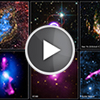
Archives, in their many forms, save information from today that people will want to access and study in the future. This is a critical function of all archives, but it is especially important when it comes to storing data from today's modern telescopes.
NASA's Chandra X-ray Observatory has collected data for over sixteen years on thousands of different objects throughout the Universe. The science team has immediate access to the data, and then a year after observation all of the data goes into a public archive where it can be folded into later studies.
To celebrate October being American Archive Month a collection of images from the Chandra archive is being released. Some of these objects may be familiar to readers, while others may be unknown. None of these images, in the exact form, has been released before.
By combining data from different observation dates, new perspectives of cosmic objects can be created. With archives like those from Chandra and other major observatories, such vistas will be available for future exploration.
[Runtime: 01:27]
(NASA/CXC/A. Hobart)
Related Chandra Images:
QuicktimeMPEG Audio Only
- Audio (1.1 MB)
Archives, in their many forms, save information from today that people will want to access and study in the future. This is a critical function of all archives, but it is especially important when it comes to storing data from today's modern telescopes.
NASA's Chandra X-ray Observatory has collected data for over sixteen years on thousands of different objects throughout the Universe. The science team has immediate access to the data, and then a year after observation all of the data goes into a public archive where it can be folded into later studies.
To celebrate October being American Archive Month a collection of images from the Chandra archive is being released. Some of these objects may be familiar to readers, while others may be unknown. None of these images, in the exact form, has been released before.
By combining data from different observation dates, new perspectives of cosmic objects can be created. With archives like those from Chandra and other major observatories, such vistas will be available for future exploration.
[Runtime: 01:27]
(NASA/CXC/A. Hobart)
Related Chandra Images:
- Photo Album: Chandra Archive Collection

2. Animation of the Phoenix Cluster
QuicktimeMPEG This animation shows how large numbers of stars form in the Phoenix Cluster. It begins by showing several galaxies in the cluster and hot gas (in red). This hot gas contains more normal matter than all of the galaxies in the cluster combined, and can only be detected with X-ray telescopes like Chandra. The camera then flies in towards the large elliptical galaxy at the center of the cluster. The hot gas near this galaxy is giving off copious amounts of X-rays and cooling quickly over time, as shown by the change to a blue color. This cooling causes gas to flow inwards along filaments and form huge numbers of stars when it continues to cool.
[Runtime: 0.45]
(NASA/CXC/A. Hobart)
Related Chandra Images:
QuicktimeMPEG This animation shows how large numbers of stars form in the Phoenix Cluster. It begins by showing several galaxies in the cluster and hot gas (in red). This hot gas contains more normal matter than all of the galaxies in the cluster combined, and can only be detected with X-ray telescopes like Chandra. The camera then flies in towards the large elliptical galaxy at the center of the cluster. The hot gas near this galaxy is giving off copious amounts of X-rays and cooling quickly over time, as shown by the change to a blue color. This cooling causes gas to flow inwards along filaments and form huge numbers of stars when it continues to cool.
[Runtime: 0.45]
(NASA/CXC/A. Hobart)
Related Chandra Images:
- Photo Album: Phoenix Cluster

3. Images of the "El Gordo" Galaxy Cluster
QuicktimeMPEG This sequence of images shows "El Gordo" in X-ray light from NASA's Chandra X-ray Observatory, optical data from the European Southern Observatory's Very Large Telescope, and infrared emission from NASA's Spitzer Space Telescope, before revealing a composite of all of the wavelengths. Galaxy clusters are the largest objects in the universe that are held together by gravity, and can be used to study many things. Finding a galaxy cluster like El Gordo when the universe was less than half its current age helps astronomers better understand how the universe was evolving at that epoch.
[Runtime: 00.12]
(X-ray: NASA/CXC/Rutgers/J. Hughes et al; Optical: ESO/VLT& SOAR/Rutgers/F. Menanteau; IR: NASA/JPL/Rutgers/F. Menanteau)
Related Chandra Images:
QuicktimeMPEG This sequence of images shows "El Gordo" in X-ray light from NASA's Chandra X-ray Observatory, optical data from the European Southern Observatory's Very Large Telescope, and infrared emission from NASA's Spitzer Space Telescope, before revealing a composite of all of the wavelengths. Galaxy clusters are the largest objects in the universe that are held together by gravity, and can be used to study many things. Finding a galaxy cluster like El Gordo when the universe was less than half its current age helps astronomers better understand how the universe was evolving at that epoch.
[Runtime: 00.12]
(X-ray: NASA/CXC/Rutgers/J. Hughes et al; Optical: ESO/VLT& SOAR/Rutgers/F. Menanteau; IR: NASA/JPL/Rutgers/F. Menanteau)
Related Chandra Images:
- Photo Album: El Gordo
4. Images of Long Galaxy Tail
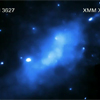
QuicktimeMPEG This sequence of images begins with a wide-field view of Abell 3627, a giant cluster of galaxies, as seen in X-rays by ESA's XMM-Newton observatory. The view then zooms into an area that shows the galaxy ESO 137-001 as it plunges toward the cluster. First shown in optical light (white) then hydrogen emission (red), the image then turns to the multimillion-degree gas observed NASA's Chandra X-ray Observatory. The final image is a composite of all of these data showing the long tail behind ESO 137-001 that is creating stars in its wake.
[Runtime: 0:13]
(X-ray: Chandra X-ray: NASA/CXC/MSU/M.Sun et al; XMM-Newton X-ray ESA/MSU/M.Sun et al; H-alpha/Optical: SOAR (MSU/NOAO/UNC/CNPq-Brazil)/M.Sun et al.)
Related Chandra Images:
QuicktimeMPEG This sequence of images begins with a wide-field view of Abell 3627, a giant cluster of galaxies, as seen in X-rays by ESA's XMM-Newton observatory. The view then zooms into an area that shows the galaxy ESO 137-001 as it plunges toward the cluster. First shown in optical light (white) then hydrogen emission (red), the image then turns to the multimillion-degree gas observed NASA's Chandra X-ray Observatory. The final image is a composite of all of these data showing the long tail behind ESO 137-001 that is creating stars in its wake.
[Runtime: 0:13]
(X-ray: Chandra X-ray: NASA/CXC/MSU/M.Sun et al; XMM-Newton X-ray ESA/MSU/M.Sun et al; H-alpha/Optical: SOAR (MSU/NOAO/UNC/CNPq-Brazil)/M.Sun et al.)
Related Chandra Images:
- Photo Album: Abell 3627
5. Images of Galaxy Cluster "Train Wreck"
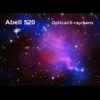
QuicktimeMPEG This sequence of images of Abell 520 shows the aftermath of a complicated collision of galaxy clusters. Chandra detects multimillion degree gas that pervades the clusters (red). Optical telescopes can be used to infer the location of most of the matter in the cluster - dominated by dark matter - through its effects on distant galaxies (blue). Visible light data also reveal the starlight from the individual galaxies (yellow and orange). The composite image shows the chaotic aftermath of this collision between at least two clusters of galaxies.
[Runtime: 0:13]
(X-ray: NASA/CXC/UVic./A.Mahdavi et al.; Optical/Lensing: CFHT/UVic./A.Mahdavi et al.)
Related Chandra Images:
QuicktimeMPEG This sequence of images of Abell 520 shows the aftermath of a complicated collision of galaxy clusters. Chandra detects multimillion degree gas that pervades the clusters (red). Optical telescopes can be used to infer the location of most of the matter in the cluster - dominated by dark matter - through its effects on distant galaxies (blue). Visible light data also reveal the starlight from the individual galaxies (yellow and orange). The composite image shows the chaotic aftermath of this collision between at least two clusters of galaxies.
[Runtime: 0:13]
(X-ray: NASA/CXC/UVic./A.Mahdavi et al.; Optical/Lensing: CFHT/UVic./A.Mahdavi et al.)
Related Chandra Images:
- Photo Album: Abell 520
6. Images of 3C438 and Surrounding Galaxy Cluster
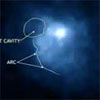
QuicktimeMPEG This sequence of images shows how 3c438, the galaxy at the center of this cluster, looks in various types of light. The X-ray image shows a much different structure from the optical image, including a massive arc-like structure to the lower left. There are also hints of a cavity in the hot gas to the upper left. Jets seen in the radio image do not point in the same directions as the cavity structure, adding more mysteries about this system.
[Runtime: 0:25]
(X-ray: NASA/CXC/CfA/R.P.Kraft; Optical: Pal.Obs. DSS; Radio: NRAO/VLA/A.H.Bridle & R.G.Strom))
Related Chandra Images:
QuicktimeMPEG This sequence of images shows how 3c438, the galaxy at the center of this cluster, looks in various types of light. The X-ray image shows a much different structure from the optical image, including a massive arc-like structure to the lower left. There are also hints of a cavity in the hot gas to the upper left. Jets seen in the radio image do not point in the same directions as the cavity structure, adding more mysteries about this system.
[Runtime: 0:25]
(X-ray: NASA/CXC/CfA/R.P.Kraft; Optical: Pal.Obs. DSS; Radio: NRAO/VLA/A.H.Bridle & R.G.Strom))
Related Chandra Images:
- Photo Album: 3C438
7. 3D Animation of Cluster Collision
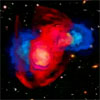
QuicktimeMPEG This visualization shows how astronomers believe the "bullet cluster" was created and will continue to develop. Courtesy of John Wise of the Kavli Institute for Particle Astrophysics and Cosmology.
[Runtime: 0.39]
(KIPAC/John Wise)
Related Chandra Images:
QuicktimeMPEG This visualization shows how astronomers believe the "bullet cluster" was created and will continue to develop. Courtesy of John Wise of the Kavli Institute for Particle Astrophysics and Cosmology.
[Runtime: 0.39]
(KIPAC/John Wise)
Related Chandra Images:
- Photo Album: 1E 0657-56
8. Zoom into Spiral Galaxy C153
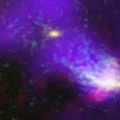
QuicktimeMPEG This video zooms into the C153 spiral galaxy found in the galaxy cluster Abell 2125. The initial view moves from the NOAO telescope wide-field mosaic into the Hubble Wide Field Planetary Camera 2 image of C153. The Hubble image then dissolves into the composite detail of X-ray, radio and optical images.
[Runtime: ]
(NASA/STScI)
QuicktimeMPEG This video zooms into the C153 spiral galaxy found in the galaxy cluster Abell 2125. The initial view moves from the NOAO telescope wide-field mosaic into the Hubble Wide Field Planetary Camera 2 image of C153. The Hubble image then dissolves into the composite detail of X-ray, radio and optical images.
[Runtime: ]
(NASA/STScI)
10. Perseus Ripple Image Dissolving into Illustration
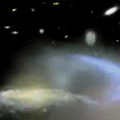
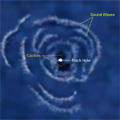
QuicktimeMPEG This sequence begins with the Chandra data, which show the ripples inthe hot gas that fills the Perseus cluster. The features were discovered by using a special image-processing technique to bring outsubtle changes in brightness. These sound waves are thought to have been generated by cavities blown out by jets from a supermassive black hole(bright white spot) at the center of the Perseus cluster. The Chandra image then dissolves into an artist's illustration of the system, which labels the important features, before returning to the original Chandra data.
[Runtime: 0:15]
(NASA/CXC/IoA/A.Fabian et al.; Illustration: NASA/CXC/M.Weiss)
Related Chandra Images:
QuicktimeMPEG This sequence begins with the Chandra data, which show the ripples inthe hot gas that fills the Perseus cluster. The features were discovered by using a special image-processing technique to bring outsubtle changes in brightness. These sound waves are thought to have been generated by cavities blown out by jets from a supermassive black hole(bright white spot) at the center of the Perseus cluster. The Chandra image then dissolves into an artist's illustration of the system, which labels the important features, before returning to the original Chandra data.
[Runtime: 0:15]
(NASA/CXC/IoA/A.Fabian et al.; Illustration: NASA/CXC/M.Weiss)
Related Chandra Images:
- Photo Album: Perseus Cluster




Revised: March 24, 2023