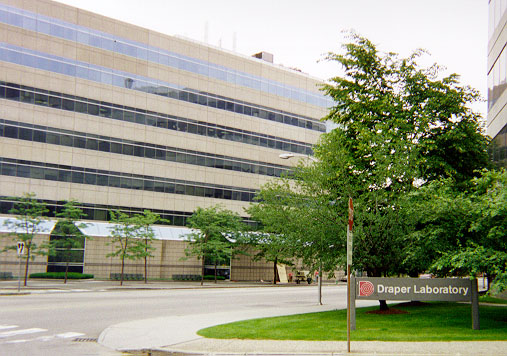
Chandra Operations Control Center in Cambridge, MA, operated for NASA by the Smithsonian Astrophysical Observatory.
Photo: CXC
August 2, 1999 Cambridge, MA :: How do Chandra's rocket scientists spend a Saturday night?
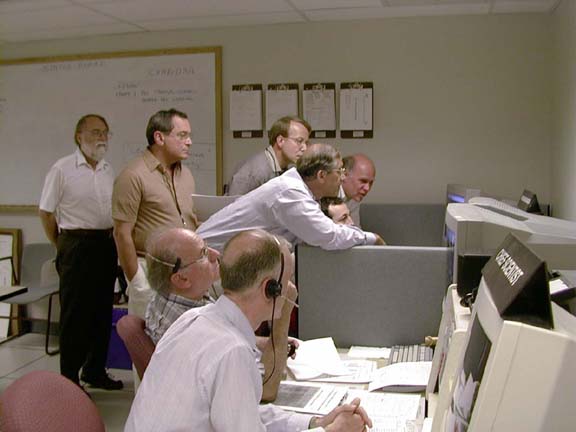
Answer: Huddled around computer monitors in the Action Room watching "The big one," as Steve Murray, of the Smithsonian Astrophysical Observatory called it.
Operations Control Center
The importance of this event was evident from the credentials of the high level officials present on a summer weekend night: Marshall Space Flight Center, the NASA center that is managing Chandra, was represented by Fred Wojtalik,
Chandra program manager, Jean Oliver, deputy program manager, and Martin Weisskopf, project scientist. TRW (now NGST), the prime contractor, had their program manager, Craig Staresinich and program scientist, Ralph Schilling. Harvey Tananbaum, director of the
Smithsonian's Chandra Center, the group responsible for the operation of Chandra was there, as was the associate director, Claude Canizares of MIT, and Smithsonian's Roger Brissenden, the manager of Chandra operations.
The "big one" was the third firing of Chandra's Integral Propulsion System (IPS), the TRW (now NGST) built rocket engine. The burn started at 6:33 p.m. EDT on July 31, and lasted 21 minutes, 27 seconds. It took Chandra to an orbit that extends as far as 86,000
miles from Earth, more than a third of the distance to the moon.
It is critical to Chandra's mission that the telescope be lifted far above the Van Allen radiation belts. The belts are caused by charged particles trapped in the Earth's magnetic field and range in altitude from 250 miles to 40,000 miles. They produce
a blizzard of background radiation or static that make observations of distant cosmic sources extremely difficult.
The computer controlled burn started on time with Chandra about 2,000 miles above the Indian Ocean. When notification of the beginning of the burn flashed across the monitors, a ripple of excitement muted by tension spread throughout
the room. Everyone crowded around the monitors and spoke in hushed tones as they watched columns of ever changing numbers, each one of which carried vital information about the progress of the burn and the state of the spacecraft -- burn temperature,
pressure, momentum unloading, velocity, delta velocity, spacecraft orientation, etc.
By 6:54 p.m., it was all over, "Exactly on time," Brissenden, reported. "Everything appears to be nominal."
The group of officials relaxed visibly but several mentioned that there were still hurdles to come. And, as one cautious official pointed out, they would not know for sure how good this burn was until they tracked the new orbit over the next several
hours. . .