

CXC Home | Search | Help | Image Use Policy | Latest Images | Privacy | Accessibility | Glossary | Q&A
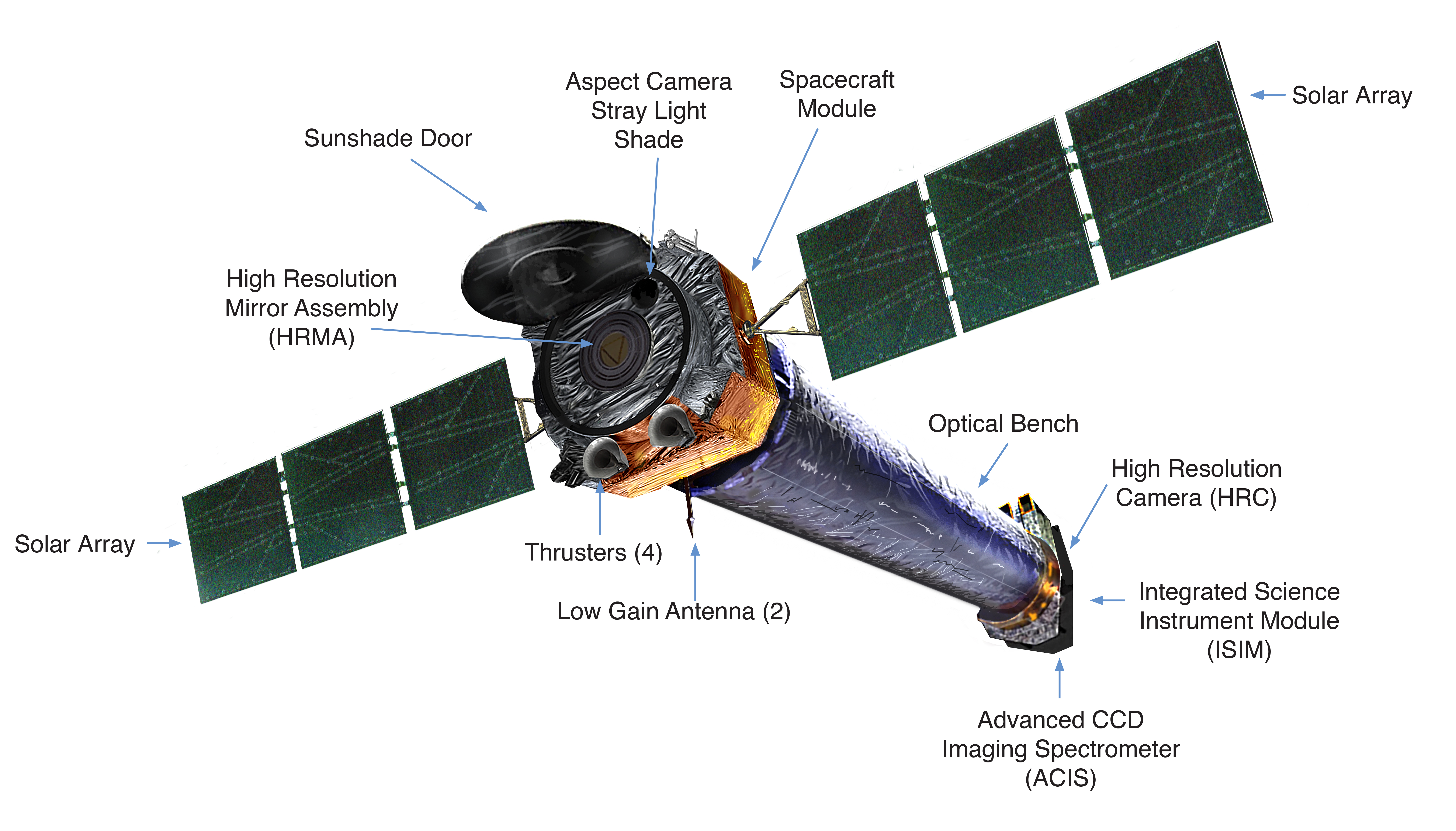
Sunshade Door
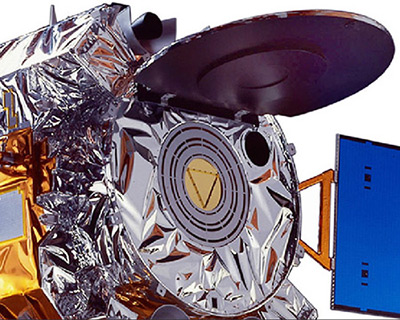
×Located at the front of the spacecraft where radiation enters the telescope, the sunshade door is one of the most basic and important elements of the spacecraft system. The sunshade door remained closed until Chandra achieved pointing control in orbit. Now that it is opened, it shadows the entrance of the telescope to allow it to point as close as 45 degrees to the Sun.
[ MORE INFORMATION ] (Opens in new window)
[ MORE INFORMATION ] (Opens in new window)
Thrusters
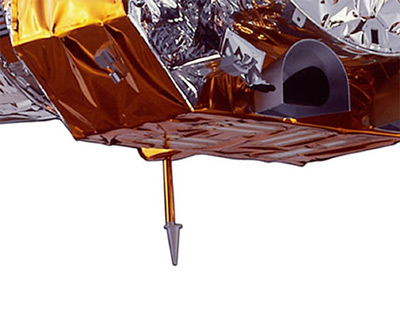
×Chandra has two different sets of thrusters, propulsion and momentum unloading. The propulsion thrusters were used immediately after launch to help propel Chandra into its final orbit, which is elliptical and very high in altitude, to provide maximum science observation efficiency. The momentum unloading thrusters are periodically used to apply toques to Chandra and, thereby, lower the accumulated momentum in its reaction wheels, which are used to control Chandra's attitude.
[ MORE INFORMATION ] (Opens in new window)
[ MORE INFORMATION ] (Opens in new window)

Low Gain Antenna
×Chandra has two low gain antennae, either one of which may be used for two-way communications with Chandra's Operation Control Center (OCC). All ground commands to and from Chandra along with telemetry data — sent through a set of three NASA ground stations constituting its Deep Space Network — are routed through on of these antennae.
[ MORE INFORMATION ] (Opens in new window)
[ MORE INFORMATION ] (Opens in new window)
Rollover the illustration to see the parts. Credit: NASA/CXC/SAO & J.Vaughan
Motion, Heat, and Energy
The spacecraft system provides the support structure and environment necessary for the telescope and the science instruments to work as an observatory.
Thrusters
In order to provide motion to the observatory, Chandra has two different sets of thrusters: one for propulsion and the other for momentum unloading. The propulsion thrusters were used immediately after launch to help propel Chandra into its final orbit, which is elliptical and very high in altitude. The momentum unloading thrusters are periodically used to apply torques to Chandra and, thereby, lower the accumulated momentum in its reaction wheels, which are used to control Chandra's altitude.
To control the temperatures of critical components, Chandra's thermal control system consists of a cooling radiator, insulators, heaters, and thermostats. It is particularly important that the temperature near the X-ray mirrors be well controlled to keep the mirror in focus. The temperature in many parts of the spacecraft is continually monitored and reported back to mission control.
There is no single operating temperature of Chandra, as there is a lot of variation. One of the coldest parts of the spacecraft is the Advanced CCD Imaging Spectrometer (ACIS) focal plane which is regulated at -120 C. It gets passively cooled by the ACIS radiator which faces straight out into cold space and is even colder than -120 C. The High Resolution Mirror Assembly (HRMA) is held at a very stable temperature and is a balmy 71 F to within about 1 degree F. Other parts of the spacecraft have wild temperature swings, for instance the Fine Sun Sensor (which is mounted on the sun-facing exterior of the spacecraft) goes from around 30 F to almost 200 F, sometimes in the space of a few hours!
Chandra's electrical power comes from its solar arrays. This energy is then stored in three banks of batteries and distributed in a carefully regulated manner to the Observatory by the electrical power system. The solar arrays generate approximately two kilowatts of power for the heaters, science instruments, computers, transmitters, etc.
Locking On and Staying Steady
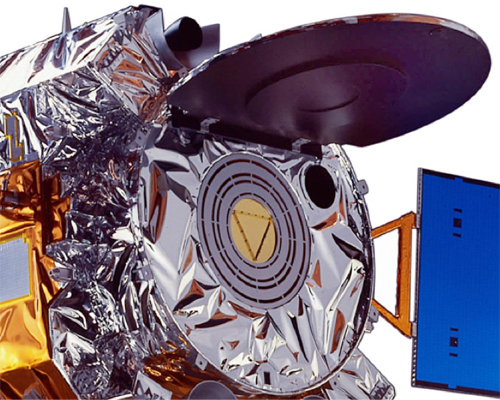
Sunshade Door
Aspect Camera
Located at the front of the spacecraft where radiation enters the telescope, the Sunshade door is one of the most basic and important elements of the spacecraft system. The Sunshade door remained closed until Chandra achieved pointing control in orbit. Now that it is opened, it shadows the entrance of the telescope to allow it to point as close as 45 degrees to the Sun.
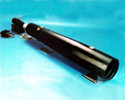
The pointing control and aspect of determination system has gyros, an aspect camera, Earth and Sun sensors, and reaction wheels to monitor and control to very high accuracy where the telescope is pointing at any given moment. It is as if you could locate the bulls-eye on a target one kilometer (0.6 miles) away to the precision of three millimeters — about the size of a pinhead. This system can also put the Observatory into various levels of inactive, quiet states known as "safe modes" of operation during emergencies.
Calling Home
Low Gain Antennae
The communications, control, and data management system is the nerve center of the Observatory. It keeps track of the position of the spacecraft in its orbit, monitors the spacecraft sensors, receives and processes commands from the ground for the operation of the Observatory, and stores and processes the data from the instrument so that it can be transmitted to the ground.
Chandra has two low gain antennae, either one of which may be used for two-way communications with Chandra's Operations Control Center (OCC). All ground commands to and from Chandra along with telemetry data — sent through a set of three NASA ground stations constituting its Deep Space Network — are routed through one of these antennae, typically about once every eight hours.
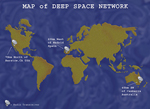
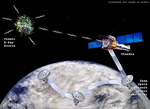
The data are transmitted from the Deep Space Network stations to the Jet Propulsion Laboratory and from there to the Operations Control Center at the Chandra X-ray Center (CXC) in Cambridge, MA. There the data are processed and made available to scientists, and eventually put in public archives.
Illustrations
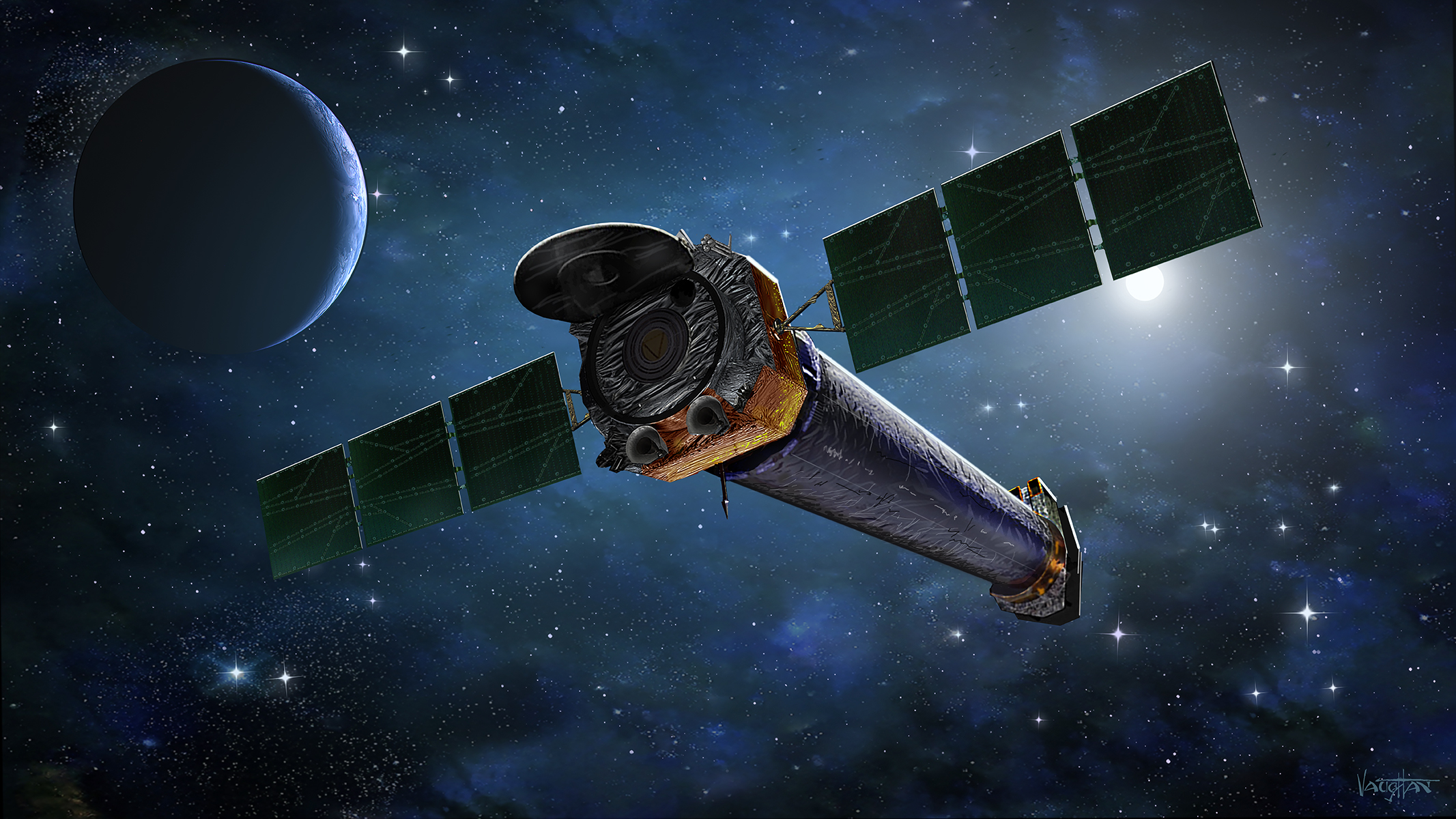

Illustration of Chandra in Space
Chandra in Space
Credit: NASA/CXC & J.Vaughan
Download:
JPEG (72 dpi)
JPEG (300 dpi)
PDF (300 dpi)
TIFF (300 dpi)
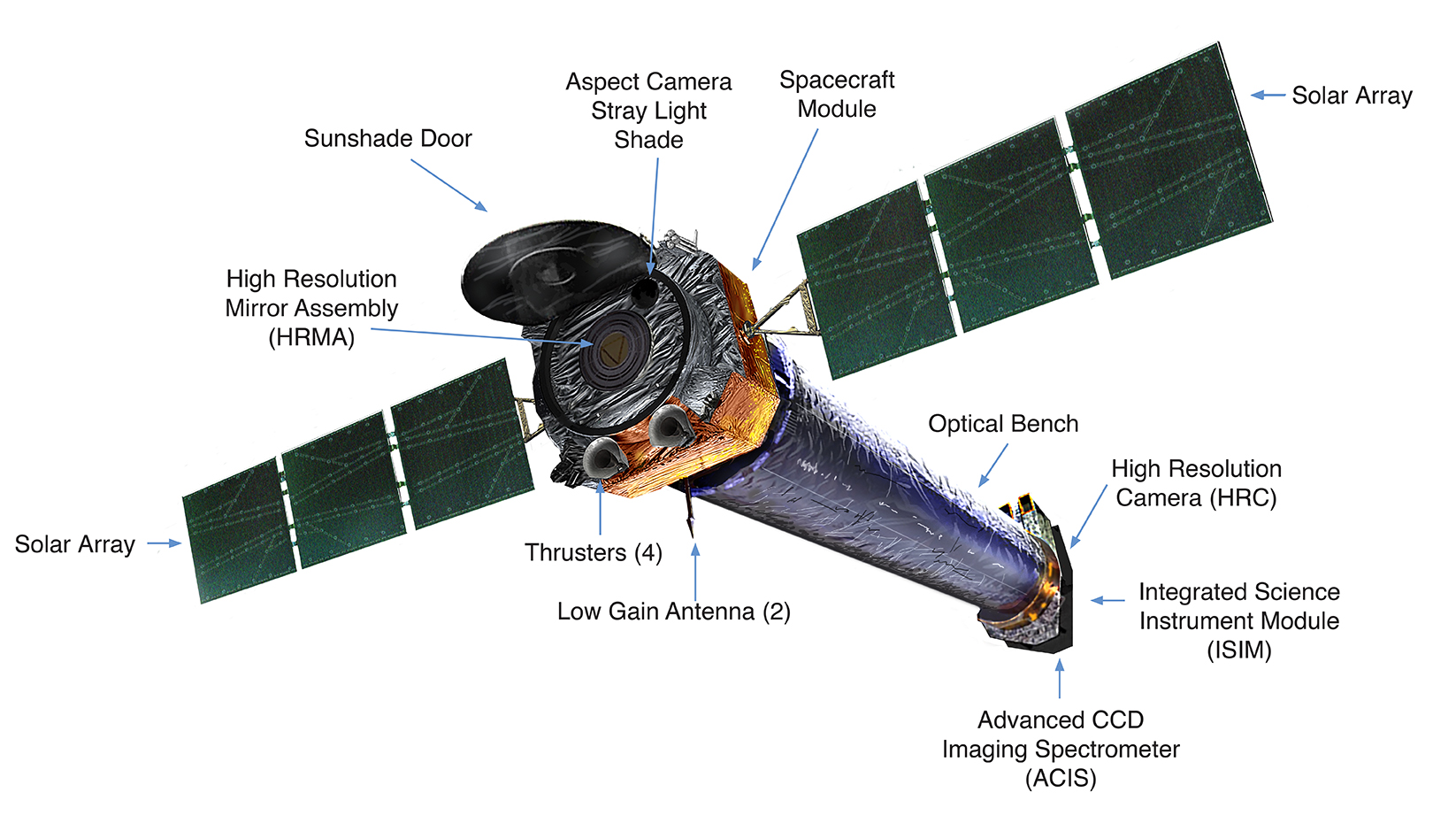
Illustration of Chandra Spacecraft Components
Chandra Chandra Spacecraft Components
Credit: NASA/CXC
Download:
JPEG (72 dpi)
JPEG (300 dpi)
PDF (300 dpi)
TIFF (300 dpi)


Revised: May 20, 2025