
Activity

A Universe of Touch and Sound
3D Print Kits: 5 Easy Activity Ideas
Bringing the Universe to Your Fingertips
The universe is often thought of as a visual masterpiece, but its true power lies in forces and kinds of light we cannot see—from gravity to X-rays, and from dark matter to dark energy. These simple activities use 3D-printed full or tactile plate models to help transform cosmic data into a physical experience. By engaging our sense of touch, we move beyond just looking to exploring the scale, texture, and distances to the stars and the hidden giants that anchor our galaxies.
Target Ages: ages 6 to Adult (Activities are easily scalable)
Facilitator Tips
"Slow Touch" Method: Encourage participants to close their eyes and move their fingers slowly across the plates. Fast touching misses the subtle "data" in the textures (like the difference between a gas cloud and a jet).
Scale Warning: Always remind participants that the models are not to scale with each other. A star is tiny compared to a galaxy, but we’ve made them similar sizes so we can feel them!
Language Inclusivity: Instead of saying "Look at this," try using tactile-inclusive language like "Explore the surface," "Find the highest point," or "Follow the ridge."
Material Prep: If doing the Galaxy Architect activity, use a "mess-free" tray (like a baking sheet or a large short cardboard box from soda cans) to keep sand or glitter contained. This activity helps participants understand the vast difference in scale between our local neighborhood and the edge of the observable universe.
Suggested Materials
Cosmic Yardstick
Blue painter's tape or 10ft of string, index cards for labels (Earth, Deep Space).
Galaxy Architects
Large paper, glue sticks, cotton balls (gas), glitter/sand (stars), pipe cleaners (jets).
Cosmic Detective
An opaque cloth bag or a small cardboard box with a hand-hole cut out.
Sound of Shadows
Smartphone (for QR codes), paper/pencils, or a flat table for tapping out "beats."
Scale Comparison
No extra materials—just the 3D Star kit and SMBH Plates.
1-Cosmic Yardstick (Distance & Location)
Have guests sort the objects by distance on a table or floor.
Goal: Ask participants to place the Black Hole tactile plates and the Mini Star kit along a taped or stringed line based on how far away they think they are.
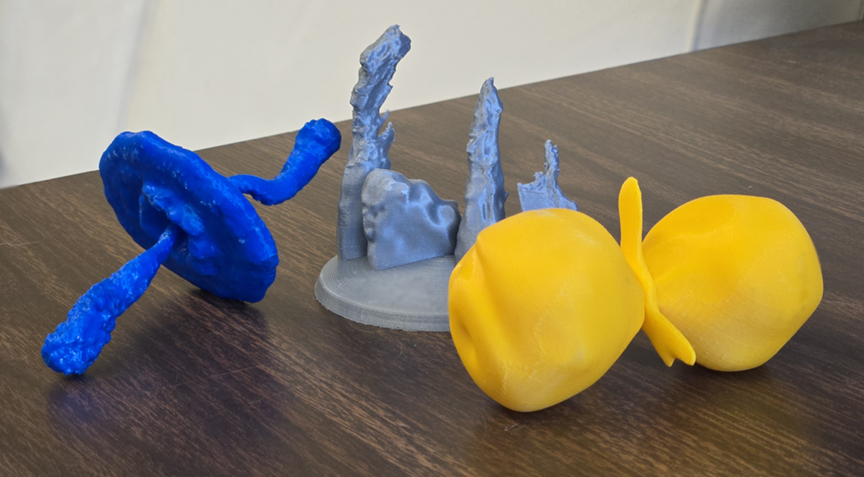
- Mini Star Kit only: Make an oval or spiral shaped area with tape or string that shows our
Milky Way and mark our home planet. Have participants guess where in our galaxy the 3
starry objects are located:
- Pillars of Creation (Eagle Nebula): Place this where stars are being born. (Location: Interior toward the Scutum-Centaurus arm).
- Eta Carinae: Place this where a star is struggling. It’s a massive star on the brink of exploding. (Location: The Carina Arm).
- Crab Nebula: Place this where a star has died. It is the "ghost" of a supernova. (Location: The Perseus Arm).
- Reflection: If the Milky Way is 100,000 light-years across, and these objects are only about 7,000 light-years away from us, can you see how much of the galaxy we haven't touched yet?
-
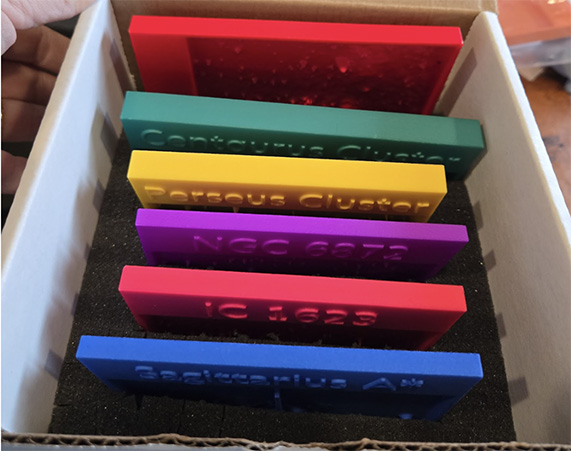
Black Hole Kit only: Lay out a long piece of string or tape on a table or floor. Label one
end "Home (Earth)" and the other "Deep Space” and have them sort, Eg:
- Sagittarius A*: at the center of our galaxy (26,000 light-years). 3. Centaurus A / NGC 6872: neighboring galaxies (millions of light-years). 4. UHZ1: the "Ancient" one (over 13 billion light-years away).
2-Galaxy Architects (Build-a-Galaxy)
Since the Supermassive Black Hole (SMBH) plates represent the "anchors" of galaxies, use them as the starting point for a craft project.
- Action: Place a plate (like NGC 6872 or Centaurus A) in the center of a large sheet of paper or a tray of sand.
- Goal: Have participants use craft materials to build the rest of the galaxy around it.
- Materials: Use cotton balls for "gas clouds," glitter or sand for "stars," and pipe cleaners for the "jets" (especially for Centaurus A).
- Discussion: Why is the black hole in the middle? Explain that it acts like a gravitational anchor, keeping the galaxy together.
3-Cosmic Detective (Exploring & Identifying)
An activity to encourage deep observation through touch.
- Action: Place all 6 SMBH plates and/or the Mini Star kit objects in a bag or under a cloth.
- Goal: A participant reaches in and feels one object. They describe the texture (e.g., "I feel a long thin line" or "I feel two things bumping together") and guess which object it is.
- "Clue" Connection:
- Centaurus A: "Find a dust lane (a deep textured line)."
- IC 1623: "Find twin centers."
- Eta Carinae: "Find a full dumbbell-like shape"
4-Sound of Shadows (Song/Storytelling)
Use the QR code audio files as a writing prompt for a creative session or to inspire a song.
- Action: Play the audio narration for a specific plate (e.g., the Perseus Cluster).
- Goal: Write a Cosmic Haiku or a 3-sentence story based on what they felt and heard.
- Example Prompt: "If this black hole had a voice, would it be a deep bass or a high whistle? Write one line describing the 'sound' of the texture you feel."
- Song: Create a rhythm or space beat using hands on the table that matches the texture—smooth parts are long slides, bumpy parts are quick taps.
- Bonus: Play a sonification of a black hole (of Perseus from https://chandra.si.edu/sound/) to compare and inspire
5-Scale Comparison: Star vs. Giant
This activity highlights the difference between a single star (Mini Star kit) and the Supermassive Black Hole kit.
- Action: Hold an object from the Mini Star kit in one hand and the Sgr A* plate in the other.
- Goal: Discuss the "Invisible Giant." Even though the object from the Mini Star kit (say Eta Carinae) is 3D and "fills the hand," the Black Hole on the plate represents something millions of times heavier but squeezed into a tiny space.
- Analogy: The Mini Star object is like a single person; the Supermassive Black Hole is like a whole city compressed into a single room.
For more information on the kits please visit
https://chandra.si.edu/tactile/ministar.html
https://chandra.si.edu/tactile/smbhkit.html


Chandra X-ray Center, Operated for NASA by the Smithsonian Astrophysical Observatory. This site was developed with funding from NASA under contract NAS8-03060 | Privacy | Accessibility
Additional support from NASA's Universe of Learning (UoL). UoL materials are based upon work supported by NASA under award number NNX16AC65A to the Space
Telescope Science Institute, working in partnership with Caltech/IPAC, Jet Propulsion Laboratory, Smithsonian Astrophysical Observatory.