
An overview of the Chandra mission and goals, Chandra's namesake, top 10 facts.
Classroom activities, printable materials, interactive games & more.
Overview of X-ray Astronomy and X-ray sources: black holes to galaxy clusters.
All Chandra images released to the public listed by date & by category
Current Chandra press releases, status reports, interviews & biographies.
A collection of multimedia, illustrations & animations, a glossary, FAQ & more.
A collection of illustrations, animations and video.
Chandra discoveries in an audio/video format.
Q&A: Chandra Mission

Q:
What is the aperture size, the resolution, and the reflector material of Chandra's mirrors?

A:
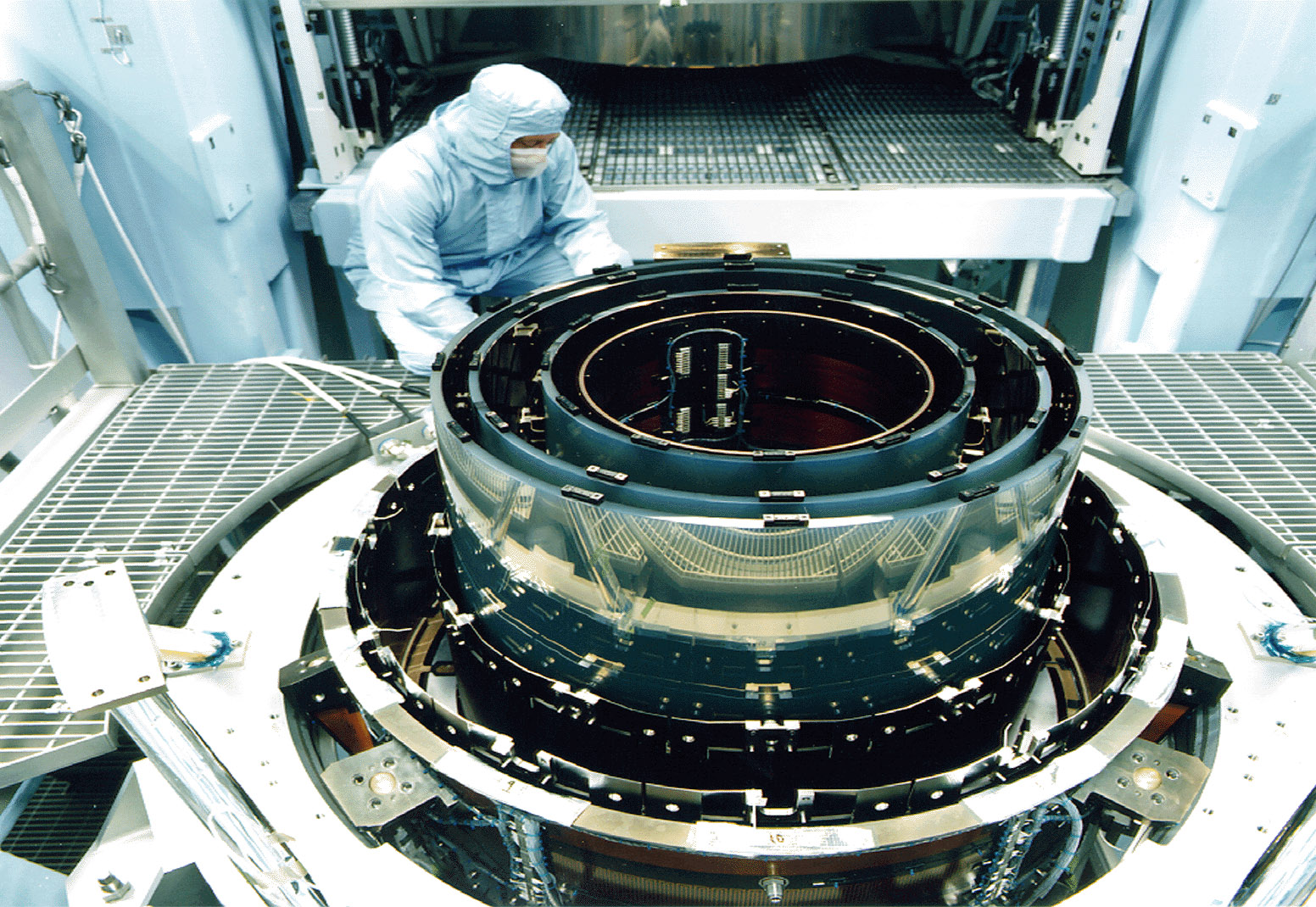
CHANDRA MIRRORS
Chandra mirrors use grazing incidence reflections to focus X-rays, so the mirrors are barrel-shaped rather than dish-shaped. Chandra's mirror assembly consists of a nested array of four mirror pairs (Two reflections are required to make an image). The largest mirror has an outer diameter of 4 feet (1.2 m). The effective area of the mirror assembly ranges from about 800 square cm at wavelengths longer than 6 Angstroms down to 40 square cm at the shortest wavelengths.

The resolution of the mirrors is one-half arc second.

The mirrors are coated with iridium.

Find out more about Chandra's specifications


Back | Index | Next