

August 23, 2004
NASA RELEASE: 04-09
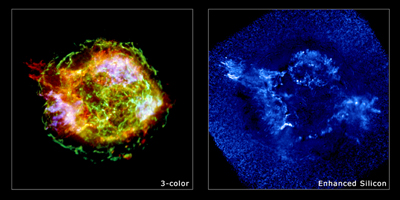
A spectacular new image of Cassiopeia A from NASA's Chandra X-ray Observatory released today has nearly 200 times more data than the "First Light" Chandra image of this object made five years ago. The new image reveals clues that the initial explosion caused by the collapse of a massive star was far more complicated than suspected.

"Although this young supernova remnant has been intensely studied for years, this deep observation is the most detailed ever made of the remains of an exploded star," said Martin Laming of the Naval Research Laboratory in Washington, D.C. Laming is part of a team of scientists led by Una Hwang of the Goddard Space Flight Center in Greenbelt, Maryland. "It is a gold mine of data that astronomers will be panning through for years to come."
The one-million-second (about 11.5-day) observation of Cassiopeia A uncovered two large, opposed jet-like structures that extend to about 10 light years from the center of the remnant. Clouds of iron that have remained nearly pure for the approximately 340 years since the explosion were also detected.
"The presence of the bipolar jets suggests that jets could be more common in relatively normal supernova explosions than supposed by astronomers," said Hwang. A paper by Hwang, Laming and others on the Cassiopeia A observation will appear in an upcoming issue of The Astrophysical Journal Letters.

X-ray spectra show that the jets are rich in silicon atoms and relatively poor in iron atoms. In contrast, fingers of almost pure iron gas extend in a direction nearly perpendicular to the jets. This iron was produced in the central, hottest regions of the star. The high silicon and low iron abundances in the jets indicate that massive, matter-dominated jets were not the immediate cause of the explosion, as these should have carried out large quantities of iron from the central regions of the star.
A working hypothesis is that the explosion produced high-speed jets similar to those in hypernovae that produce gamma-ray bursts, but in this case, with much lower energies. The explosion also left a faint neutron star at the center of the remnant. Unlike the rapidly rotating neutron stars in the Crab Nebula and Vela supernova remnants that are surrounded by dynamic magnetized clouds of electrons, this neutron star is quiet and faint. Nor has pulsed radiation been detected from it. It may have a very strong magnetic field generated during the explosion that helped to accelerate the jets, and today resembles other strong-field neutron stars (a.k.a. "magnetars") in lacking a wind nebula.

Chandra was launched aboard the Space Shuttle Columbia on July 23, 1999. Less than a month later, it was able to start taking science measurements along with its calibration data. The original Cassiopeia A observation was taken on August 19, 1999, and then released to the scientific community and the public one week later on August 26. At launch, Chandra's original mission was intended to be five years. Having successfully completed that objective, NASA announced last August that the mission would be extended for another five years.
The data for this new Cassiopeia A image were obtained by Chandra's Advanced Charged Coupled Device Imaging Spectrometer (ACIS) instrument during the first half of 2004. Due to its value to the astronomical community, this rich dataset was made available immediately to the public.
NASA's Marshall Space Flight Center, Huntsville, Ala., manages the Chandra program for NASA's Office of Space Science, Washington. Northrop Grumman of Redondo Beach, Calif., formerly TRW, Inc., was the prime development contractor for the observatory. The Smithsonian Astrophysical Observatory controls science and flight operations from the Chandra X-ray Center in Cambridge, Mass.
Additional information and images are available at:
MEDIA CONTACTS
Donald Savage
NASA Headquarters, Washington, DC
Phone: 202-358-1727
Steve Roy
Marshall Space Flight Center, Huntsville, AL
Phone: 256-544-6535
Megan Watzke
Chandra X-ray Observatory Center, CFA, Cambridge, MA
Phone: 617-496-7998
cxcpress@cfa.harvard.edu




Revised: March 27, 2008