

Location: Southern Hemisphere, low on the southern horizon in the Northern Hemisphere
Coordinates:
Right Ascension: 11h
Declination: -15º
Source: Greek mythology
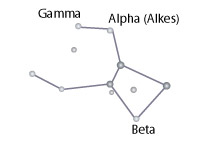
The story behind the name: The constellation Crater is in the same area of the sky as the constellations Hydra and Corvus. This constellation was not created so much because it looked like a cup, but because the stars that make it up were near the constellation Hydra. While Hydra is associated primarily with a very different story, the snake shape also reminded sky watchers of a fable about Apollo, written down by Ovid, which involved a crow, a watersnake and a cup. With one element of the story, the snake (Hydra), already in place, the two constellations, Corvus (crow) and Crater (cup) were created to represent the other two story elements.
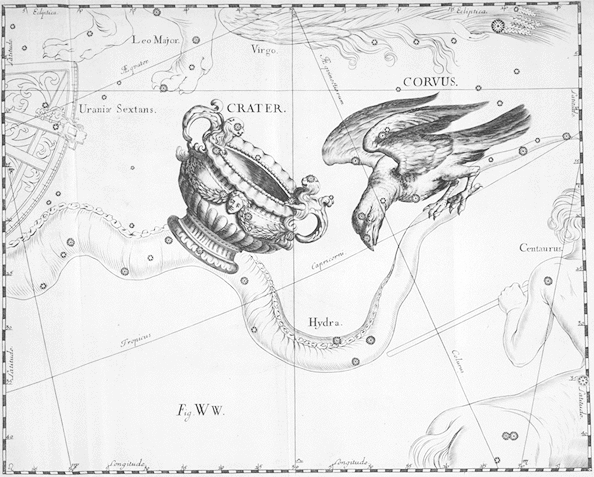
In ancient times, when stories were passed on by oral tradition, it was useful to have the main points of a fable hanging in the sky for all to see. In the story, Apollo needed water to prepare a libation. He sent the crow, who did odd jobs for him, to bring water back in a cup. The crow was not known for having a serious or respectful attitude. At the water source he found a tree of ripe figs and could not pass up feasting on them. He realized that he had kept Apollo waiting and that the god would be angry so he snatched up a water snake (not the infamous Hydra) and brought it back with him to blame for his delay. Apollo did not believe him and threw the crow, the snake, and the cup up into the sky. As a punishment, the crow is never able to reach the water in the cup. The cup is sometimes also associated with Ganymede, the cup bearer to the gods.
Introduction to Constellations | Constellation Sources | Constellations Index
Objects observed by Chandra in Crater: