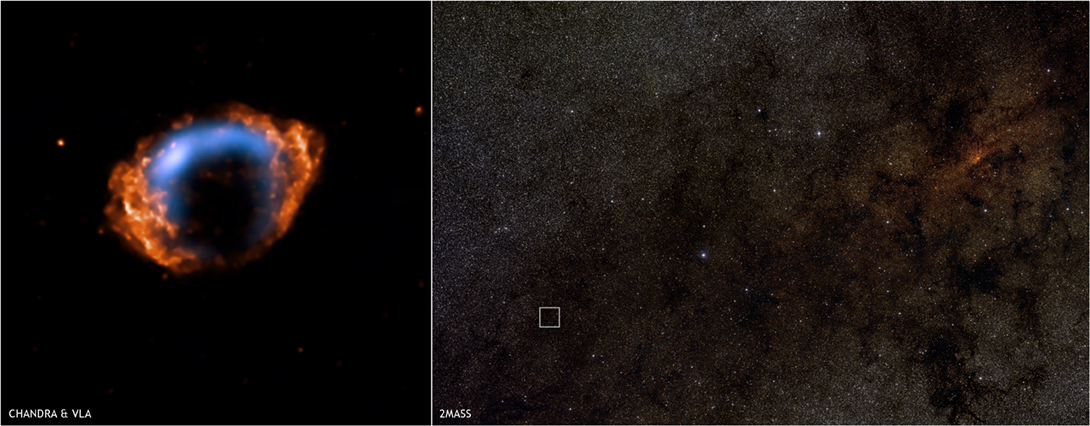
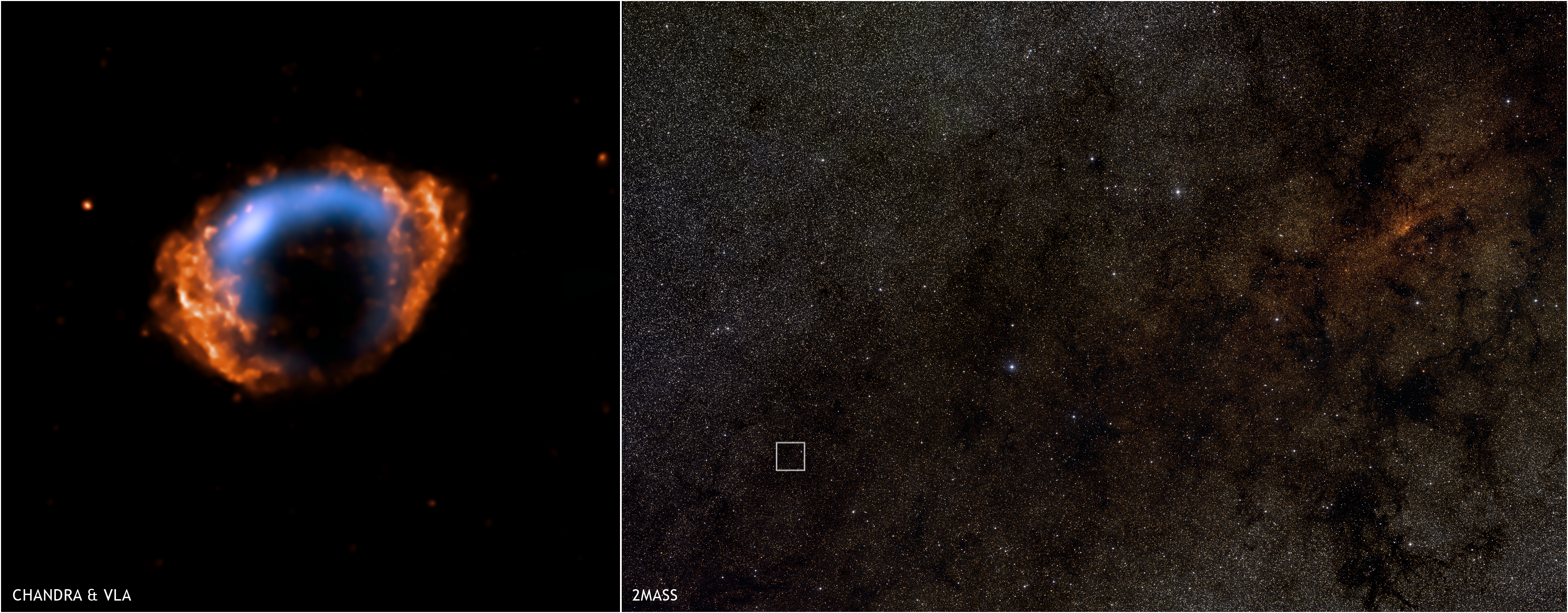
The expanding remains of a supernova explosion in the Milky Way are shown
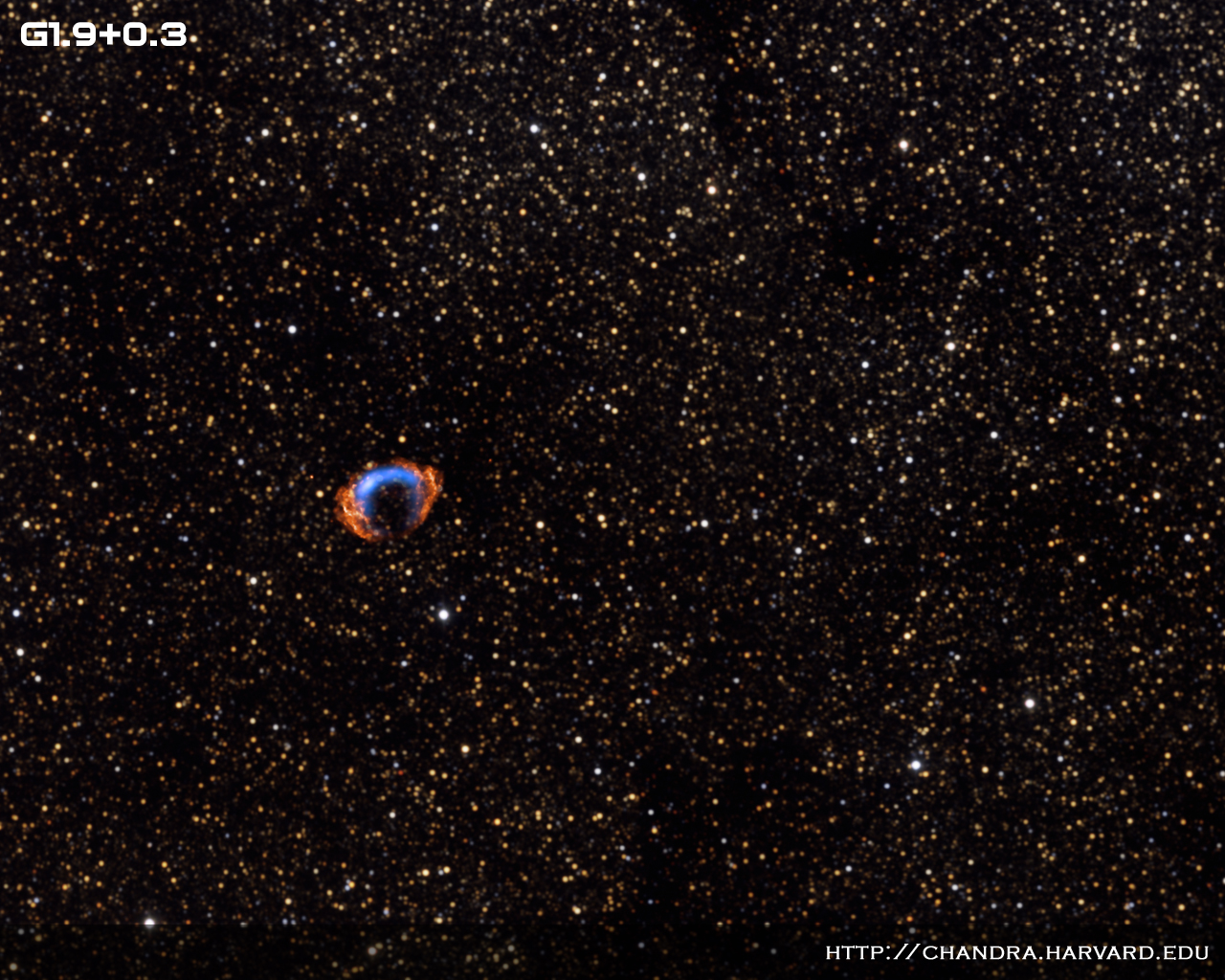
in this composite image, on the left, of the supernova remnant
G1.9+0.3. NASA's Chandra X-ray Observatory image obtained in early 2007 is
shown in orange and the radio image from NRAO's Very Large Array (VLA) from
1985 is in blue. The difference in size between the two images gives clear
evidence for expansion, allowing the time since the original supernova
explosion (about 140 years) to be estimated.
This makes the original explosion the most recent supernova in the Galaxy,
as measured in Earth's time-frame (referring to when events are observable
at Earth). Equivalently, this is the youngest known supernova remnant in
the Galaxy (140 years old), easily beating the previous record of about 330
years for Cassiopeia A. The rapid expansion and young age for G1.9+0.3 was
recently confirmed by a new VLA image obtained in early 2008.
The original supernova explosion was not seen in optical light about 140
years ago because it occurred close to the center of the Galaxy, and is
embedded in a dense field of gas and dust. This made the supernova about a
trillion times fainter, in optical light, than if it had been
unobscured. However, X-rays and radio waves from the resulting supernova
remnant easily penetrate this dust and gas.
On the right is an infrared image from the Two Micron All Sky survey
(2MASS), where the colors represent different infrared wavelengths. The
center of the galaxy is the bright red spot in the upper right and the
location of G1.9+0.3 is shown by the box in the lower left, less than two
degrees away (corresponding to about a thousand light years at the distance
of the galactic center). More stars are visible in this 2MASS image than in
an optical image, where obscuration by dust and gas is more
prominent. Also, note the difference in orientation: in the close-up view
of G1.9+0.3, north is up and east is to the left, while in the 2MASS image
north is to the left and east is down.
Supernova remnants are caused when the debris thrown outwards by the
explosion crashes into surrounding material, generating a shell of hot gas
and high-energy particles that glows brightly in X-rays, radio waves and
other wavelengths for thousands of years. In the case of G1.9+0.3 the
material is expanding outwards at almost 35 million miles per hour, or
about 5% the speed of light, an unprecedented expansion speed for a
supernova remnant. Another superlative for G1.9+0.3 is that it has
generated the most energetic electrons ever seen in a supernova remnant.
| Fast Facts for G1.9+0.3: |
| Credit |
X-ray (NASA/CXC/NCSU/S.Reynolds et al.); Radio (NSF/NRAO/VLA/Cambridge/D.Green et al.); Infrared (2MASS/UMass/IPAC-Caltech/NASA/NSF/CfA/E.Bressert) |
| Release Date |
May 14, 2008 |
| Scale |
Left panel is
5 arcmin across. |
| Category |
Supernovas & Supernova Remnants |
| Coordinates (J2000) |
RA 17h 48m 45s | Dec -27° 10´ 00" |
| Constellation |
Sagittarius |
| Observation Date |
2 pointings between 02/10/2007 & 03/03/2007
|
| Observation Time |
14 hours |
| Obs. ID |
6708, 8521
|
| Instrument |
ACIS
|
| References | Reynolds, S. et al. 2008, ApJ Letters (Accepted) |
| Color Code |
X-ray (orange); Radio (blue); Infrared (yellow/white stars) |
| Distance Estimate |
About 27,700 light years
|
|