

Download Image


More Information


Animation & Video

More Releases


Supernova 1987A:
Twenty Years Since a Spectacular Explosion

Credit: X-ray: NASA/CXC/PSU/S.Park & D.Burrows.; Optical: NASA/STScI/CfA/P.Challis


Twenty Years Since a Spectacular Explosion
Credit: X-ray: NASA/CXC/PSU/S.Park & D.Burrows.; Optical: NASA/STScI/CfA/P.Challis
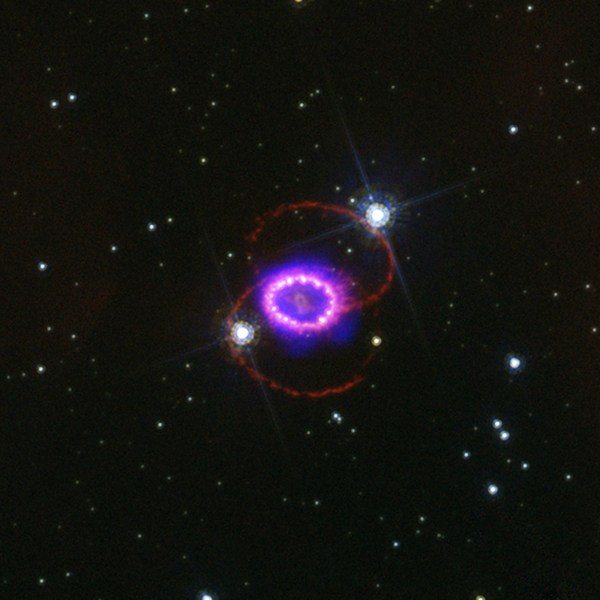
February 24, 2007 marks the 20th anniversary of one of the most spectacular events observed by astronomers in modern times, Supernova 1987A. The destruction of a massive star in the Large Magellanic Cloud, a nearby galaxy, spawned detailed observations by many different telescopes, including NASA's Chandra X-ray Observatory and Hubble Space Telescope. The outburst was visible to the naked eye, and is the brightest known supernova in almost 400 years.
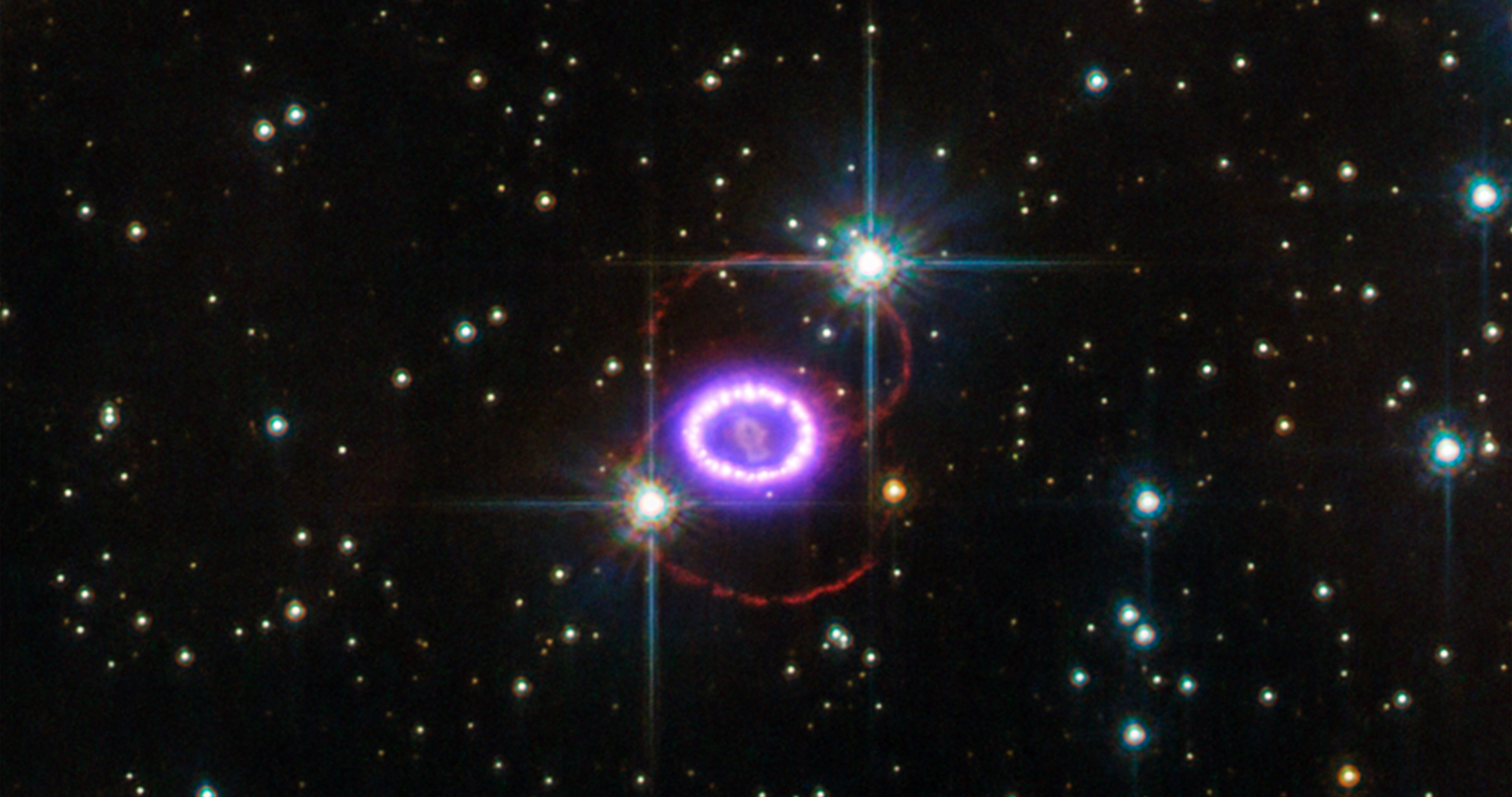
This composite image shows the effects of a powerful shock wave moving away from the explosion. Bright spots of X-ray and optical emission arise where the shock collides with structures in the surrounding gas. These structures were carved out by the wind from the destroyed star. Hot-spots in the Hubble image (pink-white) now encircle Supernova 1987A like a necklace of incandescent diamonds. The Chandra data (blue-purple) reveals multimillion-degree gas at the location of the optical hot-spots. These data give valuable insight into the behavior of the doomed star in the years before it exploded.
|
||||||||||||||||||||||||||||||



Revised: June 07, 2022