

Download Image


More Information


More Images

More Releases


Related Images


Andromeda Galaxy:
A New Look at a Close Neighbor
Credit: X-ray: NASA/CXC/MPE/W.Pietsch et al; Optical: NOAO/AURA/NSF/T.Rector & B.A.Wolpa


A New Look at a Close Neighbor
Credit: X-ray: NASA/CXC/MPE/W.Pietsch et al; Optical: NOAO/AURA/NSF/T.Rector & B.A.Wolpa
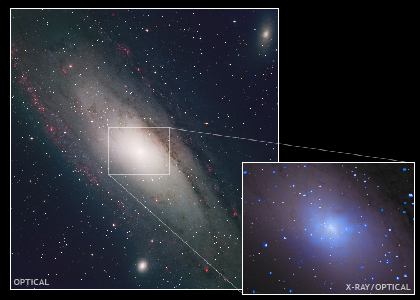
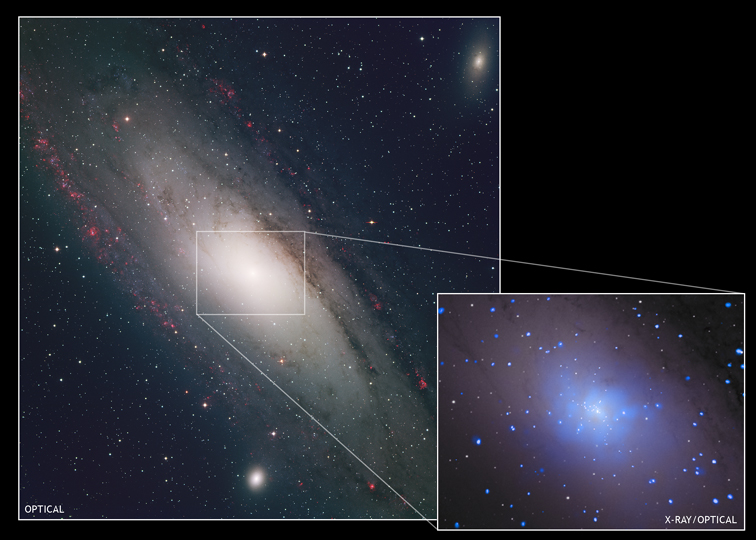
Andromeda, the nearest major galaxy to the Milky Way, is shown here in this wide-field optical image from Kitt Peak. The central region of Andromeda is shown in a composite image, with X-rays from NASA's Chandra X-ray Observatory (blue) combined with the optical image. Astronomers believe that Andromeda, also known as Andromeda Galaxy (M31), and the Milky Way will merge in a few billion years.
In the composite image, hot, X-ray bright gas is seen to envelop the central region of Andromeda. Point sources are also prominent, mostly from pairs of stars that are interacting with each other.
Many of these double stars are thought to include white dwarfs that are pulling large amounts of material away from a companion star. When the amount of gas being dumped onto the white dwarf gets too high a thermonuclear explosion occurs on the surface of the white dwarf, emitting bright X-rays.
By taking multiple observations of these so-called novae with Chandra and ESA's XMM-Newton observatories, a team of astronomers studied how long the burst of X-ray emission lasts. They found that several novae are bright in X-rays for surprisingly short periods of time, suggesting that the corresponding nova explosions were missed in earlier observations. Such short periods of bright X-ray emission, according to theoretical calculations, indicate that the white dwarfs have relatively high masses. This makes them good candidates for progenitors of Type Ia supernovas, where a white dwarf reaches a mass limit and undergoes a thermonuclear explosion and is completely destroyed. The high masses suggested by the short X-ray outbursts suggests that the white dwarfs do not have to gain very much mass before reaching their limit and being destroyed. A long-running goal in stellar astrophysics has been to identify the elusive stars that explode as Type Ia supernovas.
|
||||||||||||||||||||||||||||


Revised: June 07, 2022