




CXC Home | Search | Help | Image Use Policy | Latest Images | Privacy | Accessibility | Glossary | Q&A
Download Image
More Information
More Images
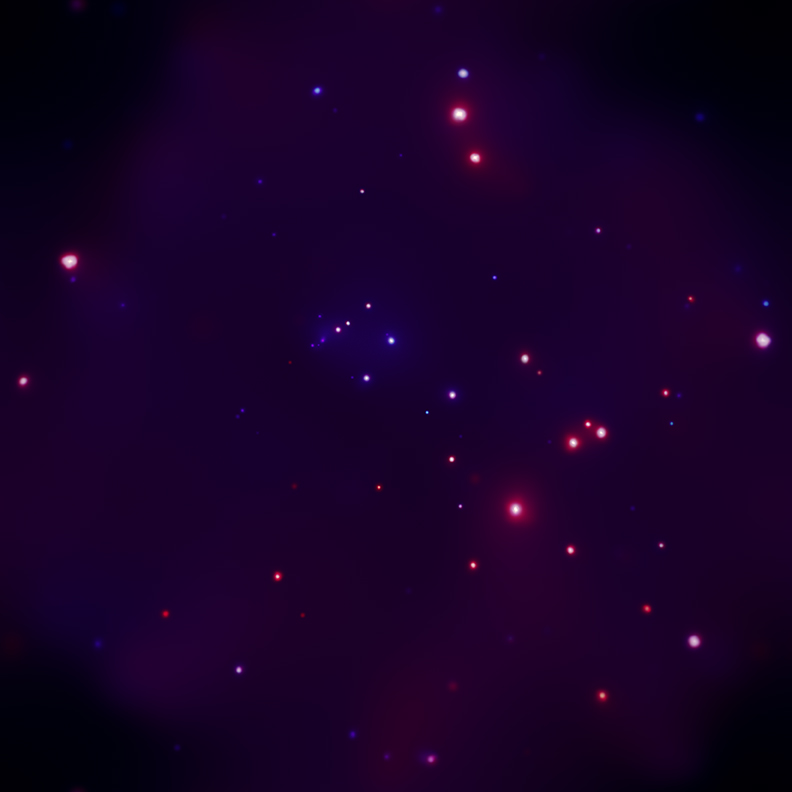
Chandra X-ray Image of
Coronet Cluster
Coronet Cluster
(Credit: Chandra: NASA/CXC/CfA/J. Forbrich)
Related Images
Coronet Cluster:
A Neighbor of Star Formation

Credit: X-ray: NASA/CXC/CfA/J.Forbrich et al.; Infrared: NASA/SSC/CfA/IRAC GTO Team

A Neighbor of Star Formation
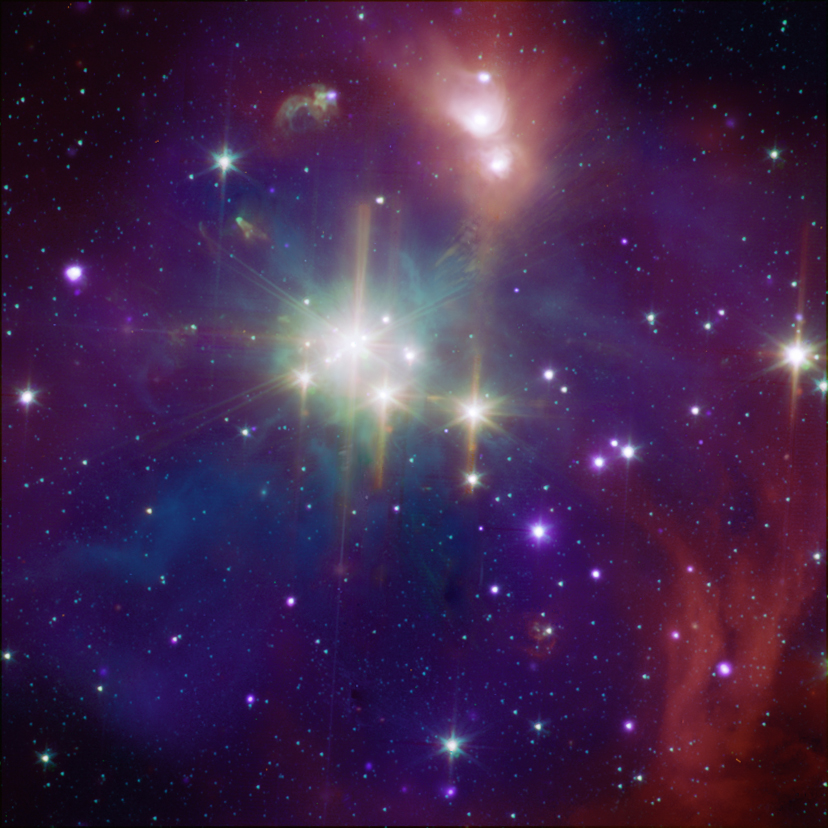
Credit: X-ray: NASA/CXC/CfA/J.Forbrich et al.; Infrared: NASA/SSC/CfA/IRAC GTO Team
Visual Description:
While perhaps not quite as well known as its star formation cousin of Orion, the Corona Australis region (containing, at its heart, the Coronet Cluster) is one of the nearest and most active regions of ongoing star formation. At only about 420 light years away, the Coronet is over three times closer than the Orion Nebula is to Earth. The Coronet contains a loose cluster of a few dozen young stars with a wide range of masses and at various stages of evolution, giving astronomers an opportunity to observe "protostars" simultaneously in several wavelengths.
This composite image shows the Coronet in X-rays from Chandra (purple) and infrared emission from Spitzer (orange, green, and cyan). The Spitzer image shows young stars plus diffuse emission from dust. In the Chandra data only (see inset), many of these young stars appear as blue objects, revealing their output of high-energy X-rays and the amount of obscuring dust and gas in the region. The reason for the blue appearance is that lower energy X-rays, which are depicted as red and green, are absorbed by this veil of material and hence are not seen. The Chandra data also support the idea that X-rays from very young stars are generated largely from magnetic activity in the outer atmospheres. Due to the host of young stars in different life stages in the Coronet, astronomers can use these data to pinpoint details of how the youngest stars evolve.
|
||||||||||||||||||||||||||
Visual Description:
The image is a composite of a star-forming region in space called the Coronet Cluster. The visual components of the image include sparkling celestial objects of stars, nebulae, and gas clouds. The center of image has a slightly hazy texture, appearing somewhat cloudy or smoky. The stars in the image are bright and shiny with some stars brighter than others, and varying degrees of luminosity. The colors in the image are predominantly pink-red and purple with a sprinkling of beige, blue and green towards the center. One of the most prominent features in the image is a bright spot near the center of the image with a patch of luminous stars. This composite image shows the Coronet in X-rays from Chandra (pink and purple) and infrared emission from Spitzer (red, green, and cyan). The Spitzer image shows young stars plus diffuse emission from dust. In the Chandra data, many of these young stars appear as blue objects, revealing their output of high-energy X-rays and the amount of obscuring dust and gas in the region. The reason for the blue appearance is that lower energy X-rays, which are depicted as red and green, are absorbed by this veil of material and hence are not seen.


Revised: September 03, 2025