

1
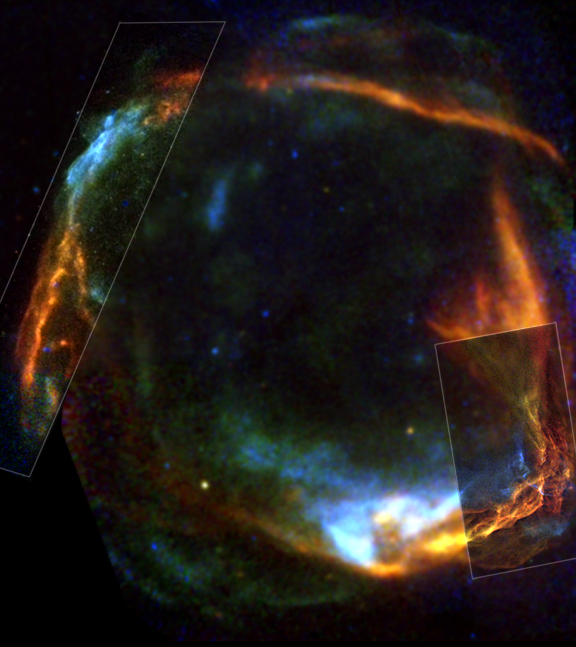

Chandra & XMM-Newton X-ray Images of RCW 86
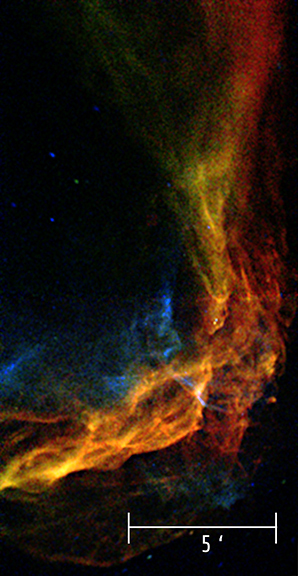
As reported in a single Chinese record, the supernova of 185 AD was visible for at least 8 months and reached a brightness comparable to Mars. Optical, radio, and X-ray emission observed at a location consistent with the Chinese record make RCW 86 the prime candidate for the remnant of SN 185 AD. Combined images from the Chandra (upper left and lower right boxes) and XMM-Newton X-ray observatories show low, medium and high-energy X-rays in red, green, and blue respectively. By studying the distribution of X-rays with energy, and measuring the remnant's size, scientists now surmise that RCW 86 was created by the explosion of a massive star roughly 2,000 years ago.
(Credit: Chandra: NASA/CXC/Univ. of Utrecht/J.Vink et al.; XMM-Newton: ESA/Univ. of Utrecht/J.Vink et al.)
As reported in a single Chinese record, the supernova of 185 AD was visible for at least 8 months and reached a brightness comparable to Mars. Optical, radio, and X-ray emission observed at a location consistent with the Chinese record make RCW 86 the prime candidate for the remnant of SN 185 AD. Combined images from the Chandra (upper left and lower right boxes) and XMM-Newton X-ray observatories show low, medium and high-energy X-rays in red, green, and blue respectively. By studying the distribution of X-rays with energy, and measuring the remnant's size, scientists now surmise that RCW 86 was created by the explosion of a massive star roughly 2,000 years ago.
(Credit: Chandra: NASA/CXC/Univ. of Utrecht/J.Vink et al.; XMM-Newton: ESA/Univ. of Utrecht/J.Vink et al.)
2
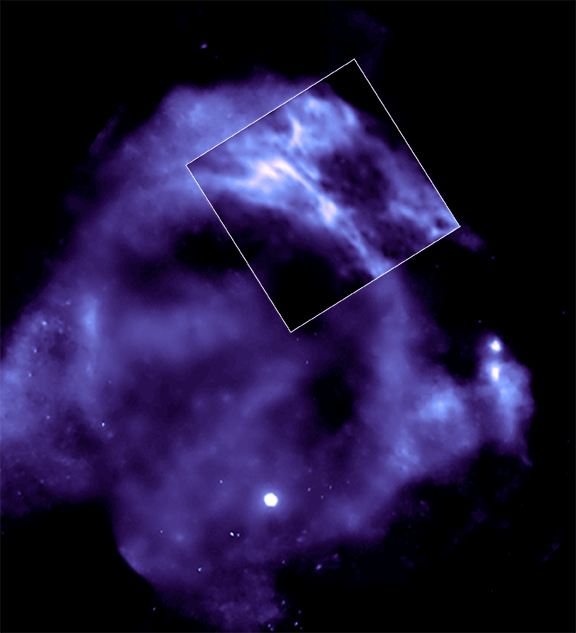

Chandra & XMM-Newton X-ray Images of G347.3-0.5
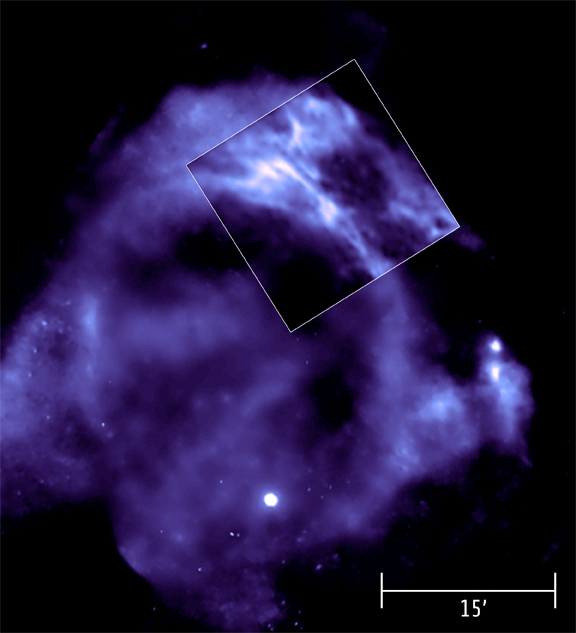
The supernova of 393 AD was recorded by the Chinese and was visible for about 8 months, reaching the brightness of Jupiter. There are several supernova remnants within this region, so it is difficult to identify the remnant of SN 393 AD with certainty. X-rays from G347.3-0.5 are dominated by radiation from extremely high-energy electrons in a magnetized shell rather than radiation from a hot gas. The remnant, seen by Chandra (inset box) and XMM-Newton, is also a source of very high-energy gamma rays. The bright, point-like source on the lower right in the image (which shows only the upper portion of the entire remnant) is similar to other known neutron stars and indicates that G347.3-0.5 is the remnant of a core-collapse supernova.
(Credit: Chandra: NASA/CXC/SAO/P.Slane et al.; XMM-Newton:ESA/RIKEN/J.Hiraga et al.)
The supernova of 393 AD was recorded by the Chinese and was visible for about 8 months, reaching the brightness of Jupiter. There are several supernova remnants within this region, so it is difficult to identify the remnant of SN 393 AD with certainty. X-rays from G347.3-0.5 are dominated by radiation from extremely high-energy electrons in a magnetized shell rather than radiation from a hot gas. The remnant, seen by Chandra (inset box) and XMM-Newton, is also a source of very high-energy gamma rays. The bright, point-like source on the lower right in the image (which shows only the upper portion of the entire remnant) is similar to other known neutron stars and indicates that G347.3-0.5 is the remnant of a core-collapse supernova.
(Credit: Chandra: NASA/CXC/SAO/P.Slane et al.; XMM-Newton:ESA/RIKEN/J.Hiraga et al.)
Return to G347.3-0.5 and RCW 86 (08 Aug 07)




Revised: June 07, 2022