Chandra X-ray Observatory - HomeAbout The ChandraEducational MaterialsField GuidePhoto AlbumPress RoomResources
Chandra X-ray Observatory - HomeChandra Photo Album - You are here
ObservatoryImages by DateImages by CategorySky MapConstellationsSpecial FeaturesChandra Zoom-insImage HandoutsScale Bar ImagesTutorial Chandra Images & False Color Note on Cosmic DistanceCosmic Look Back TimeScale & DistanceScale & Angular MeasurementImage Use
Web Site ToolsVisit the Chandra ChroniclesEmail NewsletterSite MapNew & NoteworthyImage Use PolicyQuestions & AnswersGlossaryDownload Guide

W3 Main: A Productive Star Formation Factory
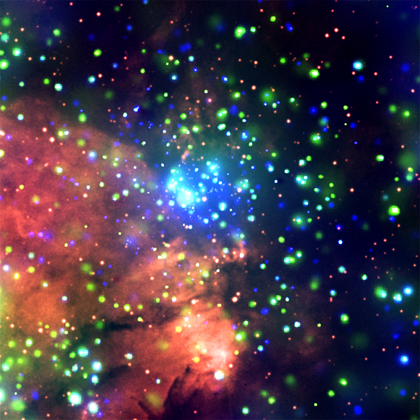
W3 Main
Credit: X-ray: NASA/CXC/Penn State/L.Townsley et al.; Optical: Pal Obs. DSS

JPEG (368.9 kb) Tiff (16.1 MB) PS (2.8 MB)
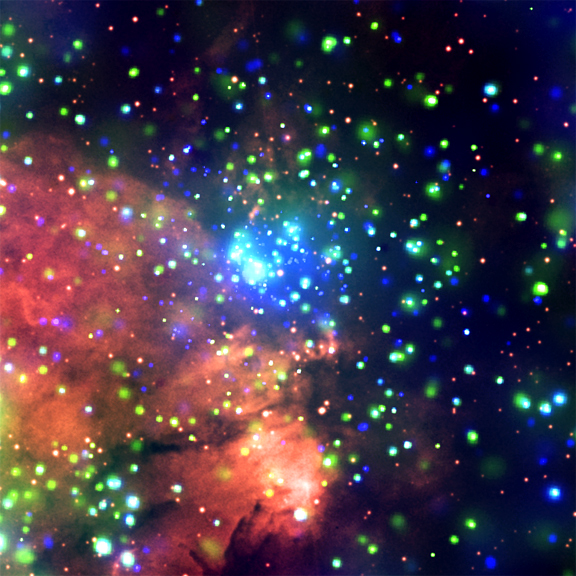
W3 is a region where many massive stars are forming in a string of stellar clusters, located about 6,000 light years from Earth in the Perseus arm of the Milky Way galaxy. W3 is part of a vast molecular cloud complex that also contains the W4 superbubble (not seen in this image). Scientists believe that the extraordinary amount of star formation in W3 has possibly been influenced by neighboring W4, an inflating bubble of gas over 100 light years across. W4 may directly trigger the birth of W3's massive stellar clusters as it expands and sweeps up molecular gas into a high-density layer at its edge, within which stars can form. Another possible scenario is that W4's expansion has caused a domino effect of star formation, forming the cluster IC 1795 (seen as a clump of X-ray sources in the bottom left corner of this image) which in turn triggered formation of the young, massive clusters in W3.

Illustration of the Milky Way's Arms
In this composite image of one of the many star-forming complexes of W3, called W3 Main, green and blue represent lower and higher-energy X-rays, respectively, while red shows optical emission. Hundreds of X-ray sources are revealed in this central region of W3 Main. These bright point-like objects are an extensive population of several hundred young stars, many of which were not found in earlier infrared studies. These Chandra data show that W3 Main is the dominant star formation region of W3. Because its X-ray sources are all at the same distance, yet span a range of masses, ages, and other properties, W3 is an ideal laboratory for understanding recent and ongoing star formation in one of the Milky Way's spiral arms.

Fast Facts for W3 Main:
Credit  X-ray: NASA/CXC/Penn State/L.Townsley et al.; Optical: Pal Obs. DSS
Scale  Image is 14 arcmin across
Category  Normal Stars & Star Clusters
Coordinates (J2000)  RA 02h 25m 40.60s | Dec +62º 05' 52.40"
Constellation  Cassiopeia
Observation Dates  23 Mar 00, 03 Apr 00, 04 Jan 05
Observation Time  22 hours
Obs. IDs  611, 446, 5890
Color Code  Energy (X-ray: Blue & Green; Optical: Red;)
Instrument  ACIS
Distance Estimate  About 6,000 light years
Release Date  December 18, 2006

More Information on W3 Main:
More Images of W3 Main
W3 Main Handout: html | pdf
Zoom in on W3 Main (flash)
Powerpoint and PDF
Download image for your desktop
W3 Main Holiday Card
Related Chandra Images:
Photo Album: NGC 3576 (26 Sep 06)
Photo Album: Trumpler 14 (31 Aug 05)
Photo Album: M17 (14 Aug 03)
Photo Album: The Tarantula Nebula (30 Doradus) (23 Apr 02)
More Information on Normal Stars & Star Clusters:
X-ray Astronomy Field Guide: Normal Stars & Star Clusters
Questions and Answers: Normal Stars & Star Clusters
Chandra Images: Normal Stars & Star Clusters


Chandra Images: '08 | ' 07 | ' 06 | ' 05 | ' 04 | ' 03 | ' 02 | ' 01 | ' 00 | ' 99 | Images by Category


separator line
CXC Home | Search | Help | Site Map | Image Use Policy | Privacy & Accessibility | Downloads & Plugins
Latest Images | New & Noteworthy | Multimedia | Flash Ecards | Glossary | Q&A | Guestbook


RSS Feed RSS Feed | Podcast Podcast | Blog Blog

[News by email: Chandra Digest]
[Contact us: cxcpub@cfa.harvard.edu]
NASA's Home Page Smithsonian's Home Page CXC Home Page Image Map for NASA's, Smithsonian and Chandra's Home Pages
Harvard-Smithsonian Center for Astrophysics
60 Garden Street, Cambridge, MA 02138 USA
Phone: 617.496.7941 Fax: 617.495.7356


Text Size:
normal font large font larger font
Chandra X-ray Center, Operated for NASA by the Smithsonian Astrophysical Observatory
This site was developed with funding from NASA under Contract NAS8-03060.
Revised: November 19, 2007