Chandra X-ray Observatory - HomeAbout The ChandraEducational MaterialsField GuidePhoto AlbumPress RoomResources
Chandra X-ray Observatory - HomeChandra Photo Album - You are here
ObservatoryImages by DateImages by CategorySky MapConstellationsSpecial FeaturesChandra Zoom-insImage HandoutsScale Bar ImagesTutorial Chandra Images & False Color Note on Cosmic DistanceCosmic Look Back TimeScale & DistanceScale & Angular MeasurementImage Use
Web Site ToolsVisit the Chandra ChroniclesEmail NewsletterSite MapNew & NoteworthyImage Use PolicyQuestions & AnswersGlossaryDownload Guide

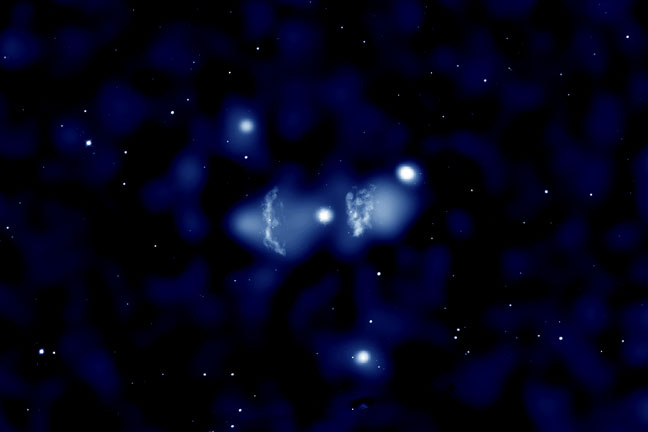
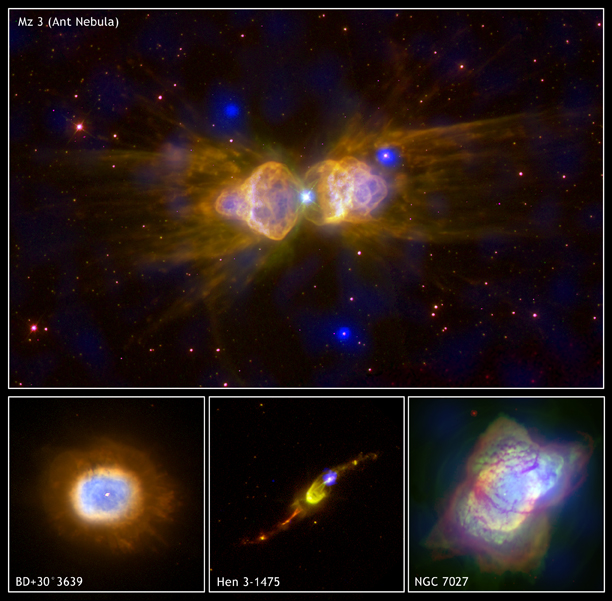
Mz 3, BD+30-3639, Hen 3-1475, and NGC 7027:
Planetary Nebulas - Fast Winds from Dying Stars

Mz 3
Credit: Credit: X-ray: NASA/CXC/RIT/J.Kastner et al.; Optical/IR: BD +30 & Hen 3: NASA/STScI/Univ. MD/J.P.Harrington; NGC 7027: NASA/STScI/Caltech/J.Westphal & W.Latter; Mz 3: NASA/STScI/Univ. Washington/B.Balick

JPEG (325.6 kb) Tiff (18.2 MB) PS (2.8 MB)

This panel of composite images shows part of the unfolding drama of the last stages of the evolution of sun-like stars. Dynamic elongated clouds envelop bubbles of multimillion degree gas produced by high-velocity winds from dying stars. In these images, Chandra's X-ray data are shown in blue, while green and red are optical and infrared data from Hubble.

Planetary nebulas - so called because some of them resemble a planet when viewed through a small telescope - are produced in the late stages of a sun-like star's life. After several billion years of stable existence (the sun is 4.5 billion years old and will not enter this phase for about 5 billion more years) a normal star will expand enormously to become a bloated red giant. Over a period of a few hundred thousand years, much of the star's mass is expelled at a relatively slow speed of about 50,000 miles per hour.

Chandra & HST Images of NGC 7027
This mass loss creates a more or less spherical cloud around the star and eventually uncovers the star's blazing hot core. Intense ultraviolet radiation from the core heats the circumstellar gas to ten thousand degrees, and the velocity of the gas flowing away from the star jumps to about a million miles per hour.

This high speed wind appears to be concentrated into opposing supersonic funnels, and produces the elongated shapes in the early development of planetary nebulas (BD+30-3639 appears spherical, but other observations indicate that it is viewed along the pole.) Shock waves generated by the collision of the high-speed gas with the surrounding cloud create the hot bubbles observed by Chandra. The origin of the funnel-shaped winds is not understood. It may be related to strong, twisted magnetic fields near the hot stellar core.

Fast Facts for Mz 3:
Credit  Credit: X-ray: NASA/CXC/RIT/J.Kastner et al.; Optical/IR: BD +30 & Hen 3: NASA/STScI/Univ. MD/J.P.Harrington; NGC 7027: NASA/STScI/Caltech/J.Westphal & W.Latter; Mz 3: NASA/STScI/Univ. Washington/B.Balick
Scale  Image is 110 x 75 arcsec
Category  White Dwarfs & Planetary Nebulas
Coordinates (J2000)  RA 16h 17m 12.60s | Dec -51º 59' 08.00"
Constellation  Norma
Observation Dates  April 1, 2004
Observation Time  11 hours
Obs. ID  4954
Color Code  Energy (X-ray: Blue; Optical/IR: Red & Green)
Instrument  ACIS
Also Known As Menzel 3, Ant Nebula
References J. Kastner et al. 2003, Astrophys. J. 591, L 37
Distance Estimate  About 3,000 light years
Release Date  May 10, 2006

More Information on Mz 3:
More Images of Mz 3
Mz 3 Handout: html | pdf
Zoom in on Mz 3 (flash)
Mz 3 Animations
Powerpoint and PDF
Download image for your desktop
Print Gallery image of Mz 3
View Mz 3 in Context (Google Sky)
Related Chandra Images:
Photo Album: NGC 7027 (13 Jun 01)
Photo Album: NGC 6543 (Cat's Eye Nebula) (08 Jan 01)
Photo Album: Planetary Nebula BD+30 3639 (06 Jun 00)
Related Sites:
Hubble: Mz 3
Hubble: NGC 7027
More Information on White Dwarfs & Planetary Nebulas :
X-ray Astronomy Field Guide: White Dwarfs & Planetary Nebulas
Questions and Answers: Normal Stars, White Dwarf Stars, Star Clusters and Binary Stars
Chandra Images: White Dwarfs & Planetary Nebulas


Chandra Images: '08 | ' 07 | ' 06 | ' 05 | ' 04 | ' 03 | ' 02 | ' 01 | ' 00 | ' 99 | Images by Category


separator line
CXC Home | Search | Help | Site Map | Image Use Policy | Privacy & Accessibility | Downloads & Plugins
Latest Images | New & Noteworthy | Multimedia | Flash Ecards | Glossary | Q&A | Guestbook


RSS Feed RSS Feed | Podcast Podcast | Blog Blog

[News by email: Chandra Digest]
[Contact us: cxcpub@cfa.harvard.edu]
NASA's Home Page Smithsonian's Home Page CXC Home Page Image Map for NASA's, Smithsonian and Chandra's Home Pages
Harvard-Smithsonian Center for Astrophysics
60 Garden Street, Cambridge, MA 02138 USA
Phone: 617.496.7941 Fax: 617.495.7356


Text Size:
normal font large font larger font
Chandra X-ray Center, Operated for NASA by the Smithsonian Astrophysical Observatory
This site was developed with funding from NASA under Contract NAS8-03060.
Revised: April 25, 2008