Chandra X-ray Observatory - HomeAbout The ChandraEducational MaterialsField GuidePhoto AlbumPress RoomResources
Chandra X-ray Observatory - HomeChandra Photo Album - You are here
ObservatoryImages by DateImages by CategorySky MapConstellationsSpecial FeaturesChandra Zoom-insImage HandoutsScale Bar ImagesTutorial Chandra Images & False Color Note on Cosmic DistanceCosmic Look Back TimeScale & DistanceScale & Angular MeasurementImage Use
Web Site ToolsVisit the Chandra ChroniclesEmail NewsletterSite MapNew & NoteworthyImage Use PolicyQuestions & AnswersGlossaryDownload Guide

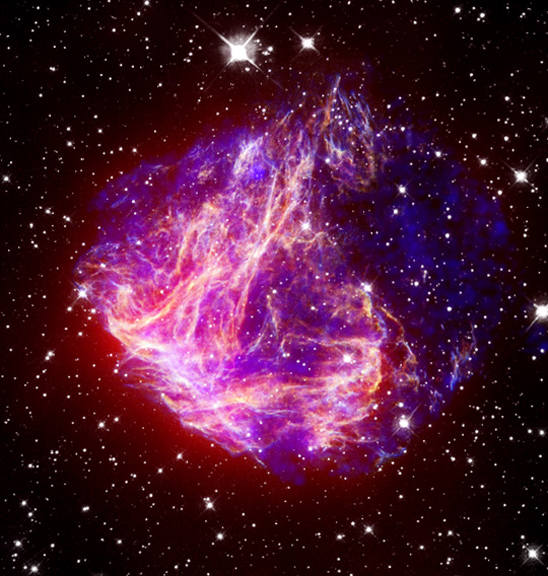
N49: Stellar Debris in the Large Magellanic Cloud
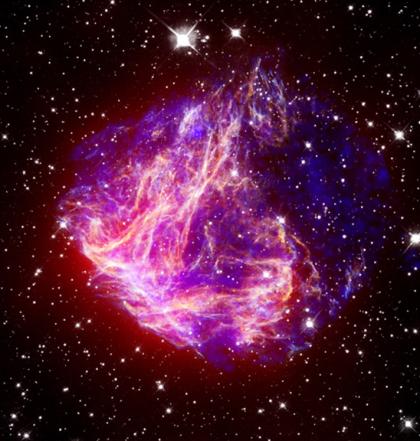
N49
Credit: X-ray: NASA/CXC/Caltech/S.Kulkarni et al.; Optical: NASA/STScI/UIUC/Y.H.Chu & R.Williams et al.; IR: NASA/JPL-Caltech/R.Gehrz et al.

JPEG (358.4 kb) Tiff (15.8 MB) PS (2.8 MB)
This is a composite image of N49, the brightest supernova remnant in optical light in the Large Magellanic Cloud. The Chandra X-ray image (blue) shows million-degree gas in the center. Much cooler gas at the outer parts of the remnant is seen in the infrared image from Spitzer (red). While astronomers expected that dust particles were generating most of the infrared emission, the study of this object indicates that much of the infrared is instead generated in heated gas.

The unique filamentary structure seen in the optical image by Hubble (white & yellow) has long set N49 apart from other well understood supernova remnants, as most supernova remnants appear roughly circular in visible light. Recent mapping of molecular clouds suggests that this supernova remnant is expanding into a denser region to the southeast, which would cause its asymmetrical appearance. This idea is confirmed by the Chandra data. Although X-rays reveal a round shell of emission, the X-rays also show brightening in the southeast, confirming the idea of colliding material in that area.

Fast Facts for N49:
Credit  X-ray: NASA/CXC/Caltech/S.Kulkarni et al.; Optical: NASA/STScI/UIUC/Y.H.Chu & R.Williams et al.; IR: NASA/JPL-Caltech/R.Gehrz et al.
Scale  Image is 1.7 by 1.8 arcmin
Category  Supernovas & Supernova Remnants
Coordinates (J2000)  RA 05h 25m 25.00s | Dec -65º 59' 22.00"
Constellation  Dorado
Observation Dates  01 Sep 01, 15 Sep 01
Observation Time  12 hours
Obs. IDs  1041, 2515
Color Code  Energy (X-ray: Blue; Infrared: Red; Optical: Yellow-white)
Instrument  ACIS
References Supernova Remnants in the Magellanic Clouds X: Multiwavelength Analysis of the Physical Structure of N49 Bilikova, J., Chu, Y.-H., Gruendl, R., Lundgren, B., & Williams, R. To be submitted to the Astronomical Journal.
Distance Estimate  About 160,000 light years (distance to Large Magellanic Cloud)
Release Date  November 29, 2006

More Information on N49:
More Images of N49
N49 Handout: html | pdf
Zoom in on N49 (flash)
Powerpoint and PDF
Download image for your desktop
View N49 in Context (Google Sky)
Related Chandra Images:
Photo Album: SNR 0540-69.3 (20 Apr 04)
Photo Album: SNR 0103-72.6 (26 May 03)
Photo Album: N132D (22 May 02)
More Information on Supernovas & Supernova Remnants :
X-ray Astronomy Field Guide: Supernovas & Supernova Remnants
Questions and Answers: Supernovas & Supernova Remnants
Chandra Images: Supernovas & Supernova Remnants
Supernova Remnants Podcast


Chandra Images: '08 | ' 07 | ' 06 | ' 05 | ' 04 | ' 03 | ' 02 | ' 01 | ' 00 | ' 99 | Images by Category


separator line
CXC Home | Search | Help | Site Map | Image Use Policy | Privacy & Accessibility | Downloads & Plugins
Latest Images | New & Noteworthy | Multimedia | Flash Ecards | Glossary | Q&A | Guestbook


RSS Feed RSS Feed | Podcast Podcast | Blog Blog

[News by email: Chandra Digest]
[Contact us: cxcpub@cfa.harvard.edu]
NASA's Home Page Smithsonian's Home Page CXC Home Page Image Map for NASA's, Smithsonian and Chandra's Home Pages
Harvard-Smithsonian Center for Astrophysics
60 Garden Street, Cambridge, MA 02138 USA
Phone: 617.496.7941 Fax: 617.495.7356


Text Size:
normal font large font larger font
Chandra X-ray Center, Operated for NASA by the Smithsonian Astrophysical Observatory
This site was developed with funding from NASA under Contract NAS8-03060.
Revised: April 25, 2008