Chandra X-ray Observatory - HomeAbout The ChandraEducational MaterialsField GuidePhoto AlbumPress RoomResources
Chandra X-ray Observatory - HomeChandra Photo Album - You are here
ObservatoryImages by DateImages by CategorySky MapConstellationsSpecial FeaturesChandra Zoom-insImage HandoutsScale Bar ImagesTutorial Chandra Images & False Color Note on Cosmic DistanceCosmic Look Back TimeScale & DistanceScale & Angular MeasurementImage Use
Web Site ToolsVisit the Chandra ChroniclesEmail NewsletterSite MapNew & NoteworthyImage Use PolicyQuestions & AnswersGlossaryDownload Guide

GRO J1655-40: NASA's Chandra Answers Black Hole Paradox
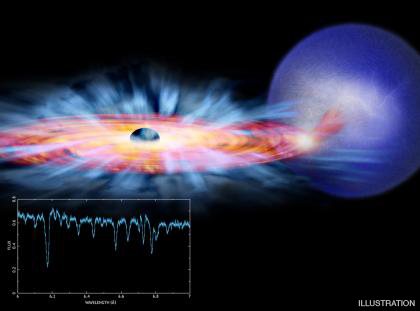
GRO J1655-40
Credit: Illustration: NASA/CXC/M.Weiss; X-ray Spectrum: NASA/CXC/U.Michigan/J.Miller et al.

JPEG (322.4 kb) Tiff (34.7 MB) PS (2.8 MB)

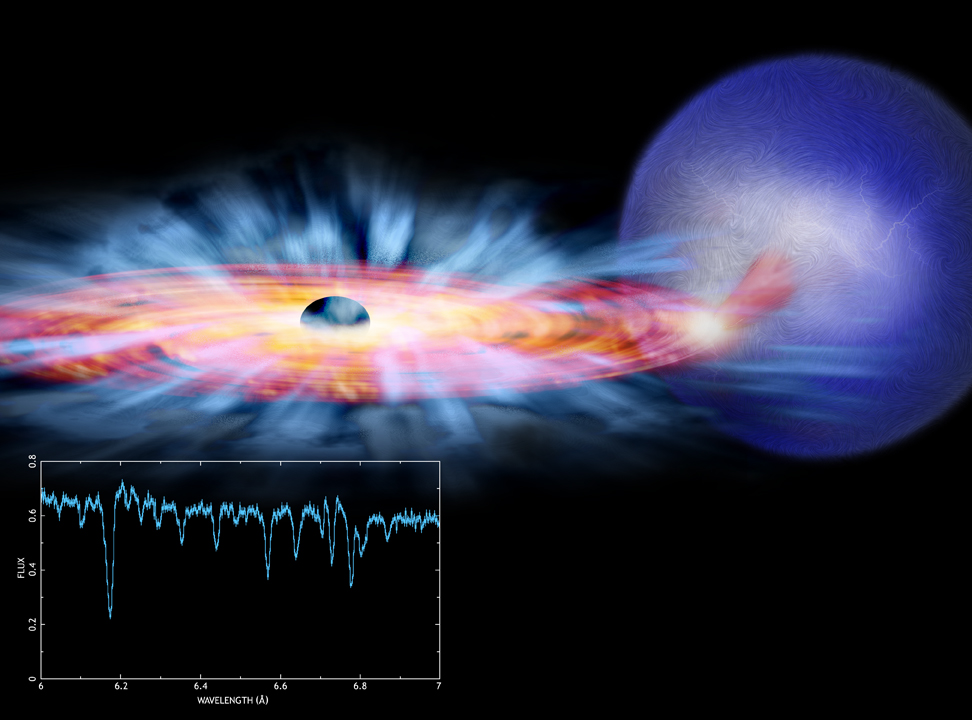
The X-ray spectrum (see inset) of a binary star system consisting of a black hole and a normal star indicates that turbulent winds of multimillion degree gas are swirling around the black hole. As the illustration shows, much of the hot gas is spiraling inward toward the black hole, but about 30% is blowing away.

The temperature and intensity of the winds imply that powerful magnetic fields must be present. These magnetic fields, likely carried by the gas flowing from the companion star, create magnetic turbulence that generates friction in the gaseous disk and drive winds from the disk that carry momentum outward as the gas falls inward. Magnetic friction also heats the gas in the inner part of the disk to X-ray emitting temperatures.

Animation of a Black Hole Pulling Matter from Companion Star
The analysis of the disk wind of GRO J1655-40, or J1655 for short, confirmed what astronomers had long suspected, namely that magnetic friction is central to understanding how black holes accrete matter rapidly. Without a process to take away some of the angular momentum of the gas, it could remain in orbit around a black hole for a very long time.

J1655 is a binary system that harbors a black hole with a mass seven times that of the sun, which is pulling matter from a normal star about twice as massive as the sun. The Chandra observation
Illustration of Magnetic Fields in GRO J1655-40
revealed a bright X-ray source whose spectrum showed dips produced by absorption from a wide variety of atoms ranging from oxygen to nickel. A detailed study of these absorption features shows that the atoms are highly ionized and are moving away from the black hole in a high-speed wind.

Understanding the importance of magnetic forces in the disk of gas around J1655 could have far-reaching implications, from the supermassive black holes associated with powerful quasars, to planet-forming disks around young sun-like stars.

Fast Facts for GRO J1655-40:
Credit  Illustration: NASA/CXC/M.Weiss; X-ray Spectrum: NASA/CXC/U.Michigan/J.Miller et al.
Category  Black Holes, Neutron Stars/X-ray Binaries
Coordinates (J2000)  RA 16h 54m 00.14s | Dec -39º 50' 44.90
Constellation  Scorpius
Observation Date  April 1, 2005
Observation Time  18 hours
Obs. ID  5461
Instrument  ACIS/HETG
Distance Estimate  About 11,000 light years
Release Date  June 21, 2006

More Information on GRO J1655-40:
Press Room: GRO J1655-40 Press Release
More Images of GRO J1655-40
GRO J1655-40 Handout: html | pdf
GRO J1655-40 Animations
Powerpoint and PDF
Chandra Chronicles: On the Hunt for Magnetic Field Winds with Jon Miller
Related Chandra Images:
Photo Album: Cygnus X-1, XTE J1650-500 & GX 339-4 (17 Sep 03)
Photo Album: XTE J1550-564 (03 Oct 02)
More Information on Black Holes:
X-ray Astronomy Field Guide: Black Holes
Questions and Answers: Black Holes
Chandra Images: Black Holes
More Information on Neutron Stars/X-ray Binaries :
X-ray Astronomy Field Guide: Neutron Stars/X-ray Binaries
Chandra Images: Neutron Stars/X-ray Binaries


Chandra Images: '08 | ' 07 | ' 06 | ' 05 | ' 04 | ' 03 | ' 02 | ' 01 | ' 00 | ' 99 | Images by Category


separator line
CXC Home | Search | Help | Site Map | Image Use Policy | Privacy & Accessibility | Downloads & Plugins
Latest Images | New & Noteworthy | Multimedia | Flash Ecards | Glossary | Q&A | Guestbook


RSS Feed RSS Feed | Podcast Podcast | Blog Blog

[News by email: Chandra Digest]
[Contact us: cxcpub@cfa.harvard.edu]
NASA's Home Page Smithsonian's Home Page CXC Home Page Image Map for NASA's, Smithsonian and Chandra's Home Pages
Harvard-Smithsonian Center for Astrophysics
60 Garden Street, Cambridge, MA 02138 USA
Phone: 617.496.7941 Fax: 617.495.7356


Text Size:
normal font large font larger font
Chandra X-ray Center, Operated for NASA by the Smithsonian Astrophysical Observatory
This site was developed with funding from NASA under Contract NAS8-03060.
Revised: November 19, 2007