

1
Chandra X-ray, Spitzer Infrared & Hubble Optical Images of Crab Nebula
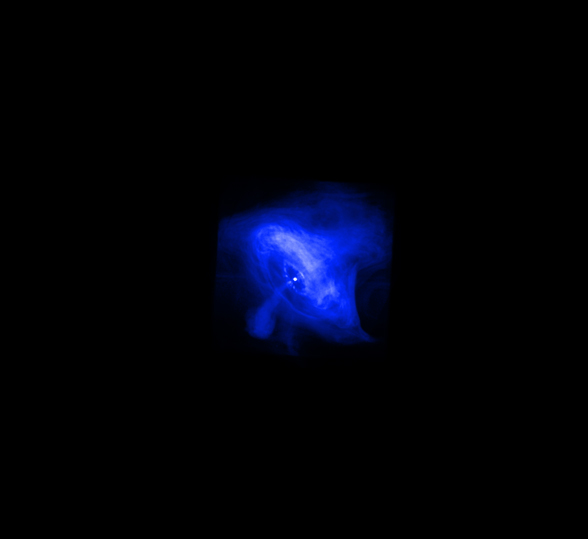
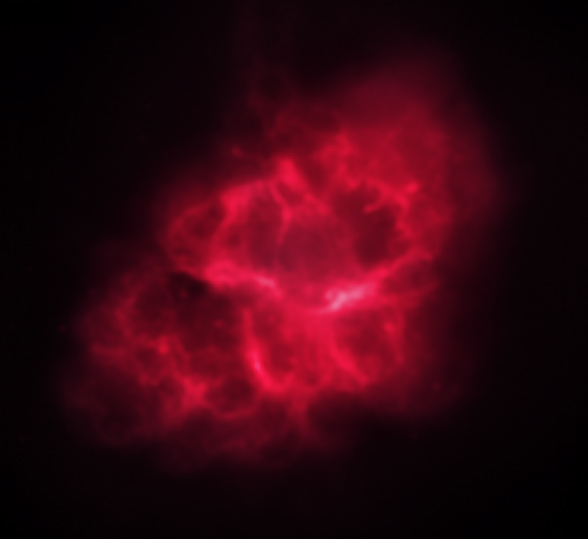
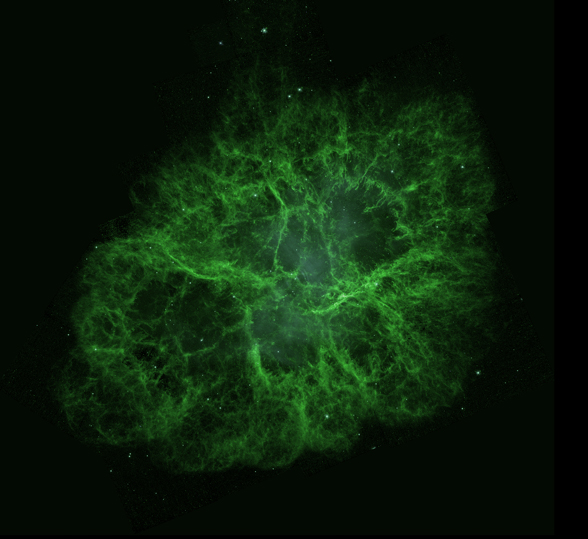
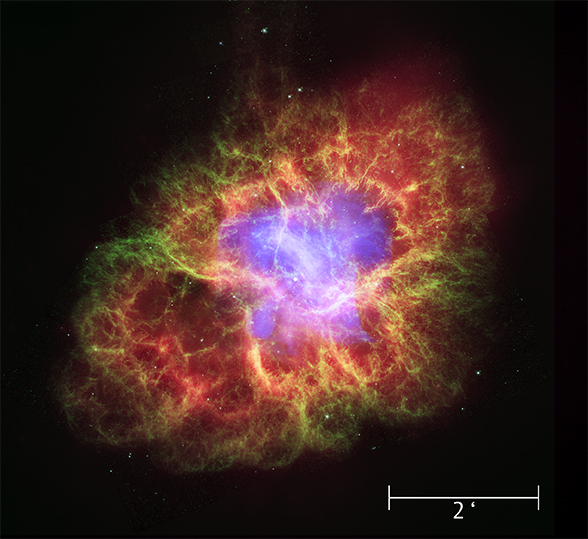
Images from three of NASA's Great Observatories show that a superdense neutron star is energizing the expanding Nebula by spewing out magnetic fields and a blizzard of extremely high-energy particles. The size of the Chandra X-ray image is smaller than the others because ultrahigh-energy X-ray emitting electrons radiate away their energy more quickly than the lower-energy electrons emitting optical and infrared light. The neutron star is the bright white dot in the center of the image.
Scale: Images are 7.8 arcmin per side
(Credit: X-ray: NASA/CXC/ASU/J.Hester et al.; Optical: NASA/ESA/ASU/J.Hester & A.Loll; Infrared: NASA/JPL-Caltech/Univ. Minn./R.Gehrz)
Images from three of NASA's Great Observatories show that a superdense neutron star is energizing the expanding Nebula by spewing out magnetic fields and a blizzard of extremely high-energy particles. The size of the Chandra X-ray image is smaller than the others because ultrahigh-energy X-ray emitting electrons radiate away their energy more quickly than the lower-energy electrons emitting optical and infrared light. The neutron star is the bright white dot in the center of the image.
Scale: Images are 7.8 arcmin per side
(Credit: X-ray: NASA/CXC/ASU/J.Hester et al.; Optical: NASA/ESA/ASU/J.Hester & A.Loll; Infrared: NASA/JPL-Caltech/Univ. Minn./R.Gehrz)
2
Chandra X-ray Image of Crab Nebula
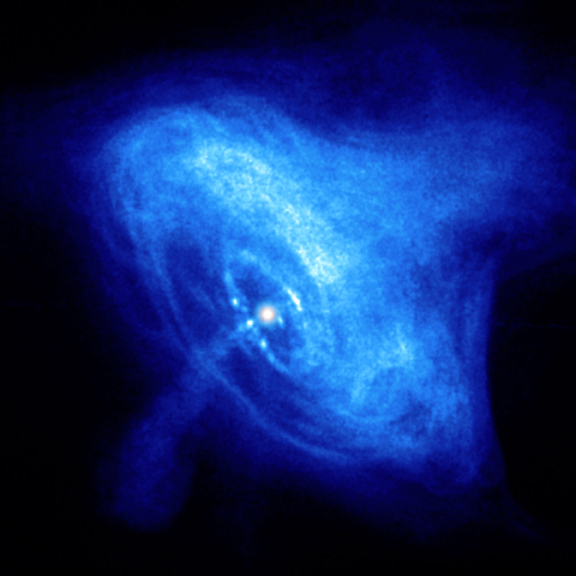
This image provides a dramatic look at the activity generated by the pulsar (white dot near the center of the images) in the Crab Nebula. The inner X-ray ring is thought to be a shock wave that marks the boundary between the surrounding nebula and the flow of matter and antimatter particles from the pulsar. Energetic shocked particles move outward to brighten the outer ring and produce an extended X-ray glow. The jets perpendicular to the ring are due to matter and antimatter particles spewing out from the poles of the pulsar.
More Information
Scale: Image is 2.24 arcmin across
(Credit: NASA/CXC/ASU/J. Hester et al.)
This image provides a dramatic look at the activity generated by the pulsar (white dot near the center of the images) in the Crab Nebula. The inner X-ray ring is thought to be a shock wave that marks the boundary between the surrounding nebula and the flow of matter and antimatter particles from the pulsar. Energetic shocked particles move outward to brighten the outer ring and produce an extended X-ray glow. The jets perpendicular to the ring are due to matter and antimatter particles spewing out from the poles of the pulsar.
More Information
Scale: Image is 2.24 arcmin across
(Credit: NASA/CXC/ASU/J. Hester et al.)
3
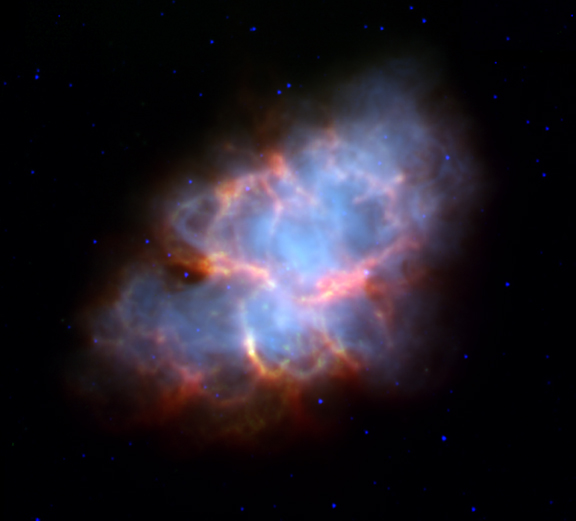
Spitzer Infrared Image of Crab Nebula
This view of the supernova remnant obtained by the Spitzer Space Telescope on June 1, 2005 shows the infrared view of this complex object. The blue region traces the cloud of energetic electrons trapped within the star's magnetic field, emitting so-called "synchrotron" radiation. The yellow-red features follow the well-known filamentary structures that permeate this nebula. Though they are known to contain hot gasses, their exact nature is still a mystery that astronomers are examining.
More Information at Spitzer
Scale: Image is 8 arcmin across
(Credit: NASA/JPL-Caltech/Univ. Minn./R.Gehrz)
This view of the supernova remnant obtained by the Spitzer Space Telescope on June 1, 2005 shows the infrared view of this complex object. The blue region traces the cloud of energetic electrons trapped within the star's magnetic field, emitting so-called "synchrotron" radiation. The yellow-red features follow the well-known filamentary structures that permeate this nebula. Though they are known to contain hot gasses, their exact nature is still a mystery that astronomers are examining.
More Information at Spitzer
Scale: Image is 8 arcmin across
(Credit: NASA/JPL-Caltech/Univ. Minn./R.Gehrz)
4
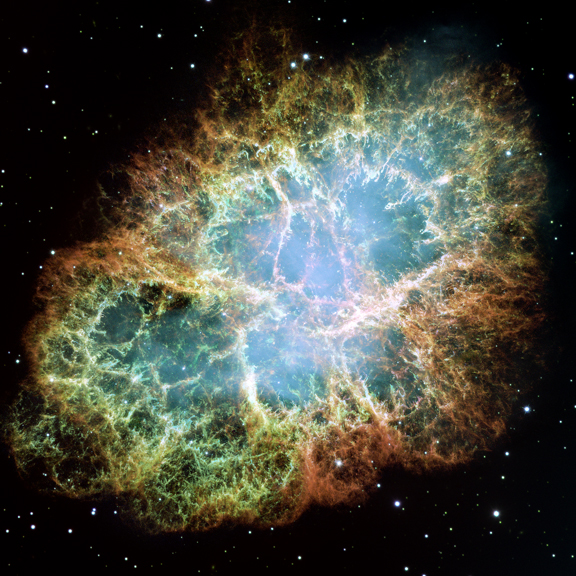
Hubble Optical Image of Crab Nebula
This composite image of the Crab Nebula was assembled from 24 individual exposures taken with the NASA Hubble Space Telescopes Wide Field and Planetary Camera 2 in October 1999, January 2000, and December 2000. It is one of the largest images taken by Hubble and is the highest resolution image ever made of the entire Crab Nebula.
More Information at Hubble
Scale: Image is 8.2 arcmin across
(Credit: NASA/ESA/ASU/J.Hester & A.Loll)
This composite image of the Crab Nebula was assembled from 24 individual exposures taken with the NASA Hubble Space Telescopes Wide Field and Planetary Camera 2 in October 1999, January 2000, and December 2000. It is one of the largest images taken by Hubble and is the highest resolution image ever made of the entire Crab Nebula.
More Information at Hubble
Scale: Image is 8.2 arcmin across
(Credit: NASA/ESA/ASU/J.Hester & A.Loll)
Return to Crab Nebula (29 Nov 06)




Revised: June 07, 2022