

1

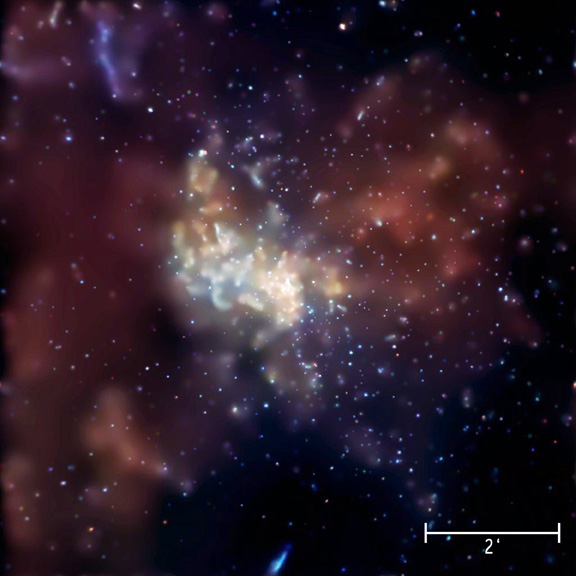
Chandra Image of Region Around Milky Way's Black Hole
The supermassive black hole at the center of the Milky Way (known as Sagittarius A* or Sgr A* for short) has surprisingly helped spawn a new generation of stars, according to observations from Chandra. This novel mode of star formation may solve several mysteries about the supermassive black holes that reside at the centers of nearly all galaxies.
Scale: Image is 8.4 arcmin on a side.
(Credit: NASA/CXC/MIT/F.K. Baganoff et al.)
More Information on Sagittarius A*
The supermassive black hole at the center of the Milky Way (known as Sagittarius A* or Sgr A* for short) has surprisingly helped spawn a new generation of stars, according to observations from Chandra. This novel mode of star formation may solve several mysteries about the supermassive black holes that reside at the centers of nearly all galaxies.
Scale: Image is 8.4 arcmin on a side.
(Credit: NASA/CXC/MIT/F.K. Baganoff et al.)
More Information on Sagittarius A*
2
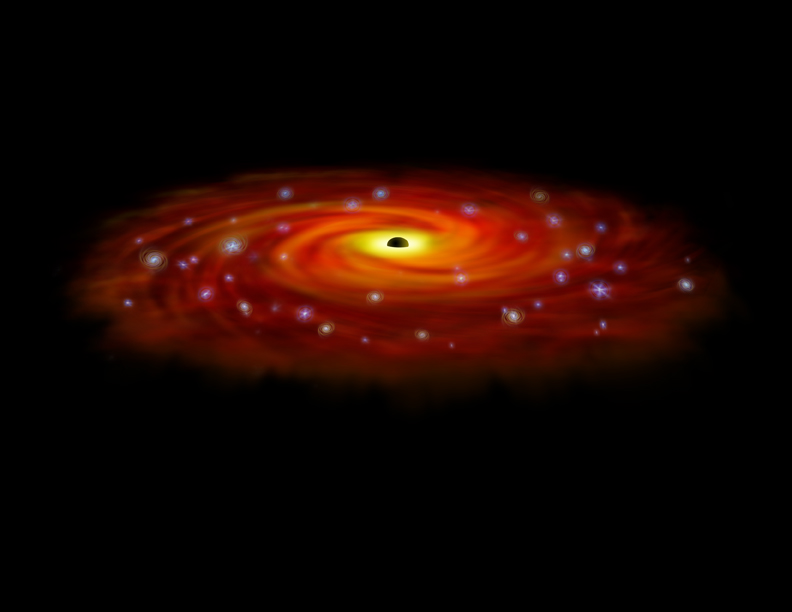
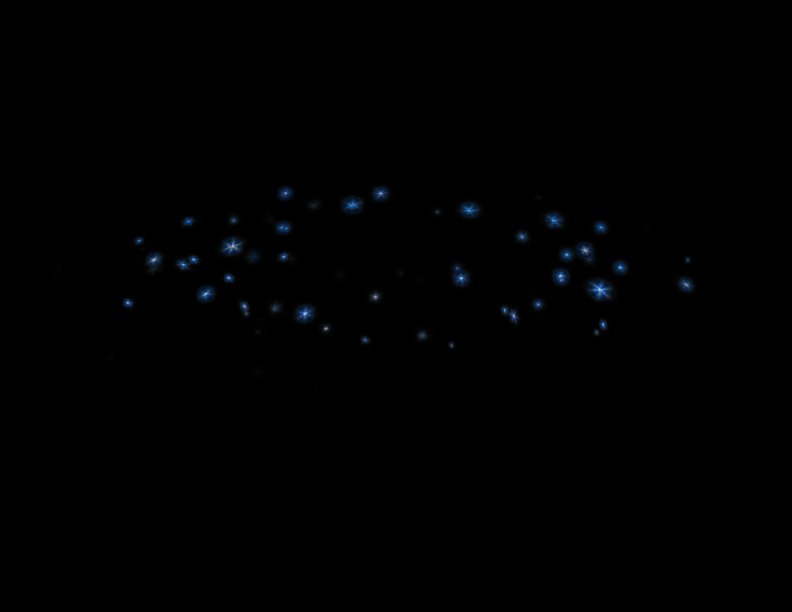
Artist's Illustration of Star Formation Around Black Hole
The artist's depiction on the left demonstrates what scientists believe is happening very close to Sgr A*. The supermassive black hole is surrounded by a disk of gas (yellow and red). Massive stars, shown in blue, have formed in this disk, while small disks represent where stars are still forming. The Chandra results show that stars have formed locally in this disk, rather than being deposited there by a star cluster. The second illustration shows the resulting ring of massive stars, which are observable with infrared telescopes.
(Illustration: NASA/CXC/M.Weiss)
The artist's depiction on the left demonstrates what scientists believe is happening very close to Sgr A*. The supermassive black hole is surrounded by a disk of gas (yellow and red). Massive stars, shown in blue, have formed in this disk, while small disks represent where stars are still forming. The Chandra results show that stars have formed locally in this disk, rather than being deposited there by a star cluster. The second illustration shows the resulting ring of massive stars, which are observable with infrared telescopes.
(Illustration: NASA/CXC/M.Weiss)
3
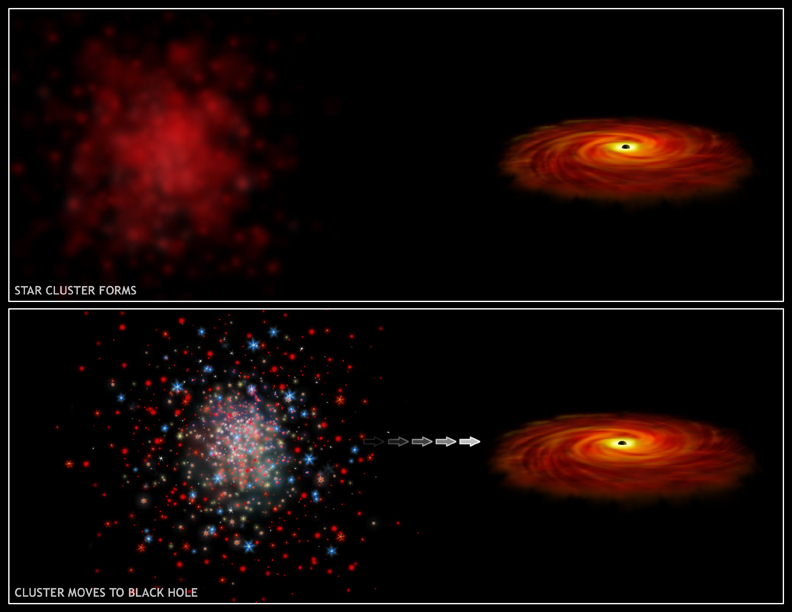
Scenario Dismissed by Chandra Results
The illustration in the upper panel shows the early formation of a star cluster (shown with red gas). To the right of the star cluster is a supermassive black hole surrounded by a disk of red and yellow gas. The lower panel shows the cluster moving towards the supermassive black hole after formation of massive stars (shown in blue) and low-mass stars (shown in red). The cluster will eventually be pulled apart by gravity from the black hole, leaving behind rings of stars.
(Illustration: NASA/CXC/M.Weiss)
The illustration in the upper panel shows the early formation of a star cluster (shown with red gas). To the right of the star cluster is a supermassive black hole surrounded by a disk of red and yellow gas. The lower panel shows the cluster moving towards the supermassive black hole after formation of massive stars (shown in blue) and low-mass stars (shown in red). The cluster will eventually be pulled apart by gravity from the black hole, leaving behind rings of stars.
(Illustration: NASA/CXC/M.Weiss)
4


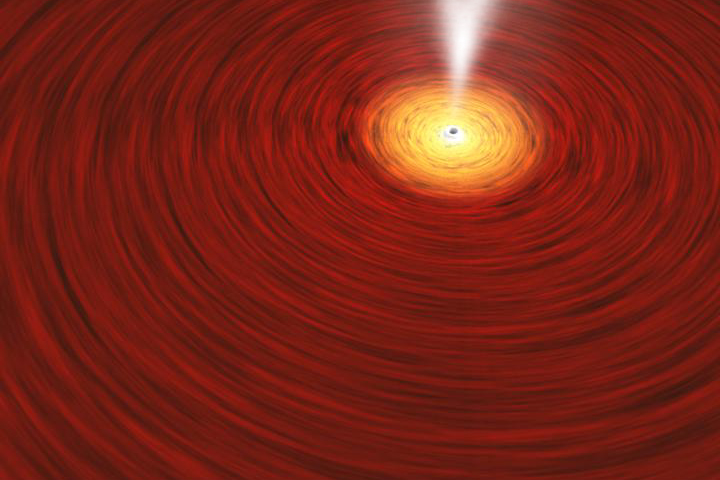
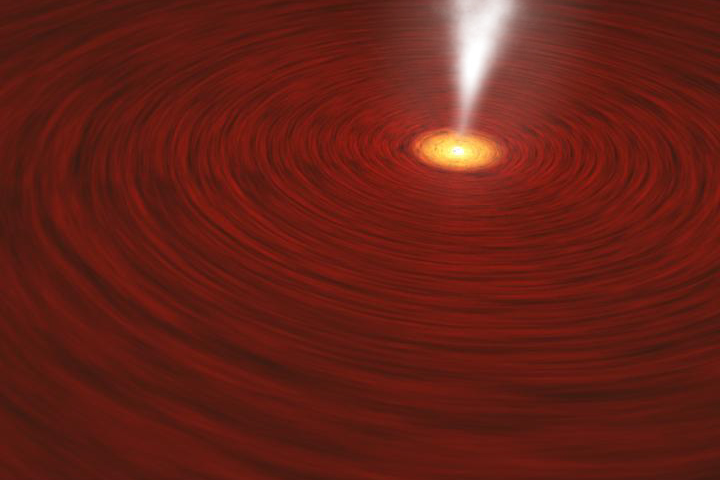

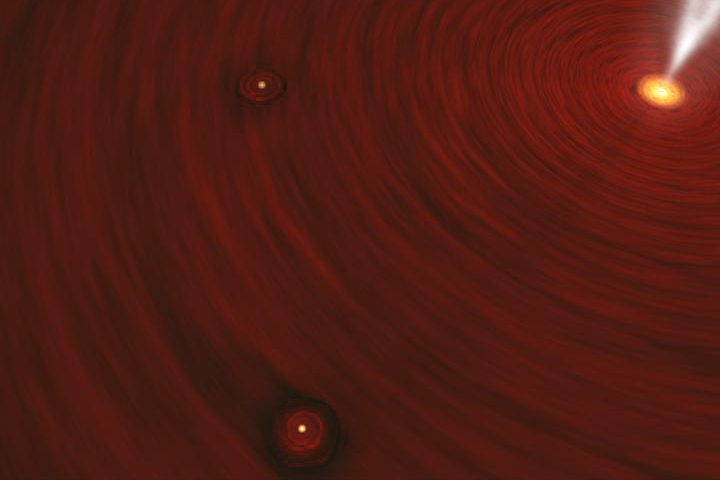

Illustrations of Stars Forming Around Black Hole
This sequence of images shows a disk of red and yellow gas around a supermassive black hole. As the view pulls back, the formation of stars in the outer regions of the disk is seen. These massive stars form when the gas becomes unstable, despite the black hole's enormous gravitational influence, and collapses inwards.
View Animation
(Illustration: NASA/CXC/A.Hobart)
This sequence of images shows a disk of red and yellow gas around a supermassive black hole. As the view pulls back, the formation of stars in the outer regions of the disk is seen. These massive stars form when the gas becomes unstable, despite the black hole's enormous gravitational influence, and collapses inwards.
View Animation
(Illustration: NASA/CXC/A.Hobart)
Return to Sagittarius A* (13 Oct 05)




Revised: June 07, 2022