


CXC Home | Search | Help | Image Use Policy | Latest Images | Privacy | Accessibility | Glossary | Q&A
1
Chandra X-ray Images of Saturn
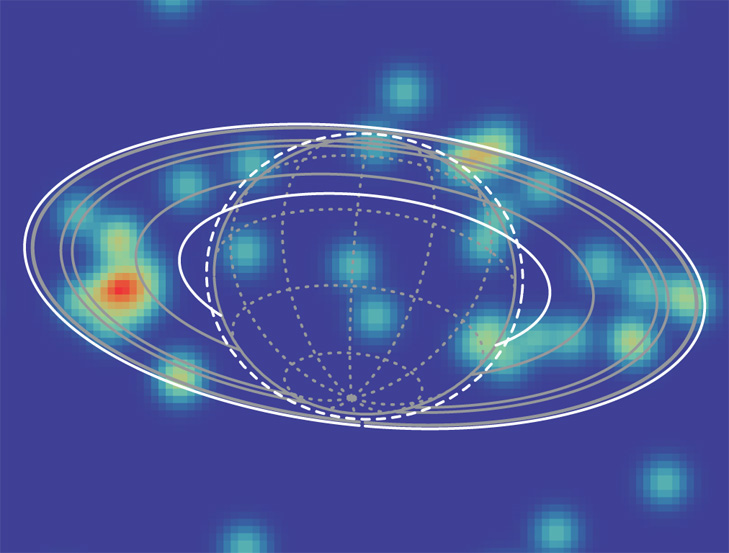
Chandra images of Saturn, the 6th planet from the Sun, reveal that the rings of Saturn sparkle in X-rays. The likely source for this radiation is the fluorescence caused by solar X-rays striking oxygen atoms in the water molecules that comprise most of the icy rings. The individual observations were taken by Chandra in April 2003 & January 2004 and combined into 1 stacked image.
(Credit: NASA/MSFC/CXC/A.Bhardwaj et al.)
Chandra images of Saturn, the 6th planet from the Sun, reveal that the rings of Saturn sparkle in X-rays. The likely source for this radiation is the fluorescence caused by solar X-rays striking oxygen atoms in the water molecules that comprise most of the icy rings. The individual observations were taken by Chandra in April 2003 & January 2004 and combined into 1 stacked image.
(Credit: NASA/MSFC/CXC/A.Bhardwaj et al.)
2
Chandra X-ray Images of Saturn, January 2004
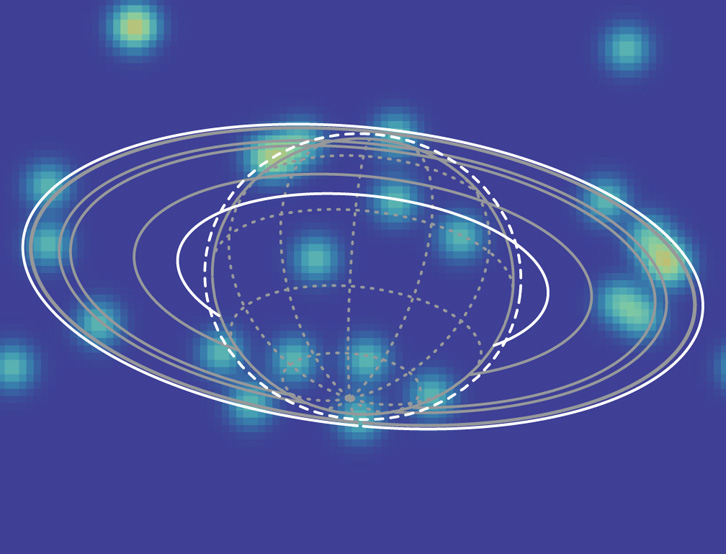
These observations of Saturn were taken by Chandra on January 20 and January 26-27, 2004. The apparent concentration of X-rays on the morning side (left side in the image) could be due to additional solar fluorescence from clouds of fine ice-dust particles that are lifted above the surface of the rings by meteoroid impacts on the rings. This explanation may also account for observations of Saturn which show that the X-ray brightness of the rings varies significantly from one week to the next.
(Credit: NASA/MSFC/CXC/A.Bhardwaj et al.)
These observations of Saturn were taken by Chandra on January 20 and January 26-27, 2004. The apparent concentration of X-rays on the morning side (left side in the image) could be due to additional solar fluorescence from clouds of fine ice-dust particles that are lifted above the surface of the rings by meteoroid impacts on the rings. This explanation may also account for observations of Saturn which show that the X-ray brightness of the rings varies significantly from one week to the next.
(Credit: NASA/MSFC/CXC/A.Bhardwaj et al.)
3
Hubble Optical Image of Saturn
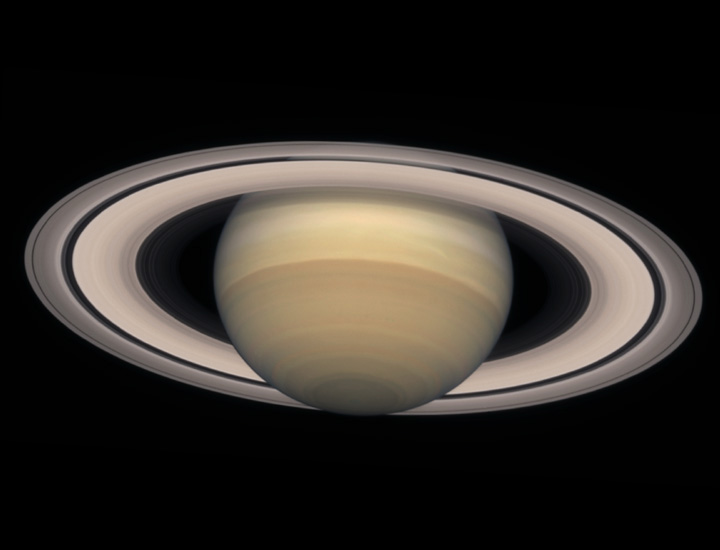
This Hubble Space Telescope image of Saturn, captured in November 2000 (1 of 5 images taken from 1996-2000), show Saturn's rings nearly fully open as it moved towards winter in its Northern Hemisphere. Saturn's equator is tilted relative to its orbit by 27 degrees, very similar to the 23-degree tilt of the Earth. As Saturn moves along its orbit, first one hemisphere, then the other is tilted towards the Sun. This cyclical change causes seasons on Saturn, just as the changing orientation of Earth's tilt causes seasons on our planet.
(Credit: NASA/ESA/STScI/AURA)
More information at Hubble
This Hubble Space Telescope image of Saturn, captured in November 2000 (1 of 5 images taken from 1996-2000), show Saturn's rings nearly fully open as it moved towards winter in its Northern Hemisphere. Saturn's equator is tilted relative to its orbit by 27 degrees, very similar to the 23-degree tilt of the Earth. As Saturn moves along its orbit, first one hemisphere, then the other is tilted towards the Sun. This cyclical change causes seasons on Saturn, just as the changing orientation of Earth's tilt causes seasons on our planet.
(Credit: NASA/ESA/STScI/AURA)
More information at Hubble
4
Composite Image with Scale Bar
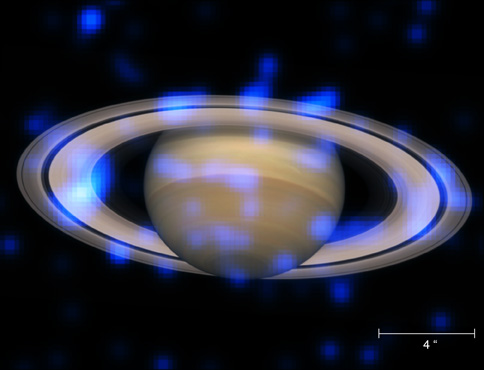
Scalebar: 4 arcsec
(Credit: NASA/MSFC/CXC/A.Bhardwaj et al.)
Scalebar: 4 arcsec
(Credit: NASA/MSFC/CXC/A.Bhardwaj et al.)
Return to Saturn's Rings (27 Jun 05)


Revised: July 16, 2008