






CXC Home | Search | Help | Image Use Policy | Latest Images | Privacy | Accessibility | Glossary | Q&A
Download Image
More Information
More Images
Animation & Video
Related Images
GRB 050709:
35-Year-Old Cosmic Mystery Solved in a Flash

35-Year-Old Cosmic Mystery Solved in a Flash
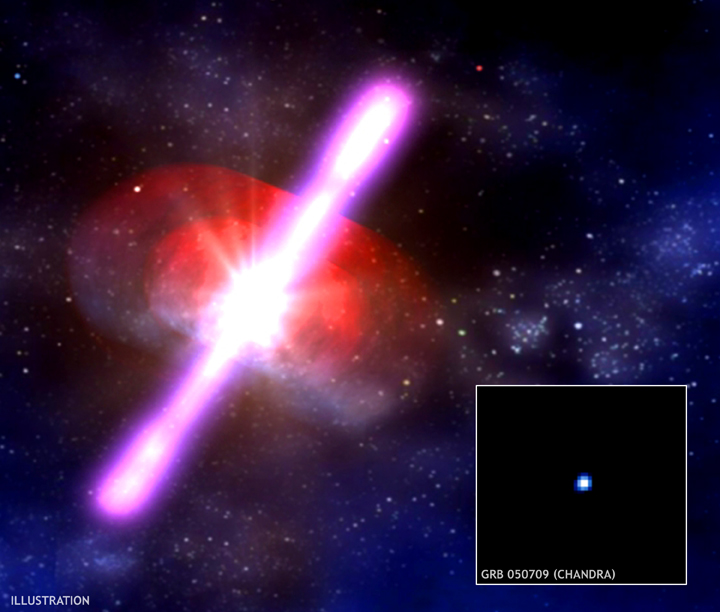
An artist's rendering (left) of GRB 050709 depicts a gamma-ray burst that was discovered on 9 July, 2005 by NASA's High-Energy Transient Explorer. The burst radiated an enormous amount of energy in gamma-rays for half a second, then faded away. Three days later, Chandra's detection of the X-ray afterglow (inset) established its position with high accuracy.
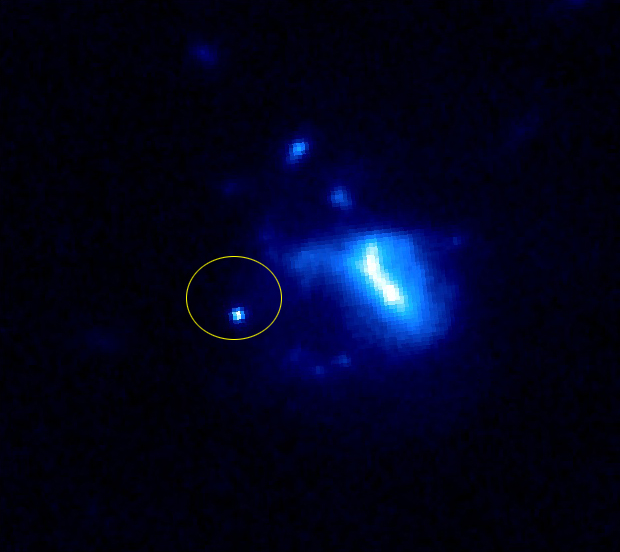
A Hubble Space Telescope image showed that the burst occurred in the outskirts of a spiral galaxy about 2 billion light years from Earth. This location is outside the star-forming regions of the galaxy and evidence that the burst was not produced by the explosion of an extremely massive star.
The most likely explanation for GRB 050709 is that it was produced by a collision of two neutron stars, or a neutron star and a black hole. Such a collision would result in the formation of a black hole (or a larger black hole), and could generate a beam of high-energy particles that could account for the powerful gamma-ray pulse as well as observed radio, optical and X-ray afterglows.
This gamma-ray burst is one of a class of short-duration bursts that now appear to have a different origin from the more powerful, long-duration gamma-ray bursts that last more than two seconds. Long-duration bursts have been connected to black holes formed in the explosion of extremely massive stars, or hypernovas.
|
||||||||||||||||||||||||||||
Visual Description:
The image features an illustration of a gamma-ray burst (GRB) named GRB 050709. The illustration shows a bright, energetic looking white object with magenta and white jets shooting out of its center, and a translucent red torus. This is surrounded by a sprinkling of dimmer stars and dark blue and purple gas and dust. This gamma-ray burst was discovered on 9 July, 2005 by NASA's High-Energy Transient Explorer. The burst radiated an enormous amount of energy in gamma-rays for half a second, then faded away. Three days later, Chandra's detection of the X-ray afterglow (shown in the lower right inset as a bright blue-white dot) established its position with high accuracy. The most likely explanation for GRB 050709 is that it was produced by a collision of two neutron stars, or a neutron star and a black hole. Such a collision would result in the formation of a black hole (or a larger black hole), and could generate a beam of high-energy particles that could account for the powerful gamma-ray pulse as well as observed radio, optical and X-ray afterglows.


Revised: September 11, 2025