Chandra X-ray Observatory - HomeAbout The ChandraEducational MaterialsField GuidePhoto AlbumPress RoomResources
Chandra X-ray Observatory - HomeChandra Photo Album - You are here
ObservatoryImages by DateImages by CategorySky MapConstellationsSpecial FeaturesChandra Zoom-insImage HandoutsScale Bar ImagesTutorial Chandra Images & False Color Note on Cosmic DistanceCosmic Look Back TimeScale & DistanceScale & Angular MeasurementImage Use
Web Site ToolsVisit the Chandra ChroniclesEmail NewsletterSite MapNew & NoteworthyImage Use PolicyQuestions & AnswersGlossaryDownload Guide

Titan: Titan Casts Revealing Shadow

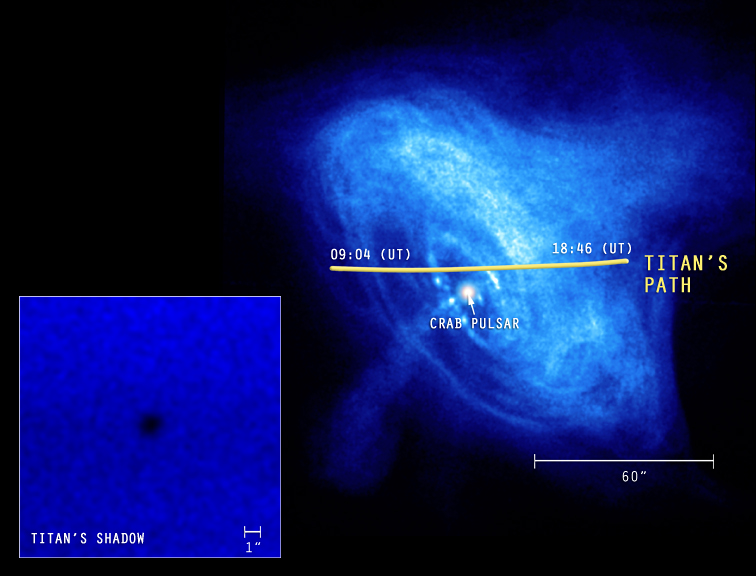
Titan
Credit: NASA/CXC/Penn State/K.Mori et al.
JPEG (219 kb), Tiff (5.4 MB), PS (4.6 MB)
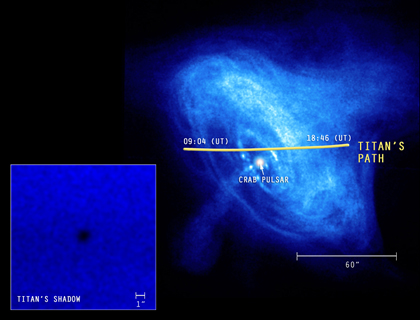
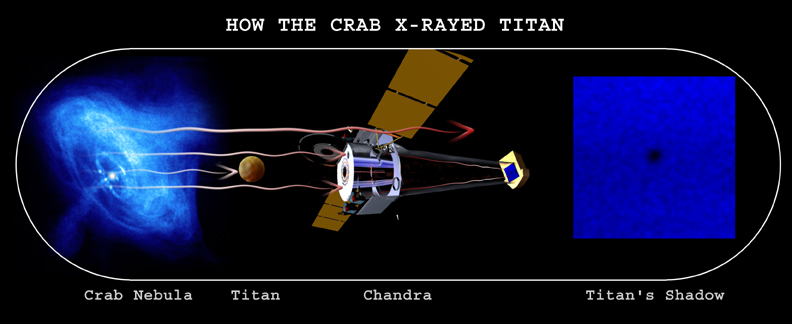
On January 5, 2003, Titan - Saturn's largest moon and the only moon in the solar system with a thick atmosphere - crossed in front of the Crab Nebula, a bright, extended X-ray source. Titan's transit enabled Chandra to image the one-arcsecond-diameter X-ray shadow cast by the moon (inset). This tiny shadow corresponds to the size of a dime as viewed from about two and a half miles.

Click for large jpg
Animation of Titan's Shadow on Crab Nebula
The diameter of Titan's shadow was found to be larger than the known diameter of its solid surface. This difference in diameters yields a measurement of about 550 miles (880 kilometers) for the height of the X-ray absorbing region of Titan's atmosphere.

Click for large jpg
Illustration of Crab, Titan's Shadow and Chandra
The extent of the upper atmosphere is consistent with, or slightly (10-15%) larger, than that implied by Voyager I observations made at radio, infrared, and ultraviolet wavelengths in 1980. Saturn was about 5% closer to the Sun in 2003, so increased solar heating of Titan may have caused its atmosphere to expand.

Although Titan passes within a few degrees of the Crab Nebula every 30 years, it rarely passes directly in front of it. This may have been the first transit of the Crab Nebula by Titan since the nebula was formed by a supernova that was observed to occur in the year 1054. The next similar conjunction will take place in the year 2267, so this was truly a once in a millennium event.

Fast Facts for Titan:
Credit  NASA/CXC/Penn State/K.Mori et al.
Scale  Inset is 16 arcsec per side;
Crab Nebula is 134 arcsec per side
Category  Solar System
Observation Date  January 5, 2003
Observation Time  8.3 hours
Obs. ID  4413, 4412, 3727
Color Code  Intensity
Instrument  ACIS
Reference  K. Mori, et al. astro-ph/0403283
Distance Estimate  At time of observation: 760 million miles (1.21 billion kilometers)
Release Date  April 05, 2004

More Information on Titan:
Press Room: Titan Press Release
More Images of Titan
Titan Animations
Titan Handout: html | pdf
Powerpoint and PDF
Related Chandra Images:
Photo Album: Saturn's Rings (27 Jun 05)
Photo Album: Saturn (25 May 05)
Photo Album: Saturn (08 Mar 04)
Photo Album: The Moon (16 Sep 03)
Photo Album: Crab Nebula (19 Sep 02)
More Information on our Solar System:
X-ray Astronomy Field Guide: Solar System
Chandra Images: Solar System
Chandra Chronicles: The Solar System Through Chandra's Eyes


Chandra Images: '08 | ' 07 | ' 06 | ' 05 | ' 04 | ' 03 | ' 02 | ' 01 | ' 00 | ' 99 | Images by Category


separator line
CXC Home | Search | Help | Site Map | Image Use Policy | Privacy & Accessibility | Downloads & Plugins
Latest Images | New & Noteworthy | Multimedia | Flash Ecards | Glossary | Q&A | Guestbook


RSS Feed RSS Feed | Podcast Podcast | Blog Blog

[News by email: Chandra Digest]
[Contact us: cxcpub@cfa.harvard.edu]
NASA's Home Page Smithsonian's Home Page CXC Home Page Image Map for NASA's, Smithsonian and Chandra's Home Pages
Harvard-Smithsonian Center for Astrophysics
60 Garden Street, Cambridge, MA 02138 USA
Phone: 617.496.7941 Fax: 617.495.7356


Text Size:
normal font large font larger font
Chandra X-ray Center, Operated for NASA by the Smithsonian Astrophysical Observatory
This site was developed with funding from NASA under Contract NAS8-03060.
Revised: August 30, 2006