

1

Chandra 3-color X-ray Image of Cassiopeia A
This spectacular image of the supernova remnant Cassiopeia A is the most detailed image ever made of the remains of an exploded star. The one million second image shows a bright outer ring (green) ten light years in diameter that marks the location of a shock wave generated by the supernova explosion. A large jet-like structure that protrudes beyond the shock wave can be seen in the upper left. In this image, the colors represent different ranges of X-rays with red, green, and blue representing, low, medium, and higher X-ray energies.
Scale: Image is 8 arcmin per side
(Credit: NASA/CXC/GSFC/U.Hwang et al.)
This spectacular image of the supernova remnant Cassiopeia A is the most detailed image ever made of the remains of an exploded star. The one million second image shows a bright outer ring (green) ten light years in diameter that marks the location of a shock wave generated by the supernova explosion. A large jet-like structure that protrudes beyond the shock wave can be seen in the upper left. In this image, the colors represent different ranges of X-rays with red, green, and blue representing, low, medium, and higher X-ray energies.
Scale: Image is 8 arcmin per side
(Credit: NASA/CXC/GSFC/U.Hwang et al.)
2

Chandra's Cas A in the Light of Glowing Silicon Ions
The X-rays in this image of Cassiopeia A are primarily due to silicon ions heated to about fifteen million degrees Celsius, so the ions retain only two orbital of fourteen orbital electrons.
Scale: Image is 8 arcmin per side
(Credit: NASA/CXC/GSFC/U.Hwang et al.)
The X-rays in this image of Cassiopeia A are primarily due to silicon ions heated to about fifteen million degrees Celsius, so the ions retain only two orbital of fourteen orbital electrons.
Scale: Image is 8 arcmin per side
(Credit: NASA/CXC/GSFC/U.Hwang et al.)
3
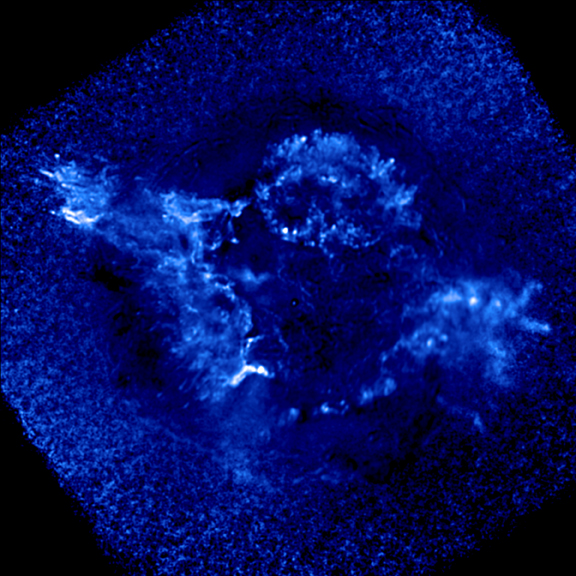
Chandra Enhanced Silicon Image of Cassiopeia A
This image shows the ratio of the intensity of the X-radiation from silicon ions with two orbital electrons to the intensity of X-radiation at slightly lower energies, which is due primarily to magnesium and iron ions. The image highlights the jet and counterjet traced by silicon X-ray emission.
Scale: Image is 8 arcmin per side
(Credit: NASA/CXC/GSFC/U.Hwang et al.)
This image shows the ratio of the intensity of the X-radiation from silicon ions with two orbital electrons to the intensity of X-radiation at slightly lower energies, which is due primarily to magnesium and iron ions. The image highlights the jet and counterjet traced by silicon X-ray emission.
Scale: Image is 8 arcmin per side
(Credit: NASA/CXC/GSFC/U.Hwang et al.)
4
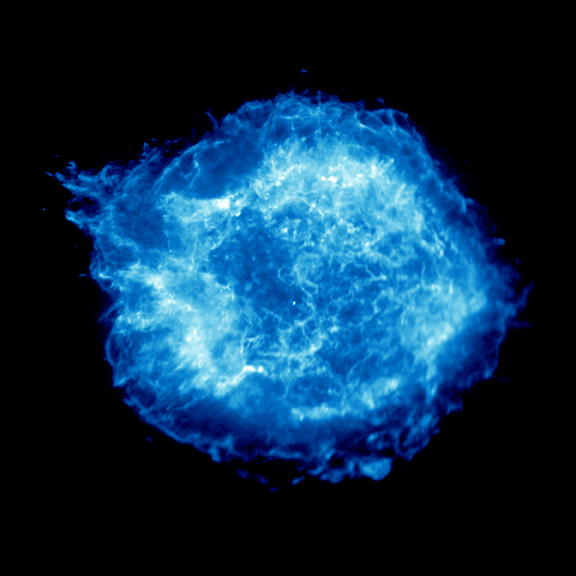
Chandra Broadband Image of Cassiopeia A
This Chandra image is the most detailed ever made of the remains of an exploded star. The one million-second image shows a bright outer ring ten light years in diameter that marks the location of a shock wave generated by the supernova explosion. A large jet-like structure protrudes beyond the shock wave in the upper left.
Scale: Image is 8 arcmin per side
(Credit: NASA/CXC/GSFC/U.Hwang et al.)
This Chandra image is the most detailed ever made of the remains of an exploded star. The one million-second image shows a bright outer ring ten light years in diameter that marks the location of a shock wave generated by the supernova explosion. A large jet-like structure protrudes beyond the shock wave in the upper left.
Scale: Image is 8 arcmin per side
(Credit: NASA/CXC/GSFC/U.Hwang et al.)
5

Chandra X-ray Image with Scale Bar
Scalebar = 2 arcmin
(Credit: NASA/CXC/GSFC/U.Hwang et al.)
Scalebar = 2 arcmin
(Credit: NASA/CXC/GSFC/U.Hwang et al.)
Return to Cassiopeia A (23 Aug 04)




Revised: May 17, 2022