

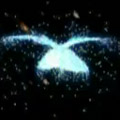
Animation of Colliding Galaxies
QuickTime
MPEG
The sequence begins by depicting the collision of two large galaxies which now form The Antennae. Gas and stars from the galaxies are ejected into long arcs. The animation then shows how collisions between huge gas clouds in the central region of the merging system trigger a stellar baby boom. Next, as seen in a closer view, the most massive of these stars race through their evolution in a few million years. These stars end their lives as they explode as supernovas that further heat the clouds and enrich them with heavy elements. In conclusion, the animation dissolves into Chandra’s X-ray image of The Antennae galaxies.
[Run time = 0:39 sec]
Credit:
Simulation: NASA/STScI/G. Bacon
Animation: NASA/CXC/A. Hobart
X-ray: NASA/CXC/SAO/G. Fabbiano et al.
QuickTime
MPEG
The sequence begins by depicting the collision of two large galaxies which now form The Antennae. Gas and stars from the galaxies are ejected into long arcs. The animation then shows how collisions between huge gas clouds in the central region of the merging system trigger a stellar baby boom. Next, as seen in a closer view, the most massive of these stars race through their evolution in a few million years. These stars end their lives as they explode as supernovas that further heat the clouds and enrich them with heavy elements. In conclusion, the animation dissolves into Chandra’s X-ray image of The Antennae galaxies.
[Run time = 0:39 sec]
Credit:
Simulation: NASA/STScI/G. Bacon
Animation: NASA/CXC/A. Hobart
X-ray: NASA/CXC/SAO/G. Fabbiano et al.
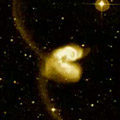
Optical and X-Ray Images of The Antennae
QuickTime
MPEG
The movie zooms in from a wide-field optical image of the colliding galaxy system known as The Antennae. The optical image dissolves to a Chandra X-ray image colored to show the intensity of the low (red), medium (green) and high (blue) energy X-rays from huge diffuse clouds of multimillion degree Celsius gas, and bright point-like sources from neutron stars and black holes.
[Run time = 0:08 sec]
Credit:
Optical Image: Digital Sky Survey
X-ray: NASA/CXC/SAO/G. Fabbiano et al.
QuickTime
MPEG
The movie zooms in from a wide-field optical image of the colliding galaxy system known as The Antennae. The optical image dissolves to a Chandra X-ray image colored to show the intensity of the low (red), medium (green) and high (blue) energy X-rays from huge diffuse clouds of multimillion degree Celsius gas, and bright point-like sources from neutron stars and black holes.
[Run time = 0:08 sec]
Credit:
Optical Image: Digital Sky Survey
X-ray: NASA/CXC/SAO/G. Fabbiano et al.
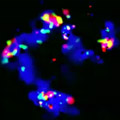
Element Map of The Antennae
QuickTime
MPEG
This sequence zooms in on an optical image of the central region of The Antennae, then dissolves to a Chandra X-ray image of the multimillion-degree-gas clouds in this system. The image next dissolves to a sequence of images that shows hot gas clouds where the abundances of iron (red), magnesium (green), and silicon (blue) atoms are greatest. The final image is a composite of the three abundance maps.
[Run time = 0:16 sec]
Credit:
Optical Image: Digital Sky Survey
X-ray and Element Maps: NASA/CXC/SAO/G. Fabbiano et al.
QuickTime
MPEG
This sequence zooms in on an optical image of the central region of The Antennae, then dissolves to a Chandra X-ray image of the multimillion-degree-gas clouds in this system. The image next dissolves to a sequence of images that shows hot gas clouds where the abundances of iron (red), magnesium (green), and silicon (blue) atoms are greatest. The final image is a composite of the three abundance maps.
[Run time = 0:16 sec]
Credit:
Optical Image: Digital Sky Survey
X-ray and Element Maps: NASA/CXC/SAO/G. Fabbiano et al.
Return to The Antennae (07 Jan 04)




Revised: April 22, 2020