

1

2
Radio
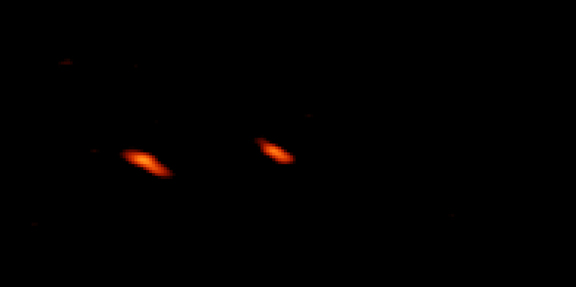
Image of XTE J1550-564 (June 2000)
This image of XTE J1550-564 was taken with the Australia Telescope Compact Array on June 1, 2000. The stationary black hole is seen at the center of the image and the eastern jet clearly appears in the radio wavelengths. The diagonal tilts of the sources in the image are instrumental artifacts.
(Credit: ATCA)
This image of XTE J1550-564 was taken with the Australia Telescope Compact Array on June 1, 2000. The stationary black hole is seen at the center of the image and the eastern jet clearly appears in the radio wavelengths. The diagonal tilts of the sources in the image are instrumental artifacts.
(Credit: ATCA)
3

Radio Image of XTE J1550-564
(January 2002)
A follow-up observation of XTE J1550-564 with the Australia Telescope Compact Array reveals that the western jet has emerged while the eastern jet has faded at this time period. The diagonal tilts of the sources in the image are instrumental artifacts.
(Credit: ATCA)
A follow-up observation of XTE J1550-564 with the Australia Telescope Compact Array reveals that the western jet has emerged while the eastern jet has faded at this time period. The diagonal tilts of the sources in the image are instrumental artifacts.
(Credit: ATCA)
4
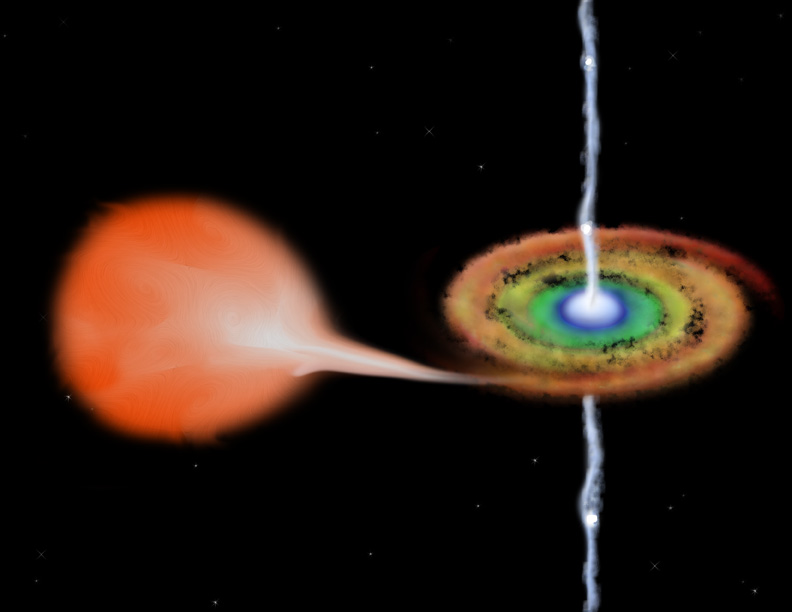
Artist's Conception of X-ray Binary System
An artist's conception shows a double star system with a normal Sun-like star in orbit around a black hole. As gaseous matter is pulled from the normal star, it forms a disk around the black hole and is heated to temperatures of millions of degrees. Intense electromagnetic forces in the disk can expel jets of high-energy particles.
(Credit: NASA/CXC/M.Weiss)
An artist's conception shows a double star system with a normal Sun-like star in orbit around a black hole. As gaseous matter is pulled from the normal star, it forms a disk around the black hole and is heated to temperatures of millions of degrees. Intense electromagnetic forces in the disk can expel jets of high-energy particles.
(Credit: NASA/CXC/M.Weiss)
5

X-ray Jet PKS
1127-145
The Chandra X-ray image of the quasar PKS 1127-145, a highly luminous source of X-rays and visible light about 10 billion light years from Earth, shows an enormous X-ray jet that extends at least a million light years from the quasar. The inset box compares the relative size of the Milky Way with the jet. The size of the quasar from which the jet emanates is an instrumental artifact due to the brightness of the source. The quasar is consistent with a point-like object. Furthermore, the system XTE J1550-564 is just a fraction of the size and is found in one of the spiral arms of the Milky Way galaxy.
(Credit: NASA/CXC/A.Siemiginowska(CfA)/J.Bechtold(U.Arizona))
The Chandra X-ray image of the quasar PKS 1127-145, a highly luminous source of X-rays and visible light about 10 billion light years from Earth, shows an enormous X-ray jet that extends at least a million light years from the quasar. The inset box compares the relative size of the Milky Way with the jet. The size of the quasar from which the jet emanates is an instrumental artifact due to the brightness of the source. The quasar is consistent with a point-like object. Furthermore, the system XTE J1550-564 is just a fraction of the size and is found in one of the spiral arms of the Milky Way galaxy.
(Credit: NASA/CXC/A.Siemiginowska(CfA)/J.Bechtold(U.Arizona))
6
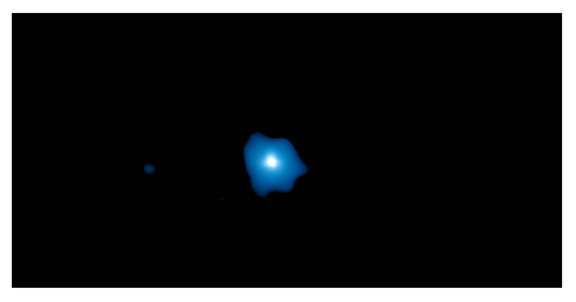
Chandra Image of XTE J1550-564 (June 2000)
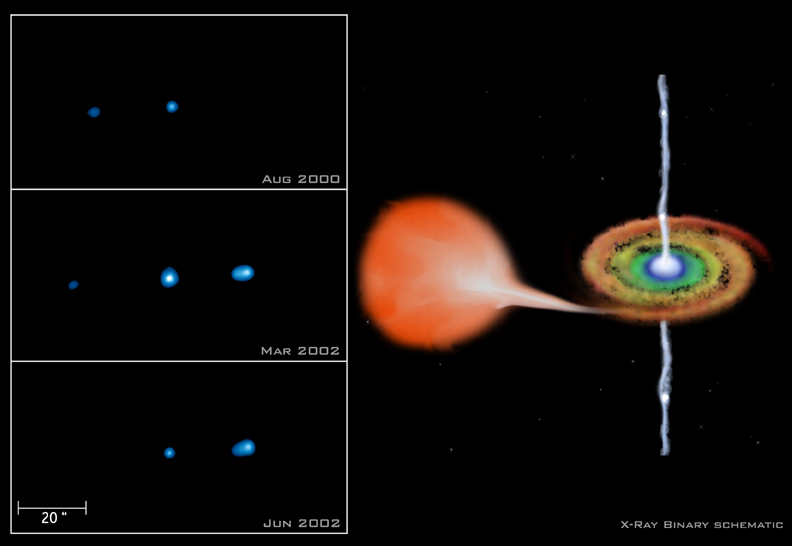
This Chandra image taken in June 2000 shows the black hole XTE J1550-564 (center) and the approaching eastern jet (right). In four years the jets moved about two light years from the black hole. The jet appears faint because the High Energy Transmission Grating was in place for this observation. The apparent large size of the source of X-rays from the vicinity of the black hole is an instrumental artifact due to the brightness of the source. The size of the source is consistent with a point-like object.
Scale: Image is 1.64 x 0.82 arcmin.
(Credit: NASA/CXC)
This Chandra image taken in June 2000 shows the black hole XTE J1550-564 (center) and the approaching eastern jet (right). In four years the jets moved about two light years from the black hole. The jet appears faint because the High Energy Transmission Grating was in place for this observation. The apparent large size of the source of X-rays from the vicinity of the black hole is an instrumental artifact due to the brightness of the source. The size of the source is consistent with a point-like object.
Scale: Image is 1.64 x 0.82 arcmin.
(Credit: NASA/CXC)
7

8

9

Chandra Image of XTE J1550-564
(March 2002)
This Chandra image taken in March 2002 shows the black hole XTE J1550-564 (center), the approaching eastern jet, and the receding western jet (right). In four years the jets moved about two light years from the black hole. The apparent large size of the source of X-rays from the vicinity of the black hole is an instrumental artifact due to the brightness of the source. The size of the source is consistent with a point-like object.
Scale: Image is 1.64 x 0.82 arcmin.
(Credit: NASA/CXC)
This Chandra image taken in March 2002 shows the black hole XTE J1550-564 (center), the approaching eastern jet, and the receding western jet (right). In four years the jets moved about two light years from the black hole. The apparent large size of the source of X-rays from the vicinity of the black hole is an instrumental artifact due to the brightness of the source. The size of the source is consistent with a point-like object.
Scale: Image is 1.64 x 0.82 arcmin.
(Credit: NASA/CXC)
10

Chandra Image of XTE J1550-564 (June 2002)
This Chandra image taken in June 2002 shows the black hole XTE J1550-564 (center) and the receding western jet (right). The jet has a cometary shape, indicating that it is being slowed down by interstellar gas. In four years the jets moved about two light years from the black hole.
Scale: Image is 1.64 x 0.82 arcmin.
(Credit: NASA/CXC)
This Chandra image taken in June 2002 shows the black hole XTE J1550-564 (center) and the receding western jet (right). The jet has a cometary shape, indicating that it is being slowed down by interstellar gas. In four years the jets moved about two light years from the black hole.
Scale: Image is 1.64 x 0.82 arcmin.
(Credit: NASA/CXC)
11
Return to XTE J1550-564 (03 Oct 02)




Revised: July 09, 2008