

Download Image


More Information


More Images

More Releases


Related Images


Sagittarius A*:
Chandra Catches Milky Way Monster Snacking
Credit: NASA/MIT/F.Baganoff et al.


Chandra Catches Milky Way Monster Snacking
Credit: NASA/MIT/F.Baganoff et al.
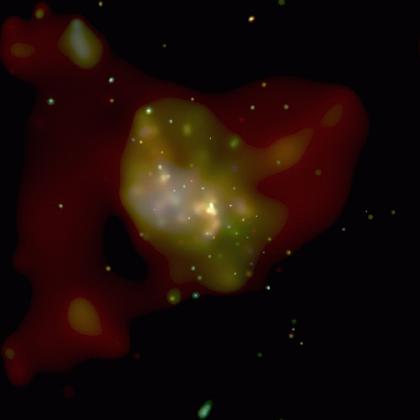
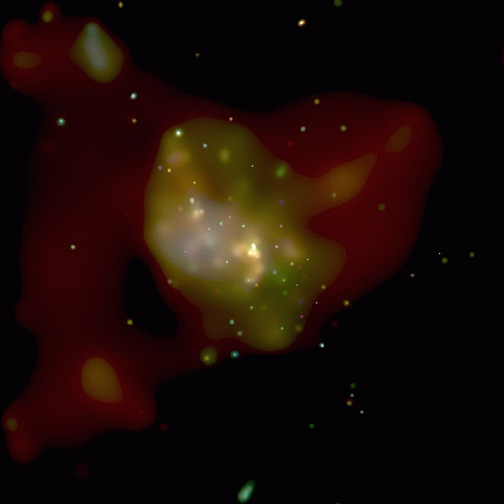
This false-color image shows the central region of our Milky Way Galaxy as seen by Chandra. The bright, point-like source at the center of the image was produced by a huge X-ray flare that occurred in the vicinity of the supermassive black hole at the center of our galaxy. This central black hole has about 2.6 million times the mass of our Sun and is associated with the compact radio source Sagittarius A*.
During the observation the X-ray source at the galactic center brightened dramatically in a few minutes, and after about 3 hours, rapidly declined to the pre-flare level. The rapid variation in X-ray intensity indicates that the flare was due to material as close to the black hole as the Earth is to the Sun. This is the most compelling evidence yet that matter falling toward the black hole is fueling energetic activity in the galactic center.
|
||||||||||||||||||||||||||||


Revised: June 04, 2022