An overview of the Chandra mission and goals, Chandra's namesake, top 10 facts.
Classroom activities, printable materials, interactive games & more.
Overview of X-ray Astronomy and X-ray sources: black holes to galaxy clusters.
All Chandra images released to the public listed by date & by category
Current Chandra press releases, status reports, interviews & biographies.
A collection of multimedia, illustrations & animations, a glossary, FAQ & more.
A collection of illustrations, animations and video.
Chandra discoveries in an audio/video format.
Disclaimer: This material is being kept online for historical purposes. Though accurate at the time of publication, it is no longer being updated. The page may contain broken links or outdated information, and parts may not function in current web browsers. Visit chandra.si.edu for current information.
Chandra's Mission Extended to 2009
September 28, 2001 ::
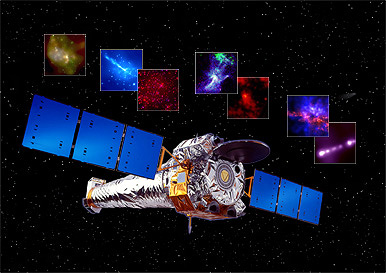
The Chandra X-ray Observatory and some recent Chandra Images
(Credit: CXC) |
On September 4, NASA's Marshall Space Flight Center announced that NASA will extend Chandra's current five year mission to ten years.
"Adding five more years of operation to Chandra's mission will provide double the opportunity for amazing discoveries," said Chandra project scientist Martin Weisskopf of NASA's Marshall Space Flight Center.
The extension will support five additional years of day-to-day operations such as controlling the spacecraft, observing celestial targets, processing the data and passing it on to scientists around the globe. It also includes continuing the
administration of hundreds of science grants for astronomers to analyze their data and publish their results. The total budget for the Chandra X-ray Center (CXC) to perform all these tasks is about $49 million per year.
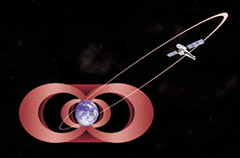
A schematic side view of Chandra's orbit, showing the inner and outer radiation belts. (Illustration: CXC/M. Weiss) |
Harvey Tananbaum, director of the CXC, and Roger Brissenden, manager of the CXC welcomed this news and related some of their experiences with Chandra so far.
"A major highlight was to watch how fast the science and flight operations teams accomplished such a high observing efficiency," said Brissenden. "After only 2 months, we were operating at close to maximum efficiency."
The maximum efficiency is about 70 percent, because Chandra has to shut down when passing through the radiation belts, and some time is lost going from one target to the next. Among the greatest challenges for the operation of the observatory are the
Targets of Opportunity. When a supernova or gamma ray burst occurs, or when a flare occurs near a black hole, Chandra may be required to interrupt its regular observing schedule and slew to the target. In these cases, time is of the essence.
"The responses to Targets of Opportunity have been exceptional," Brissenden said. "Once a target has been activated, we have been able to respond quickly and efficiently. This is a tribute to the great dedication of the Chandra team to getting the maximum science from this mission."
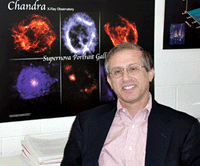
Harvey Tananbaum, Director of the Chandra X-ray Center
|
Both Tananbaum and Brissenden have been gratified by the smooth, relatively problem-free operation of the spacecraft. "Chandra goes from target to target without a hitch," Tananbaum noted. "Both the onboard hardware and the ground system used to plan the observations work incredibly well -- a credit to those who designed, built and tested Chandra, and to those who now operate the observatory."
Of course, doing science in space remains a risky endeavor, and those involved inevitably find their palms sweating and their hearts in their throats at certain times. Chandra has had its share of tense moments.
"The first three weeks were the most nervous for me," recalled Tananbaum. "The booster rockets had to work, the cover on the ACIS door -- which had failed a year before during ground testing -- had to open, and the covers on the back and front of the telescope had to come off, or the mission would fail."
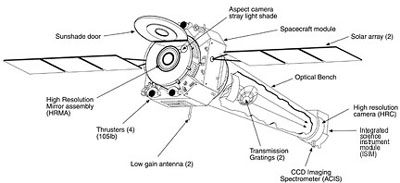
Labeled sketch of Chandra |
Once the rockets worked, the doors opened and the covers came off, the scientists were prepared for their first major observation when Chandra went into a safe mode because of a minor computer glitch. The extended technical support
teams from TRW (now NGST) and Marshall Space Flight Center had returned to their home bases, and the responsibility for operating the mission and recovering from the safe mode was now under Brissenden's management.
"It was a great relief to get through that crisis successfully and get back to science operations in two days," said Brissenden.
Both Brissenden and Tananbaum agree that the most worrisome period after that was the discovery about 6 weeks after launch that the CCD detector (ACIS) was degrading.
"We didn't know how to stop it," said Brissenden. "It was a very nervous time."

Roger Brissenden, Manager of the Chandra X-ray Center |
After two weeks of intense investigation, teams from Marshall Space Flight Center, MIT, Penn State University and the CXC found that the damage was due to low energy protons reflecting off the Chandra mirrors onto the detector when
Chandra was passing through the radiation belts. To avoid further damage, ACIS is now moved out of the focus during the radiation belt passage.
"It was a huge relief to get that under control just in time," Brissenden acknowledged.
Since then Chandra's operations have been largely trouble-free, allowing people to focus on the scientific discoveries that were anticipated. They have discovered rings and jets of high-energy material around pulsars, weather fronts in hot gas in
clusters of galaxies, and jets of X-ray emission extending over hundreds of thousands of light years. They have resolved the X-ray background into individual sources and made rich X-ray spectra from objects as diverse as comets, stars, galaxies and
clusters of galaxies.
The pulsar images made both Brissenden and Tananbaum's list of Chandra's greatest hits so far.
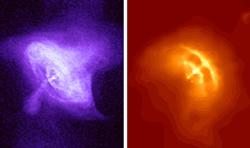
Crab Nebula and Vela Supernova Remnants. These images show the region of space around two rapidly rotating neutron stars in the Crab Nebula (left) and the Vela (right) supernova remnants. A magnetized, rapidly rotating neutron star
produces electric voltages of several quadrillion volts. Particles are pulled off the neutron star and accelerated to speeds near the speed of light. A blizzard of electrons and anti-matter electrons, or positrons, is produced by these particles. The
jets, and rings are thought to be caused by this process. The inner Crab ring is 1 light year in diameter; in Vela it is 0.1light year) (Credit: NASA/CXC/SAO; Right: NASA/PSU/G. Pavlov et al.) |
"Seeing so directly the dynamic nature of the inner regions around pulsars was a great surprise," said Brissenden. Tananbaum agrees. "Chandra's images of the details of the rings and jets around pulsars will illuminate the transfer of energy from some of nature's most efficient powerhouses to the surrounding medium."
As to the prospects for the future, Tananbaum looks forward to results from Chandra that will test models for the formation of neutron stars in supernova explosions, and the search in
deep space and deep time for very young and distant galaxies more than ten billion light years away.
"There is potential for exciting discoveries with just about every Chandra observation," he concluded.
How long can Chandra be expected to operate? According to Brissenden, Chandra has no short-term life limiting factors. "The only consumable on board is the fuel used for unloading momentum and that's projected to last for more than 20 years," he said.
Other factors that will limit the lifetime, such as electronic failures and the degradation of the solar arrays are common to all spacecraft. These and other effects are currently being monitored closely, but the expectation is that Chandra will continue
to operate well past 10 years.
Brissenden and Tananbaum, for their part, are eager to continue with their work. "The focus is now moving toward planning for long term operations and building an excellent archive of science data," said Brissenden. "I'm also looking forward to finding ways to apply the knowledge we have developed from Chandra to other missions, like
Constellation-X."
Disclaimer: This material is being kept online for historical purposes. Though accurate at the time of publication, it is no longer being updated. The page may contain broken links or outdated information, and parts may not function in current web browsers. Visit chandra.si.edu for current information.







