
Now or Then: Explaining Light Travel Time
With the press release for G1.9+0.3 we talked about when an event in a distant part of the Milky Way galaxy occurred. One delicate issue that immediately came to mind was what to do about the light travel time to this object. We decided to adopt the astronomer's convention and talk about events in Earth's time frame, that is when the light reached the Earth, as we noted in the press release and in a few other places on our web-site.
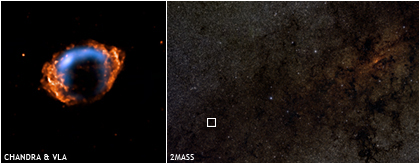
G1.9+0.3
Here's the result: astronomers estimated that the supernova explosion which caused G1.9+0.3 occurred about 140 years ago, in Earth's time frame, which means that's when the feeble optical signal reached the Earth. Of course, no-one noticed it back then, because of absorption by dust and gas.
What we did was effectively ignore the light travel time of about 25,000 years for this supernova and its remnant. This sounds misleading, or even blatantly dishonest to some people. Was our intention to deliberately confuse people? Well, no, but there are several reasons why the astronomer's convention of discussing Earth's time frame makes the most sense:
1. It's practical: since nothing can exceed the speed of light, it is impossible for us to know what is happening at this instant in a different part of the Galaxy, such as the Galactic center. So, the most practical solution to this problem is to talk about when an event can be *seen* by us.
2. It focuses on what's important: the light travel time to distant parts of the Galaxy is non-trivial in human terms, but not in this astronomical context. Even the light travel time to the other side of the galaxy is still likely to be much less than the time it takes for significant changes in the Galactic supernova rate (and estimating this rate is a crucial goal). Therefore, despite the finite speed of light we can still make useful comparisons of the supernova rate between different parts of the Galaxy, such as the central region where G1.9 is located, and the more local parts of the galaxy where the historical remnants like Cas A and Tycho are found.
3. It's precise: the distance to G1.9+0.3 has an uncertainty of perhaps several thousand light years, but the uncertainty in the age of the supernova remnant is only a few decades, so it's much more precise to discuss Earth's time frame than a general galactic time frame. This holds even more so for optical detections of supernova explosions or other cosmic events where the time of the event can be pinned down to a few days or better. The distances to most objects in space aren't known very accurately, so discussing the light travel time involves highly uncertain numbers.
4. It's often no more confusing than other options: there is clear potential for confusion when discussing things in Earth's time frame, since the caveat about the time frame used can easily be dropped. However, there is also potential for confusion, with short news reports, if one *includes* the light travel time. For example, the NBC news story about G1.9 said that the supernova occurred 26,000 years ago. That's fine, but without an understanding of delays because of light travel time one might conclude that this explosion was somehow seen 26,000 years ago. Also, no information was given about the assumed distance to the remnant, so even experts would not know when the explosion was actually seen, which is a crucial part of this story.
-Peter Edmonds, CXC
Category:
- Log in to post comments