Where's Chandra?
This image represents the current (updated every minute) position of Chandra in relation to the surface of the Earth. more

Interactive Chandra
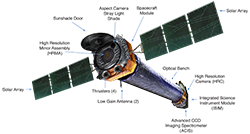
Learn about all the parts of the Chandra spacecraft and how they work together to take the x-ray images you have seen over the years. (requires flash)
Chandra Hosts a Carnival Of Space
This week, the United States marks the Thanksgiving holiday. For most of us, this means lots of time with...
[More (23 Nov 09)]
This week, the United States marks the Thanksgiving holiday. For most of us, this means lots of time with...
[More (23 Nov 09)]
About Chandra
Since its launch on July 23, 1999, the Chandra X-ray Observatory has been NASA's flagship mission for X-ray astronomy, taking its place in the fleet of "Great Observatories."
NASA's Chandra X-ray Observatory is a telescope specially designed to detect X-ray emission
from very hot regions of the Universe such as exploded stars, clusters of galaxies, and matter
around black holes. Because X-rays are absorbed by Earth's atmosphere, Chandra must orbit
above it, up to an altitude of 139,000 km (86,500 mi) in space. The Smithsonian's Astrophysical
Observatory in Cambridge, MA, hosts the Chandra X-ray Center which operates the satellite,
processes the data, and distributes it to scientists around the world for analysis. The Center
maintains an extensive public web site about the science results and an education program.
Chandra carries four very sensitive mirrors nested inside each other. The energetic X-rays strike
the insides of the hollow shells and are focussed onto electronic detectors at the end of the 9.2-
m (30-ft.) optical bench. Depending on which detector is used, very detailed images or spectra
of the cosmic source can be made and analyzed.
Chandra has imaged the spectacular, glowing remains of exploded stars, and taken spectra
showing the dispersal of elements. Chandra has observed the region around the supermassive
black hole in the center of our Milky Way, and found black holes across the Universe. Chandra
has traced the separation of dark matter from normal matter in the collision of galaxies in a
cluster and is contributing to both dark matter and dark energy studies. As its mission continues,
Chandra will continue to discover startling new science about our high-energy Universe.
Follow us on Facebook, Twitter and Myspace.
Chandra's First Decade of Discovery
Explore the Universe with Chandra and discover Chandra's most significant discoveries.
Chandra Mission Overview
Chandra is designed to observe X-rays from high-energy regions of the Universe.
Google Earth & WorldWide Telescope
Immerse yourself in Chandra's X-ray Universe with Sky in Google Earth and Microsoft WorldWide Telescope.
Subrahmanyan Chandrasekhar (Chandra)
Discover the man behind the name, including which area of study he was awarded the Nobel prize for.
How The C-X-O Got its Name
See the details of the naming contest of the contest of the Chandra X-ray Observatory and winning essays.
Fun Facts
Learn some interesting trivia about the Chandra X-ray Observatory in a question & answer format.
Top 10 Facts About Chandra
Did you know Chandra was the largest satellite the Shuttle Columbia ever launched?
Read about the people and science involved in making Chandra discoveries.
The latest additions, updates, announcements & other special features.